Sep 19, 2026
Sep 19, 2026
Of course, the very word ‘Anxiety’ or a state of ‘Grief’, give a negative connotation; but Srimad Bhagavad-Gita tells how they themselves can become instruments to come out of that state. They help in moving forward in life. A sort of ‘Move On’ usage as is in vogue in modern times.
Let us look at Arjuna’s state of anxiety. He was grief-struck right in the middle of the battlefield. He was though accompanied by a trusted friend, Lord Krishna himself.
So, first learning from here is, people in distress cannot be left alone to their own destiny. If they are wise enough to recognize their own state of mental health, they would confide into a trusted friend or relative. Why we say ‘trusted’ is because, that dear one is dear since he is willing to spend time, hear him out and do the necessary counselling. To be with somebody, especially during the hour of a person’s distress, is a great softener and life saver. Exceptions of disability apart, God has not created any life completely dependent on another. Contrarily, God has built in enough energy in every life to cope up with all ups and downs. Afterall, Life would not be life, if were not eventful.
Then how does one take it from Gita, from here? Arjuna is at the verge of exhibiting suicidal tendency. He is unwilling to be an instrument in the imminent death of his friends and relatives, the likes of his Guru Drona and Bhishma, the Grandsire of the Kuru dynasty, standing before him to give up their lives for the sake of Duryodhana, albeit who represents the opposite of righteousness.
This aspect of Yoga has mostly been ignored by the great authorities on Bhagvad-Gita. Beginning from Rudra Avtaar Bhagwan Shankaracharya Mahabhag – Though he compiled the Gita of 700 shlokas as we continue to follow till date, but he started the commentary on Shlokas only from the second chapter. Ramanuja and Madhva interpreted with devotional perspective while Lokmanya Bal Gangadhar Tilak in his book ‘Gita Rahasya’, focused purely on Karma Yoga. Just like the names of following 17 chapters are very context specific, the name of the first chapter, “Arjuna Vishad Yoga” equally conveys complete context and subject matter of the first chapter.
What follows can be seen in the gestures, symptoms and words from the ‘Yoga’ of Arjuna’s grief.
In a state of anxiety, thoughts become unusually intense. Mental turmoil leads to a thought process. A person’s conscience is awakened. He begins to contemplate like a wise man. He imagines alternatives. He analyses the practical consequences from every angle. He believes he is confused and is unable to take a decisive stand. If one is aware of his depression, he can seek help and advice from a therapist and guide like Lord Sri Krishna.
Arjuna did the same. Inspired by the physician in the form of Lord Krishna, he began to demonstrate his own wisdom, his apprehensions on the outcome of war; and in the process, also the symptoms of his grief. Thus, the Yoga of Grief became the Yoga of Self-Realization.
The benefit of this kind of a sudden shock which Arjuna received is that, one tends to turn towards God. If we don’t seek refuge in him, which exist in the form of various scriptures of all religions, then whom should we seek refuge in? Seeking refuge means, letting go of our ego. Once he did so, and having listened to the advice of his friend attentively, he could shun inhibition. He came out of that shyness, that nervousness, which was stopping him from doing what he really wanted to do.
Krishna’s discourse in Gita was essentially meant to rescue Arjuna from a very distressful state of mind. From shock treatment to imparting spiritual knowledge and awakening him to the level of pure consciousness, Aruja’s Yoga became the foundation for higher thinking, higher knowledge.
A wise person suffering from depression and sadness can quickly come out of that unfortunate state of mind with the help of a capable friend. The gist of the article is captured in a Hindi message which I flash to my devotee followers in India every morning. Translation of this message already forms the conclusions formed in this article.
A very Hare Krishna to all readers.
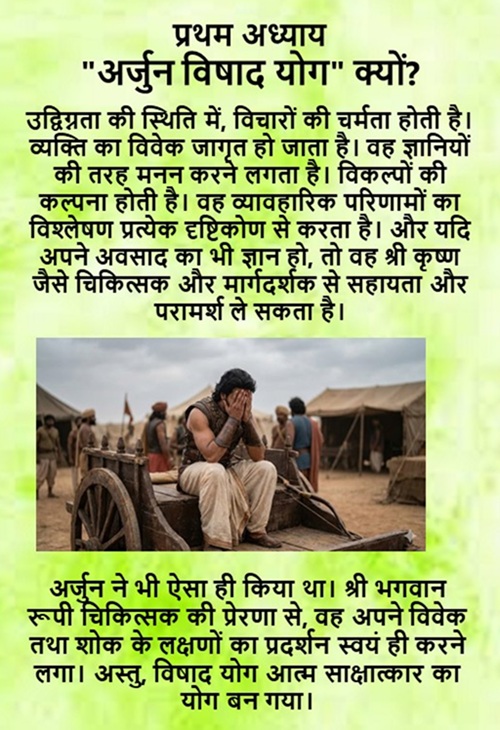
Arjuna in a state of shock. Image created on Gemini.
06-Dec-2025
More by : Sanjay Chowdhary
Top | Spirituality | Home

|
You would think that anxiety and depression are modern ideas, but when you connect them to Arjuna's story, you come to appreciate how relevant the Gita is even today. Especially the idea of seeking guidance from people you respect being a sign of strength, not weakness. |
|
|
Hari bol |
|
|
Very good brother , keep up the good work |
|
|
Very true |