Sep 18, 2026
Sep 18, 2026
 Sanskrit words have many connotations. Mixed with prefixes and suffixes, the root words form more usages and inferences.
“Paksh”, that is to side with, like only one side of the coin; or still better said, a partisan view in English could be a close inference, while ‘partiality’ could be implied upon writers’ will.
Recently, in our extended family WhatsApp group, most unexpectedly, like out of the blue, a cousin flashed a message expressing concerns over the unresolved issue of our ancestral property. The undertone of the message was total sympathy for a particular stakeholder. These biased sentiments, (I was thinking in Hindi!), in my mind I called “Pakshpaati”, i.e, prejudiced.
Another instance happened recently during temple services. For some time, I had been observing acts of over and less indulgence in rendering devotional services. Though everything is voluntary work, yet the regular devotees follow a conduct, as per “Seva” allocated to them. On pointing out this anomaly to the group leader, he opined to be with over-indulging, while neglecting a devotee left without Seva. Devotional services are not about material targets. It’s about following a system of discipline. So, I called it “Paksh-dosh”, i.e., Tainted Thinking, an offence against a devotee of Krishna!
I wanted to leave the WhatsApp group and the Seva group, but then decided, there is no need to take extreme steps. Life must go on. Let’s move on.
These instances become completely unimportant as they truly are, but this word “Paksh” became dominant to contemplate resulting in this writeup. Indeed, I am spiritually inclined, and my thoughts gave way to connect with “Shastra”.
Paksh Se Pakshi (Bird): It was summer of 1982. I was visiting my elder brother, RK who was then based in Bombay (now Mumbai). The results of Class X were out. Our father called up RK in total delight, that I had passed. Marks were not important. Be it a razor-thin margin. I had passed! On returning home from office, my brother informed me, hugged me and kissed me on forehead. Family went out for dinner, and I tasted Chinese food for the first time in life! I was flying free in open sky. Like the uncaged bird. In Hindi, I would call it “Pakshi Uda Swachhand”, the free flying bird.
But this was the beginning of the flight to spiritualism. RK asked me to read ‘Complete Works of Swami Vivekananda’ shelved right there. The first chapter was ‘Karma Yoga’. SV is the greatest orator. He is like Shukdev Goswami of Bhagwatam. He explained the dualities of life. Two perspectives. A bird has two Pakshas or wings. They provide it perfect balance. We need to take a lesson from this bird, who uses its flanks to achieve higher goals, even though using both opposite sides. Krishna used both the warring sides to achieve the purpose of his incarnation.
Then SV took us to the illustration of two birds (Kath Upnishad), Here the soul is compared to a bird. The two Pakshas represent Jnana (Knowledge) and Karma (Action). We can call them Vivek, the power to discriminate; and Vairagya, the mode of objective detachment. Now these two birds (Jivatma & Paramatma) are sitting on the branch of a tree. One bird eats the fruits of the tree and reacts to sweet and bitter tastes. Jiva caged in body. While the watching bird is only an observer, our pure consciousness.
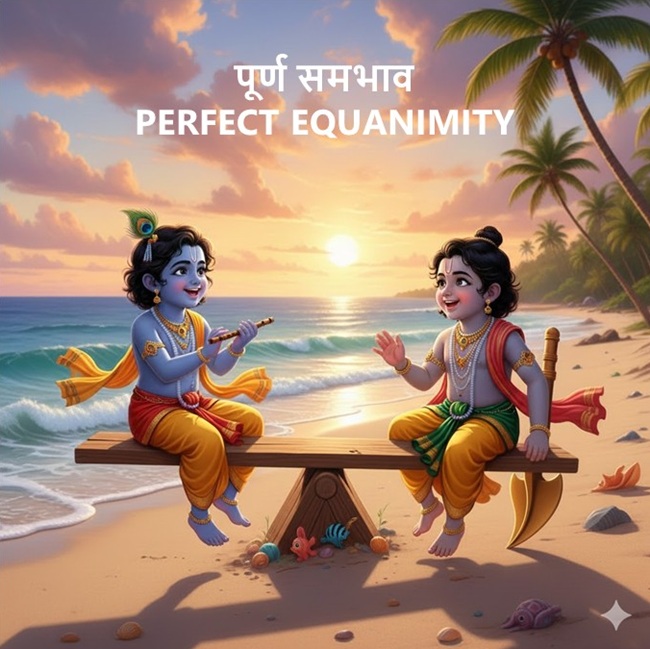
Image generated on Gemini
When Krishna says, “Samatvam Yoga Uchyate”,
it simply means –– equanimity and balance in life.
In several verses of Gita, Lord Krishna gives examples of dualities that we face in life, but should accept these dualities as a “Samdarshi” and not be perturbed by temporary situations. Success and failure, insult or honour are but like summer and winter. With “abhyaas”, a little bit practice, one develops the art of maintaining this balance as a personal trait. A kind of think dispassionately before you act.
Back to the WhatsApp episode, when one sides with or makes a statement without complete knowledge of all facts and stories, this immature act is called “Poora-Paksh” or a preconceived notion. Like a bird flying on one wing. But when complete information gets available, one tends to change mind. The view under knowledge is called “Uttar-Paksh”, like a post script. The rulers of distant lands sided with Duryodhana due to “Poorva Paksh” and became victims. In Bhishma they saw the eternal saviour of Hastinapur. Not knowing that the Bhishma’s heart beats for Arjuna and his soul is ever in servitude of the Supreme Lord present on the field himself.
You propose something, it is called “Paksh”. Like Krishna proposing return of Indraprashtha, or for that matter, just five villages to Pandavas. A counter argument or a proposal would have been “Pratipaksh”, proponents being Dhritrashtra himself, Vidura and Sanjaya. But that was not to be. And it was all “Vipaksh”, totally opposed by evil minded and adamant Duryodhana.
Like the waning moon (Krishna Paksh) and the bright nights (Shukla Paksh); they also represent the dualities of nature. Shukla Paksh symbolizes desire, whereas Krishna Paksh indicates withdrawal from worldly – a sort of outward and inward-looking arrangement guided by nature to realize equilibrium for onward journey. From the point of view of days mathematics, Paksh means a fortnight. Hence, like a weekly or a monthly magazine, the fortnightly magazine is called “Pakshik”.
Krishna, or the Supreme Being, Param-Satya, represents Absolute Truth. Hence ‘justice; is of greatest value for maintenance of this world. From cosmic order down to Karma and the fruits thereof in perfect equanimity; He is delivering all, being completely Nishpaksh, Equal treatment. Without any love or enmity. For Judge there is neither a friend nor a foe. The rivalries are trivial acts of worldly upmanship. If He is not impartial, there would be chaos in society. Nyaya, means deliverance without taking sides.
But Krishna is not bound by any laws of governance. His Karmic system assures commensurate bitter and sweet fruits as per Karma to one and all. But to his own devotees, he favours. He says, I personally manifest myself to protect the noble souls and punish the miscreants. Like a father takes care of his children, I protect and provide for all needs of my devotee. Krishna promises Yogkshemam Vahamyaham.
Hare Krishna!
03-Jan-2026
More by : Sanjay Chowdhary
Top | Spirituality | Home
