Sep 30, 2026
Sep 30, 2026
Introduction:
We are in the third week of the regional war in the Persian Gulf involving primarily Iran, Israel and US but with collateral damage and attacks on the US military bases in almost all the Gulf countries, Iraq, Jordan and Turkiye. Israel’s attacks on Lebanon have made this war intractable. The price of Brent crude oil has spiked up from $72 per barrel to $102 per barrel in a short period of time. Very few oil tankers are being allowed to pass through the Strait of Hormuz. Iran’s stated goal is to effectuate the increase in the price of Brent crude to $200 per barrel. Protection & Indemnity insurance clubs have canceled the coverage for oil tankers and merchant ships. The captains of these Very Large Crude Carriers (VLCCs) are reluctant to sail through the strait of Hormuz owing to possibility of mines exploding.
The US President initially toyed with the idea of providing $20 billion from the US Federal Government for insurance coverage. For last couple of days, he has tried to cobble together a coalition of the willing to escort the merchant vessels through the strait of Hormuz without any success. He named seven or eight countries including China, Japan, North Korea, UK, Australia, France, Germany and Switzerland. None of these countries have expressed any eagerness and have given polite, avoidant but cautious responses.
If this regional war continues for a longer period, as it already has entered an escalation dominance ladder, the Asian economies, namely, India, China, Japan, South Korea, Bangladesh etc. will suffer heavily as they are not energy sufficient. In contrast some of the Western economies like Canada, Norway, UK and US may not have that detrimental effect because they are net producers of hydrocarbons.
Similarly, Indonesia and Malaysia are net exporters of hydrocarbons and will not have significant impact on their economies in the long run. Meanwhile, the GCC countries face serious shortage of vegetables, fruits and staple foods as the stocks are running low during the third week of the regional war.
The Malacca Dilemma:
 China has faced the Malacca dilemma for centuries as the Strait of Malacca is a maritime chokepoint for Chinese oil imports and merchandise exports. China’s oil imports pass through two maritime chokepoints, the Strait of Hormuz where 90% of Chinese crude oil imported from Iran and GCC countries originates and the Strait of Malacca from where it goes to the Chinese mainland. For the last two centuries, The Thai Royal family has toyed with the idea of building the Kra canal to bypass the Strait of Malacca to allow merchant vessels to go directly from the Gulf of Thailand (East Coast of Thailand) to the Andaman Sea (West Coast of Thailand) by a canal dug across the Kra Isthmus in Thai peninsula. However, the rugged mountainous terrain defies the engineering marvel. In last couple of years, the China and Thailand have toyed with the idea of a $28 billion land bridge traversing the Thai peninsula by train and roadways carrying merchandise by dry containers. This solution is very cumbersome and requires labor-intensive loading and reloading of merchandise from merchant vessels to trucks and train wagons.
The Hormuz Dilemma:
The Western Europe, US and the GCC countries have similarly dealt with the Hormuz dilemma since 1979 when Islamic regime in Iran took over the power and weaponized the transport of shipping vessels through the strait of Hormuz.
In September 2023, there was a proposal to provide an alternative multimodal trade route in the form of India-Middle East-Europe Economic (IMEC) corridor. However, owing to lack of political will in some countries, this proposal has not materialized concretely. Perhaps, with the shock therapy of closure of the strait of Hormuz in the recent war, the thinking will change and this project may materialize.
Hormuz Bypass Canal:
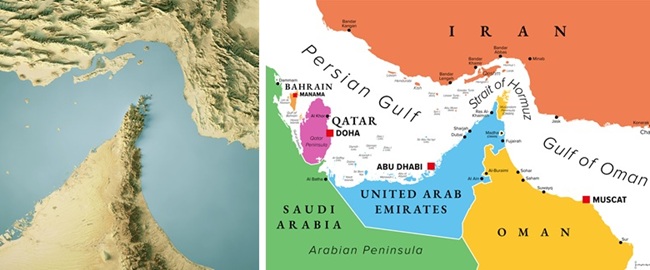
Hence, one ponders over the idea of creating a Hormuz bypass canal in the Peninsular Oman and the UAE to link the Gulf of Oman with the Persian Gulf, totally bypassing the chokepoint of the Strait of Hormuz. We have previous examples of enhancing trade connectivity and achieve significant gains in both time and economic efficiencies by creating manmade canals and waterways. The Suez Canal is a 120.1-mile-long (193.3-km) artificial sea-level waterway in Egypt, connecting the Mediterranean Sea and the Red Sea. The Panama Canal is an artificial waterway approximately 51 miles (82 kilometers) long that connects the Atlantic Ocean (via the Caribbean Sea) and the Pacific Ocean. If one studies the regional maps and geography, there are several competing candidate routes for building a man-made waterway between the Gulf of Oman and Persian Gulf cutting across the land while bypassing the maritime chokepoint of the strait of Hormuz.
Channel 1:
Proposed channel 1 is the shortest and the cheapest route for a putative candidate canal to bypass the strait of Hormuz. Musandam peninsula is shared between Oman and UAE. The peninsula lies to the south of the Strait of Hormuz, between the Persian Gulf and the Gulf of Oman. The Musandam peninsula is generally about 22 miles (35 km) wide. The mountains slope steeply seaward, forming an extremely rugged and rocky coast that makes Musandam a serious hazard for navigation. There are fjords that are 10 miles long but not suitable for container ship movements. Possibly, a canal can be dug between Ras Al Khaymah on the West coast connecting the Persian Gulf and Hisn Dibba on the east coast in the Gulf of Oman. The distance between Dibba Al-Hisn and Ras al-Khaimah is only 24 miles (38 kilometers). This manmade canal will avoid the maritime chokepoint of the strait of Hormuz but still will be within the reach of Iranian ballistic missiles and drones.
Channel 2:
The second proposed route is from Khawr Al Fakkan on the east connecting Gulf of Oman to Umm Al Qaywayn. Distance between Umm Al Quwain and Khawr Al Fakkan is 50.29 miles (80.93 km). This will double the cost of construction but will be relatively safer route.
Channel 3:
The longest solution will be to dig a canal between Sharjah on the west coast in the Persian Gulf and Al Fujayrah on the East coast in the Gulf of Oman. This will be the safest route but also the most expensive. Distance between Al Fujayrah and Sharjah is 62.15 miles (100.02 km).
Cost of Construction:
A geographical survey of these three proposed routes can give the most cost-efficient and strategically optimal engineering solution to the Hormuz dilemma. The cost of this engineering marvel could be shared by the six monarchies constituting the Gulf Cooperation Council (GCC). Incidentally, Iran is not a member of the GCC. Once the Hormuz Bypass canal is operational, the transit fee paid by the VLCCs and the merchant ships will generate revenue for the investors forever in future making it a very profitable venture.
Sovereignty:
The sovereignty of the Hormuz bypass canal can be shared between the Sultanate of Oman and the Government of the United Arab Emirates. However, for operational issues, a multinational Board of Governors and Directors giving representation to all the investor countries can be created. The contract to manage the operations of this man-made canal can be awarded to a neutral and multi-aligned country that can manage diplomatic issues without ruffling the feathers of the regional countries.
Conclusions:
An engineering solution to the Hormuz dilemma is possible but requires visionary planning, fiscal resources, and multi-state cooperation to avoid future weaponization of merchant shipping through the Strait of Hormuz. We have discussed several solutions to this problem that may not be mutually exclusive. In other words, more than one solution may be effectuated to provide redundancies in connectivity to avoid future logjams in shipping goods and energy transport. Ultimately, it is left to the wisdom and the will of the countries representing the GCC whether they opt for any of these solutions.
Images (c) istock.com
17-Mar-2026
More by : Dr. A. Adityanjee