Sep 25, 2026
Sep 25, 2026
by Monika Anand
An Interview with Author Rajesh Talwar
1. You were recently honoured at the India–UK Achievers Awards 2026. How significant is this recognition at this stage of your career, and what does it represent for Indian authors on the global stage?
This recognition is hugely significant at this stage of my career. What makes it especially satisfying is that it does not honour a single achievement or book, but rather a body of work and related activities sustained over many years. That breadth of acknowledgment carries a deeper meaning.
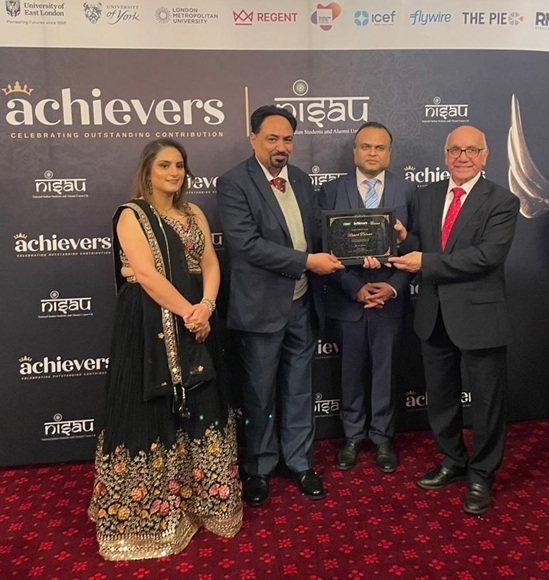
There are two aspects that gave me particular satisfaction. First, while several achievers were selected within a category, one individual was further recognized as an Outstanding Achiever - and that happened to be me. It was already an honour to be acknowledged as an achiever, but being singled out in that way, and spoken of as a ‘global policy author’ made it even more special. Second, the award was conferred at the House of Lords in the British Parliament, with Lords, Baronesses, and Vice Chancellors present, lending the occasion a unique gravitas.
The award also stands out because of its distinguished company. Previous recipients have included figures such as former Prime Minister Dr. Manmohan Singh, Olympic champion Neeraj Chopra, and philanthropist‑entrepreneur Ananya Birla. To be recognized alongside such names underscores the seriousness of the honour.
For Indian authors, I believe this award is significant because it implicitly recognizes the transformative power of writing. It affirms that literature and ideas can shape discourse and inspire change on a global stage. That said, not all writing must carry a message, but when it does, and when it resonates, it can achieve recognition of this kind.
2. This honour follows your International Alumni Laureate Award from the University of Nottingham in 2025. Do you see these recognitions as validation of your themes around social justice and global policy?
Recognition from the institutions that have shaped us is always deeply meaningful. In many ways, my writing journey began at La Martiniere College, Lucknow. I was an average student until essays were introduced in Class 9, and suddenly I began to excel in that particular subject. We had a brilliant English teacher, Mr. Elton, a warm and kind personality who influenced me profoundly, as he did many others in the class. His encouragement gave me the confidence to pursue writing seriously. The school itself, with its grand and majestic setting - cannons, dungeons, and mysterious out‑of‑bounds areas - also left a lasting impression and helped spark my imagination.
Hindu College was also hugely influential in my journey. It would probably take up too much space to discuss its full impact here, so I’ll leave that for another time, but it remains a formative part of my development as both a student and a writer.
Later, the University of Nottingham was equally influential. I went there in 1996 on a British Chevening scholarship to study Human Rights Law, and in 2025 the university honoured me with the Alumni Laureate Award. That recognition held special meaning because the jury highlighted specific works of mine, including works on caste discrimination and toxic terror. Knowing that the award was the result of a rigorous and careful selection process made it a true validation of my work.
In today’s world, we see countless awards, some unfortunately manufactured by PR agencies and advertised daily on social media. Against that backdrop, honours from respected institutions carry genuine weight. They affirm not only the themes I have explored around social justice and global policy, but also the integrity of the journey itself.
3. Your latest book, Bollywood, Hollywood and the Future of World Cinema, explores the intersection of global film industries. What inspired you to turn your attention to cinema at this point in your journey?
All of us are influenced by cinema in our growing years, and I have been an avid watcher since childhood. Even today, hardly a week goes by without my watching a film. Having worked with the United Nations for over two decades, I witnessed firsthand the penetration of Bollywood across the world and came to appreciate its enormous potential.
We are now at a turning point globally, with economic power shifting towards Asia. I felt it was important for India to seize this moment and claim a larger share of the international film market. Of course, certain reforms are necessary before that can happen. My book was inspired by the need to discuss these issues openly, in the broader interests of India’s soft power and its future role in shaping world cinema.
4. In the book, you examine how cinema shapes cultural narratives. Do you believe global cinema today is increasingly influencing geopolitics and public opinion?
Cinema remains one of the most powerful mediums in the world today, and its influence on geopolitics and public opinion is only growing. Shekhar Kapur once remarked that by Spiderman 8 the lead might be Indian or Chinese. I believe that moment could arrive even sooner. Already, you can see India’s growing influence: James Cameron reached out to S.S. Rajamouli to discuss the release of Avatar: Fire and Ash, a clear sign that the Indian market can no longer be ignored.
The challenge, however, is that India has been punching far below its weight. If we are to truly shape global opinion, reforms are essential. That is why one section of my book focuses on the Justice Hema Committee report. Although the report is centred on Malayalam cinema, its recommendations are relevant across all regional industries, including Bollywood.
India has no shortage of talent, but we must move away from a star‑dominated system toward one that is content‑driven. There are many other reforms that are outlined in my book. Only then can our cinema fully realize its potential as a force in global cultural narratives and geopolitics.
5. Having now been recognised internationally, do you feel a greater responsibility to address global concerns through your future writing and creative projects?
Yes, I do feel a greater responsibility. Every writer needs validation, even if the urge to write comes from within, and international recognition strengthens that sense of duty. At the same time, I believe that within India, governments, both central and state, must do more to ensure that writers and creative artists do not face such an uphill struggle.
I often recall a photograph of the great Premchand, standing tall in a simple dhoti beside his wife, his shoes badly worn, proof of financial distress. We cannot allow our national and regional writers to languish in poverty. There must be programs to encourage young writers, as well as initiatives to support older writers and creative artists across disciplines. Recognition brings responsibility, and for me that responsibility includes advocating for a system where creativity is nurtured, respected, and sustained.
6. With your foray into filmmaking alongside your recent book on cinema, how do you see your role evolving—from author to a broader storyteller influencing both literature and visual media?
My role is evolving from being solely an author to becoming a broader storyteller who engages with both literature and visual media. At present, I am working on two films. One explores the potential global reach of Indian tales, in the form of animation cinema or otherwise, a reminder that India was once the storyteller to the world. The other, perhaps even more urgent, addresses the issue of air pollution.
Both projects are AI‑generated animation films in the Disney style, created in collaboration with a talented young colleague, Ananya Sharma, who brings strong technical expertise to complement my creative vision. In about six months from now, we expect to complete Smoky Sky Songs, an animation film on the toxic terror that hangs over our cities and towns, causing millions to die prematurely.
Through these projects, I see myself extending the themes I have long explored in writing into a new medium, using cinema to reach wider audiences and spark conversations on issues that matter globally. Having said that writing would always remain my first love.
09-May-2026
More by : Monika Anand
