Oct 01, 2026
Oct 01, 2026
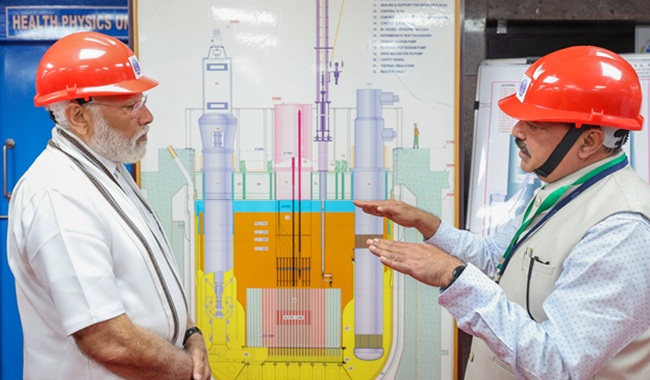
On 6th April, India’s Prototype Fast Breeder Reactor (PFBR) at Kalpakkam in Tamil Nadu attained criticality. It is a significant advancement towards our much-dreamt-of three-stage nuclear program. With this achievement, we move closer to realizing the full potential envisaged under Homi Bhabha’s three-stage nuclear program.
This indigenously developed 500 MWe fast-breeder nuclear reactor shall serve as a vital bridge between the existing fleet of pressurized heavy-water reactors (PHWRs) in operation and future thorium-based reactors. It will, of course, take a few more months to conduct additional tests before PFBR becomes fully operational and is connected to the grid.
To better appreciate the significance of this accomplishment, we must first take a look at what Homi J Bhabha, the father of India’s nuclear program, proposed way back in the 1950s. He, keeping in view the limited Uranium and vast thorium deposits in our country, proposed a three-stage nuclear program to achieve long-term energy independence. This runs as:
Now, let us examine where we currently stand vis-à-vis this framework:
Stage 1
We have established around 22 Pressurized Heavy-Water Reactors (PHWRs) between 1960 and the early 2000s. We have used natural uranium as fuel to run these reactors. Uranium is a naturally occurring element. It primarily has three radio-isotopes—U-238, U-235, and U-234. Of these, U-235 is the only naturally fissile uranium isotope. U-238 is the most abundantly available isotope. But it is not fissile. It, however, absorbs neutrons and converts into plutonium-239 (Pu-239).
These reactors run on the principle of nuclear fission. In all these reactors, natural uranium is used as fuel, with heavy water— deuterium oxide (D2O)—as a coolant. In the reactor, neutrons collide with U-235 nuclei, causing them to split and release a large amount of energy in the form of heat. This heat is used to generate steam, which ultimately drives the turbines to generate electricity.
In these reactors, plutonium is produced as a byproduct. The U-238— which constitutes 99.3% of the natural uranium fuel— captures a neutron during the fission reaction and decays into plutonium-239. Thus, PHWRs using natural uranium and efficient heavy-water moderation produce a significant amount of P-239 as the fuel burns. This plutonium becomes the fuel for the second-stage reactors.
Stage 2
The second-stage reactor, namely, Fast Breeder Reactor (FBR), uses a mixed oxide of plutonium produced in the first-stage reactor and uranium as fuel. This mixture is called Mixed Oxide Fuel (MOX). The core of the reactor is also surrounded by a blanket of U238. This enables breeding and optimizes neutron economy.
In this reactor, liquid sodium is used as a coolant. Though sodium, as a coolant, transfers heat efficiently, it raises safety concerns. Reacting violently with air and water, liquid sodium produces fires. Hence, it demands highly specialized leak-proof systems to prevent sodium fires.
It is these fires that made Japan abandon its work on FBRs. Even countries such as France and America gave up this technology due to its complexity. Russia is the only country that is operating a fast-breeder reactor on a commercial scale.
Now, with the achievement of criticality of Kalpakam PFBR, we have become the second country in the world to operate a fast breeder reactor. Here, criticality means: sustaining a controlled fission chain reaction that produces a constant power output.
The advantage of PFBR is that it produces more fuel than it consumes. The U-238 blanket captures excess fast neutrons leaking from the MOX core and undergoes transmutation—U-238→U-239→Pu-239—producing more fissile plutonium than the reactor consumes. It is this excess production of plutonium that eventually leads to Bhabha’s 3rd stage reactors: the thorium cycle.
Stage 3
The third stage involves the development of the Advanced Heavy Water Reactors (AHWR), which are specifically designed to run with thorium as fuel. Here, it should be noted that thorium is not a fissile material and therefore it must first be converted to uranium-233 for use as a fuel.
Hence, thorium is mixed with U-233, which acts as a driver fuel in the reactor. The driver fuel undergoes fission, releasing neutrons. They convert thorium (Th-233) into more U-233, creating a self-sustaining cycle. This then becomes the fissile fuel in the reactor.
The development of thorium reactors may be a couple of decades away, for we must first build and operate FBRs to successfully generate power and breed plutonium-239. Secondly, we have to also bear in mind that the fast breeder at Kalpakam that achieved criticality is only a prototype. It took more than 20 years to build the PFBR. So, it may take another two to three decades for us to reach the third stage of thorium-based reactor development.
Though it took 20-plus years to attain criticality for the PFBR at Kalpakam, it is, in the words of Nick Touran, who specializes in advanced nuclear reactor design, “a great accomplishment”.
Dr. Anil Kakodkar, the prominent nuclear scientist and former chairperson of AEC, said, attainment of PFBR’s criticality placed India in “the second stage of our three-stage nuclear power program”.
Having thus achieved a ‘critical milestone’ in our nuclear journey, let us hope that the country is not far away from what Homi Bhabha envisaged: using thorium as fuel for nuclear reactors to produce electricity and achieve energy independence.
16-May-2026
More by : Gollamudi Radha Krishna Murty
