Oct 26, 2026
Oct 26, 2026
by Hema Ravi
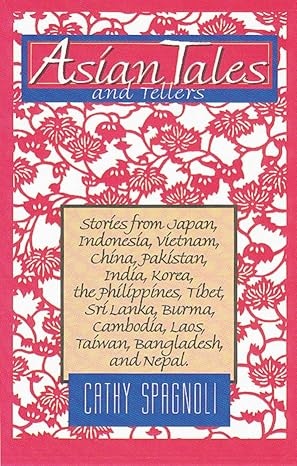 Asian Tales and Tellers by Cathy Spagnoli
ISBN: 978-0874835267 Paperback: $ 22.95
Publisher: August House Publishers Inc., Arkansas, USA
About the Author:
Cathy Spagnoli often heard storytelling in her Italian German home but discovered it as a life path later in Asia. In her search for stories, she has traversed Indian rice fields, sipped sake with Japanese epic singers, met with monks in Thailand and Korea, and hiked the Himalayas alongside Tibetan dancers. Cathy has written 18 books, received fellowships from The Japan Foundation, The Korean Foundation, USIS, and numerous other organizations, created several cassette tapes, a CD, and numerous articles.
Cathy Jean Spagnoli's spirited journey began on February 10, 1950, and ended on October 20, 2023, after a prolonged battle with brain Cancer. Her passing is a profound loss- not just to storytellers, but to everyone who was empowered by her remarkable life and the stories she so generously shared.
In her preface, Cathy shares: Since 1970, I’ve lived, worked, and shared stories for over twelve years in India, Japan, Korea, and parts of South Asia. Here in Washington state, I have exchanged tales with gracious Southeast Asian refugees. In her engaging introduction, Cathy writes: Asia remains one of the world’s richest sources of varied storytelling materials and techniques. Religious beliefs and prejudices were exchanged in the region, along with silks, medicines, spices, and more. Fierce wars and battles alternated with peaceful times that nurtured rich cultural growth.
Glimpses of the rich tradition are revealed all through the book with such dexterity, skill, warmth, and childlike enthusiasm that only a born storyteller can share. Cathy’s passion has been infectious– she is regarded as the Godmother of Storytelling, in the words of contemporary writer and storyteller Jeeva Raghunath.
But how did this happen so organically? Cathy narrates her first visit to India. In 1968, I started school at Tufts University and went for two years, then left to go off overland to India, got hepatitis, got arrested, met amazing people, then returned to finish my BA with Honours, in three years (total) by building a playground, teaching dance to the hearing impaired, and more. It was just the beginning… Her marriage to Indian sculptor Parasivam Samanna of Cholamandal Artists’ Village cemented the Asian and Indian connection for life. The proverbial made-for-each-other couple, notwithstanding their disparate cultures and their socio-economic status.
Cathy always captivated her audience with vivid narratives, anecdotes, and truths. “They always listened to her with undivided attention, as they did on that one fine day in the late 1970s, under the banyan tree at the Krishnamurthi School in Chennai,” ruminates Radhika Menon of Tulika Publishers.
It is a wonder how her stories would cascade as a waterfall – she would use a guitar, and the words would just flow, reminisces Radhika Menon.
In the narrative Storytellers and Styles (p. 17), Cathy recalls her meeting with eighty-six-year-old Nabe Shirasawa in the early nineties. She was one of the few Ainu storytellers in Hokkaido, Japan. The Ainu people, once the original inhabitants and now a minority on Hokkaido Island, had almost lost their stories because their language was banned for a while; many of the yukana stories were all lost or forgotten.
Cathy recalls her meeting with Harikatha exponent Kamala Murthy in Thanjavur, India. Cathy reports – the bhagavathars have forgotten the true purpose of Harikatha – to offer devotion to God and to instruct people on the important side of life, the spiritual.
The other renowned storytellers mentioned in the episode are Sachiko Yokoyama (Northern Japan), Young Sook Song (Korea), Putha Touch (Cambodia), Wang Yulan (China), V. Sambasivam (India), and Kyoko Matsuoka (Japan), all of whom Cathy had found with grit and determination.
Each of the stories/legends is rich with a message: humour, fantasy, adventure, subtle truths and values incorporated. Cathy points out the familiar storytelling tools- the voice, words, gestures, music, props, and more. She reiterates that at times, a single word or image is enough narration in a regional language gives a feeling of belonging to the children.
Mukashi, mukashi…is the classic Long, long ago or Once upon a time…
Again, I’ve read that she begins her sessions with simple Show and Tell objects, even a chocolate wrapper, for example.
In this collection, Paramasivam Samanna’s simple illustrations in the form of kolams, flowers, elephant and other symbols subtly complement the narratives.
Taking a page from her life, in Blended Cultures (p.166), she states how she drank saffron milk, as Indian friends suggested, wore a charm for safe childbirth sent from Japan and how she listened to her Italian aunts as well. Once, her husband, after meeting an Indian friend came home and mentioned that his North Indian friend wanted to do a ceremony for her – a special bath! He couldn’t elucidate further, as he was from the Southern part of India. Suddenly, the name of baby shower donned in her head, and she had a hearty laugh with her spouse. With a glint of humour, in her notes, Cathy adds – our cross-cultural marriage is rich in such discoveries…and sometimes argue over different values!
Interestingly, Valli and Kande Yaka (p.123) is attributed to Kataragama, Sri Lanka. The Valli-Murugan story is an interesting Indian folklore. Another story, Silent Debate, attributed to Korea, has a similar story from India, perhaps; how a mute poet put a renowned poet to shame – the message, True wisdom is beyond words!
One humorous episode that I’d like to share is about Amazing Indian Trains (p.173), in which a man steps off in the middle of the night for tea. Suddenly, he heard the whistle and rushed into a compartment that seemed like his. Finding a person awake, he asked him if he was going to Delhi. The man replied- I’m going straight to Chennai right now. Ah! said the man – our Indian trains are truly amazing, aren’t they? Top bunk goes to Delhi, while bottom bunk goes to Chennai.
Although this collection was published in 1998, I believe it continues to enthral the minds of people from all walks of life.
Storytelling is alive and not fading – with a slight difference. Today, people also share real, personal stories through podcasts and media platforms. And this only proves that our need for true, human connection is strong, and will remain so…
Author’s Note: Very recently, I had the good fortune of meeting the award-winning artist Paramasivam Samanna and gained first-hand information about Cathy Spagnoli’s exemplary life… until the Big C snatched her away. A brief about him – although his life seems to be filled with challenges, he shows no rancour or bitterness; in his eighties, he remains cheerful and continues to enjoy art, as he moves on with life.
“Paramasivam Samanna, was one of 40 students at the Government Arts and Crafts school in Madras who resolved in the early 1960's to devote their lives to art. They pooled their meager funds to buy a cheap eight and a half acres of land south of the city, and set out to build a cooperative that would support them and their aspirations. Cholamandal, named after an ancient dynasty that encouraged the arts, is India's largest self-supporting art colony and one of the most successful in Asia.”
NYTimes article “Arts Abroad; In India, Pioneers of Modernism Savor Their Success”
Born in Gudiyattam, Tamil Nadu, Samanna became a life member of Cholamandal Artists’ Village. He has won prizes at the All India exhibition of Art, Kerala, Mercer Island and Ocean Shores for Sculpture. Has featured in the books ‘The Madras Metaphor’ and ‘An Algebra of Figuration’ by Oxford University Press. Participated in the Bumbershoot show, WA, Seattle Urban League, WA, and ‘Sculptural Configuration – Prospective/Retrospective’, exhibition at Chola Sheraton, Chennai.
30-May-2026
More by : Hema Ravi
Top | Book Reviews | Home
