Oct 02, 2026
Oct 02, 2026
When I was growing up in the 70s and 80s, life in Colaba and Cuffe Parade had a very different rhythm. We moved through the area on foot, and the city was something you learned by walking it.
Around the corner from my home was Sohrab Bharucha Road (SBR). We would take walks on SBR practically every day. At the end of SBR was Batra House and then the wall. On the other side of the wall was Badhwar Park, the colony built to provide housing for railway employees.
Often we would scale that wall to access a tree on the other side. The tree had a fruit we called bimli. We would pluck them and return to Sheila Mahal, where we would sit around counting the bimlis and sharing them evenly. After biting off a small piece, we would dip them into a mixture of salt and red pepper.
I often walked into Cusrow Baug, which was situated adjacent to Badhwar Park. It was a colony exclusively for Parsees. Many of the students at Scholar High School were Parsees, so it felt natural for me to enter the premises. There was a fire temple within Cusrow Baug, and I used to walk around it, though I never entered it because I was not Parsee.
One of our memorable activities was walking from Sheila Mahal to various locations both south and north. On the south side were Sassoon Dock, Colaba Bus Station, and Cuffe Parade. On the north side were Regal Cinema, Gateway of India, and Oval Maidan. We often used the water fountains at Campion School. In fact, they were the only fountains we really knew in the area, and for a while stopping there became something of a fad among us.
Oval Maidan was where we played cricket regularly. On some days we would just sit there, and on others it would turn into full matches with whoever was around. I also remember once going to Cooperage Grounds to watch a football match between Mafatlal and Orkay. The scale of it, the crowd, and the energy of the game stayed with me.
We moved easily through nearby landmarks—Campion School, Holy Name, YMCA—and the triangular park behind Campion, that small green space sandwiched between those institutions, was also part of our world.
Recently, my uncle told me about life in the same area in 1947, when he had first arrived as a refugee. He was only eight years old at the time. It appears that he used to pass by the same spot where the wall stood that I used to scale in the 1970s. There was no wall in 1947. People could simply walk through and reach the beach in those days.
There was no beach when I was growing up. The land had already been reclaimed and replaced with commercial buildings in what is now Nariman Point.
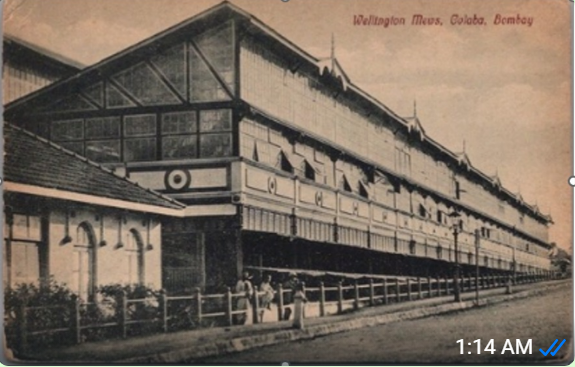
My uncle also told me that Colaba Train Station once stood in what is now Badhwar Park. There used to be a bridge over the tracks leading up to the station, and there were stables near the foot of the bridge.
After months of searching, I finally found a photograph of Wellington Mews—the stables that once stood at the foot of that bridge.
That photograph changed the way I look back at all of it. It suggests that the spaces we thought of as simply “ours” had another layer of history underneath—one that had already disappeared by the time we arrived.
Looking back, it was never just a collection of individual places. It was one continuous neighborhood — walkable, open in parts, and completely shaped by how children experienced it on foot, while carrying an older city we did not yet know was there.
30-May-2026
More by : Shailendra Chainani
