Oct 25, 2026
Oct 25, 2026
...in Ruskin Bond's Writings
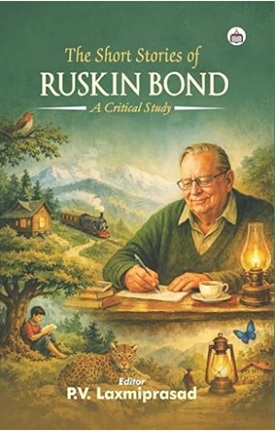 The Short Stories of Ruskin Bond: A Critical Study, edited by P.V. Laxmiprasad, is an important academic work that examines Bond's tales, who is arguably one of India’s best-loved writers. In an era where literature often tends toward the more complex, experimental, and dramatic, the Short Stories of Ruskin Bond offers a scholarly perspective on one of the most significant writers of this century.
The compilation of articles in this edited volume brings together critical essays that explore a wide range of themes, styles, and perspectives on Bond's short stories. Each article sheds light on a different aspect of Bond's writing, thereby promoting a broader appreciation for the richness in Bond's work.
The editor’s introductions to each article provide context and importance for the author, as he/she shows how this body of literature reflects the uniqueness of Bond's position within Indian English Literature.
Bond is not aligned with any political position or literary movement that advocates for political or experimental literary influences. Instead, he establishes himself in his writing by focusing on everyday human experiences, the people and communities of small towns and the beauty of nature in quiet, understated ways. A strong feature of this book is that it emphasizes the simplicity of Bond's writing style. Many of the authors critique Bond's ability to convey complex ideas through simple means.
The essays contained within this collection examine significant motifs throughout Bond's short stories, such as childhood, isolation, memory and kindness; these themes recur throughout many of his works. Scholars analyse well-known stories by Bond, including "The Eyes Have It," "The Night Train at Deoli," "The Woman on Platform 8," and demonstrate how he treats ordinary, everyday interactions between humans with extraordinary empathy and nuance. Many of his protagonists are unexceptional types of people (schoolboys, passengers, old men, unidentified individuals sharing a train car), yet the stories illustrate feelings shared universally (hope, desire and generosity of spirit).
In addition to examining recurring themes within Bonds fiction, this volume also looks specifically at how nature serves as an integral component of Bond's work. Many of the essays highlight the structural significance of the Himalayan foothills (especially Mussoorie and Dehradun) to shaping the protagonists' experiences and value systems in his stories. In Bond's writing, nature is not just a setting, but also a vital entity that has an effect on humans. Often, the seasons, trees, mountains, and rain reflect aspects of his characters' emotional experiences, thereby instilling an awareness of environmentalism that seems even more pertinent today. In addition, several essays explore Bond's humanistic perspective and the manner in which much of his fiction tends not towards conflict but rather towards themes such as empathy, generosity and morality.
The book also examines contemporary critical theories (such as eco-criticism, cultural studies, and narrative analysis), positioning Bond in the broader context of literary discourse, demonstrating how his seemingly simple stories possess much scholarly depth; and collectively challenge the stereotype that popular writers are not serious literary figures. While the tone of the essays is primarily academic, they are also written in a manner that will be equally accessible to general readers who appreciate Bond's writing style. The use of clear language throughout the essays, with a tight linkage to the stories themselves, creates a successful bridge between academic, scholarly criticism and popular, reader-appreciative literature.
In conclusion, The Short Stories of Ruskin Bond: A Critical Study is an important contribution to the area of Indian English literary criticism. The book creates an argument that by exploring the various academic frameworks, Bond's gentle narratives inspire readers from generations past to present. It also reminds us that literature doesn't have to be grand to be important; often will powerful literature, through ordinary things. P.V. Laxmiprasad deserves full appreciation for his innovative works in Indian English Literature
06-Jun-2026
More by : Prof. Dr. Mahammad Ghouse Shaik
Top | Book Reviews | Home

|
A well explored book review. Appreciations |
