Oct 10, 2026
Oct 10, 2026
by B.S. Ramulu
"I won’t study," sobbed Gangadhari, his tears flowing in streams as he hiccupped and cried.
"If you say that word again, I’ll kill you, you donkey’s son!" Father Ellayya raised the stick to hit him again. Unwilling to let that scene unfold in front of his house, school teacher Achayya (Alias Lachayya). Sir stopped Ellayya and pulled Gangadhari into his arms.
Achayya noticed the welts already rising on Gangadhari’s tender, dark body. This was the result of Achayya calling Ellayya to the school yesterday and telling him, "Your son isn’t coming to school regularly." Feeling as if he himself had gotten Gangadhari beaten, Achayya’s heart writhed in pain.
Achayya had great affection for Gangadhari. When Achayya first came to that village, Gangadhari’s name in the school was Gangayya. It was Achayya ( Lachayya) who had it changed to 'Gangadhar'. Earlier, Gangadhar used to be very enthusiastic about studies. He even scored good marks. It was only recently that Gangadhari had changed like this.
"The water is getting cold," saying this, Achayya’s wife Mallavva brought tea for the three of them. Though her given name was Mallavva, Achayya called her Malleshwari.
Since the day he came to that village, Ellayya had become close to Malleshwari. From firewood for the stove to anything she needed, if she told Ellayya, he would track it down, bargain, and send it. Gangadhari too had become alivi [one’s own person] to that house.
Gangadhari didn’t take the tea. "What did the tea ever do to you, child! Take it," Malleshwari pleaded. Gangadhari took the glass, set it beside him, and kept sobbing. After drinking his tea, saying "I’ll bathe and come back right now," Achayya walked toward the fence of ampula paarakala [thorny branches]. That was their bathing room.
While bathing, putting on clothes, and combing his hair...
"Even if you kill me, I won’t study, I won’t!"
Shouting that, Gangadhari suddenly ran away from there.
His feet struck the tea glass and it rolled with a kanakana sound all the way across the front yard. Ellayya couldn’t catch him.
Achayya came running.
"Don’t say anything to him. In four or five days, I myself will make him understand, tiy [take it easy],"
saying this, Achayya calmed Ellayya and sent him away.
This year Gangadhari got fever many times.
Dysentery caught hold of him. They couldn’t show him to a big doctor in time.
Because of that, he couldn’t come to school for many days.
Yet he was still at a level where he could catch up with the lessons.
Perhaps he thought this education and these notes had become some kind of obstacle to his freedom.
These textbooks seem to be written for middle-class upper-caste children of the city. For village children, and especially for Dalits, they are written in a way that holds not the slightest interest.
This was the same problem he himself had faced in childhood.
But now, the solution to it is not in his hands.
If the boy somehow gets through till Intermediate, after that the cart of education will roll on to any distance.
Achayya was not without experiences like Gangadhari’s.
But those were his elder brother Narsanna’s.
Narsanna did exactly this at this same age.
Father, mother… they behaved and fretted just like Gangadhari’s father Ellayya and mother Boodavva.
Narsanna, who stubbornly said "I won’t go to school, I won’t," was put through many tortures.
They turned the house into a police lock-up.
They put him in thodapaasham [leg-shackles].
They called it kodandam and hung him upside down from the beam and beat him.
They starved him of food.
The whole village and community humiliated him.
They said black magic was done and performed rites to ward off evil.
They shaved his head and rubbed lemons and such on him.
The more they did that, the more stubborn he became.
They called him obstinate, they called him mad.
For some days he wandered here and there, and came home to eat only when no one was there.
He slept wherever he could.
Perhaps seeing the beatings his brother took, that was the fear that made him go to school…
Why this much violence over education?
Vishwakavi Rabindranath didn’t have any schooling till he was fourteen, he roamed freely.
Perhaps it was because there was no pressure about studies that Tagore became Vishwakavi.
Perhaps that’s why he founded Shantiniketan for free education.
If Narsanna too had the opportunities Tagore had, perhaps he would have become a great writer.
Narsanna was excellent at telling stories, at unraveling shaastraalu.
He attracted so many children.
Nature, trees, plants, tanks, canals — brother loved them dearly.[riddles]
After watching for some days, Father pestered him to learn the caste occupation.
With Father’s behavior, the feeling ‘Don’t listen to anything Father says’ got planted deep in Narsanna.
"Kill me," he said, and endured the tortures, but he neither went back to studies, nor did he learn the caste occupation.
Narsanna was a real daredevil.
He would go searching through fields and wastelands and come back with all sorts of things.
He brought many kinds of fruits.
He brought firewood, he caught and brought fish.
How wonderfully he performed tricks spinning tops on his palm!
While all of us feared snakes and vines in the water,
Narsanna would bravely go and pluck mogili, lotus, and water-lily flowers and sell them.
One day Father tied Narsanna to a post, beat him, and told him to learn the caste occupation.
He didn’t give him food. Narsanna lost consciousness.
When Mother tried to feed him kaaram gadaka [a spicy paste], Father beat Mother.
One night Mother got up, fed Brother, untied the ropes,
"Go to some relative’s house. Don’t go anywhere else, child!" she said, touched his feet and sent him away.
Father beat Mother again.
Mother didn’t get out of bed for three days.
Studying was easier than our caste occupation.
But Narsanna liked neither.
A week later, Narsanna vanished without a trace.
They learned he was not at any relatives’ house, not in any village.
They said he ran away.
They said maybe he fell into some well or tank and died.
Mother went crying, searching all those places.
There was no trace anywhere. No one could tell them where Brother was.
After some days, they said Narsanna was seen in Nizamabad.
When they said he was seen working as a supplier in some hotel,
Father, under Mother’s pressure, gathered bus fare, finished his work, and went searching for him, but by then they said he had quit and left.
Once they said he was seen in Jalna, another time in Bhiwandi.
Someone else said he was carrying saddulu [lunch carriers] for mill workers in Bombay.
They said he was weaving on power looms.
Someone else said he had settled into work winding yarn in a mill.
They said he became a mechanic.
They heard all sorts of things, but no letter ever came from Narsanna.
Brother earned a name that he wouldn’t stick to any job, that he wouldn’t submit to anyone.
But no one ever said that Brother cheated anyone, or that he took a loan and ran away.
Because he wouldn’t tolerate anyone’s arrogance, he never stayed long working under anyone.
Once he came home and said he would stay here from now on, so they got him married.
Thinking she was a burden around his neck, he left his sister-in-law at home and went away to a distant land without telling anyone.
Fed up and exhausted, they got his sister-in-law a divorce and arranged a second marriage for her.
After that, they said Brother kept a Maratha woman.
After that came the news that he separated from her.
Some days later came the news that he had run away with someone’s wife.
After that, they said someone beat Brother to death and threw him into the Bombay underground drainage. They said he was seen like a madman in Pandharpur, in the Shirdi Sai region.
They said he was working in Surat.
After that, no more news came.
Brother’s life, which had longed for freedom, ended like that.
Why do some people hate social bonds so much!
Does freedom exist beyond social bonds?
Perhaps people hate social bonds because freedom becomes a right for one person, and for another it turns into a burden, into bondage.
They called Brother mad. If only he had gotten even a little tenderness, a little joy, a little freedom — whether in studies or in the caste occupation — how much he would have grown! Teachers’ sadism, society’s foolishness, superstitions together, do people like Narsanna, whose self-expression was never nurtured, have no chances to develop their freedom and creativity in a natural way?
Can he not do anything to keep Gangadhari from becoming like Brother?
Gangadhari has a sensitive mind.
He gets hurt easily, doesn’t say it out loud.
Gangadhari loves trees and plants.
Just like Brother, he roams along canals, along tanks, brings fish.
He takes the three kids in the house and wanders endlessly along hillocks, among trees. He strings together words and sings songs.
He has the traits of a poet. But how can he study?
Not everyone can become a poet like Tagore. Does Gangadhari have those opportunities?
Remembering Narsanna, his heart grew heavy with sorrow, and saying he was late for school, Lachayya sent a leave note.
After eating a little of what was there, he walked aimlessly toward the outskirts of the village. Here and there, women were singing some folk songs.
Beautiful gardens, fields, the sweet smell of the redgram crop wafting,
he was about to pluck a few pods when decency stopped him and he held back, Achayya.
Along the bunds, marigolds were in full bloom, radiating light.
How long he wandered like that!
By sunset, on the bund of the Sriramsagar minor canal, he saw Gangadhari sitting, singing some songs, coaxing the goats to drink water.
Watching Gangadhari, without letting himself be seen, he turned back, and reached home as darkness fell, Lachayya.
Can a person find so much joy in the solitude of nature?
Is there so much freedom in nature?
How light his body and mind had become!
Is Gangadhari refusing this education because he feels it is distancing him from this nature?
Will this age turn Gangadhari, a nature-lover who owns no land of his own,
into an agricultural laborer?
Do agricultural laborers and farmhands share this much freedom and joy in nature?
Thinking all sorts of thoughts, eating absent-mindedly, Lachayya slept that night.
The next morning, Gangadhari’s mother Boodavva came to Lachayya’s house with a forlorn face.
"My son didn’t come home last night, Sir! The goats came home. He didn’t come home even during the day. Thinking he might come and eat at some time, I didn’t even lock the door. What happened to my son, Sir! He used to do whatever work was told. He was active in everything. See that his father doesn’t beat him again. And see that he doesn’t go anywhere, I beg you," she said, tears in her eyes.
"Don’t you worry. Leave his responsibility to me. Even if he doesn’t come to school for some time, it’s alright. Treat him lovingly as if he is going to school. He is an intelligent boy. What if he doesn’t come to school? He can pass Tenth, Inter, Degree, anything privately by paying the fees. If he gets the interest, he can study at any age," said Lachayya consolingly.
From then on, Gangadhari became a free spirit.
When he went to Hyderabad for some work, Lachayya
( Achayya) brought back several Telugu and English books written about the education system and began to examine them.
The more he read them, the more new doubts began to arise.
The doubt grew strong that, for every ten who join first class, only one or two reaching tenth class, and the rest not being able to — the reason might be the ‘Narsanna-Gangadhari factor’ more than poverty.
Gradually, that idea began to take firm root.
When a seminar was held at the District Institute of Education and Training (DIET), Lachayya raised this very issue.
At a wedding, when he met his old friend Lakshmayya, a B.Ed. College Lecturer, he raised this discussion.
Many people showed interest in that discussion.
Is it possible to have opportunities to learn education on one’s own, as Jiddu Krishnamurti said, or as someone else said, without anything to do with this school system?
If those who don’t go to school are not put to any work and are looked after till the age of twenty, allowed to roam freely like Tagore, will their development increase?
However much money parents have, will they agree to that for their children?
While meals were going on on one side, this interesting discussion was taking place on the other side.
To tell the truth, today’s school education system is not giving due importance to children’s creativity, freedom, and their interests.
It suppresses their power of self-expression and turns them into robot centers.
We are turning them into tape recorders, into relay centers of a radio or TV.
You tell something and they have to give it back to you, write answers to lessons...
All these things are nothing but suppressing the interest, attention, and creativity in a human being.
Just to learn the script, there is no need to study for so many years.
Like calling a person who is going his own way and slapping him on the cheek,
this system summons Dalits in the name of school, stamps them as ‘your brain has gone blunt’ and suppresses them," said Lakshmayya bluntly.
"Does that mean nothing learned in school is useful for life?"
"I’m not saying that.
According to this system, children must express only what is in the lesson.
After reading a lesson, there is no opportunity in this education system for children to express the new feelings that arise in them, that’s one thing.
Second, for some, the subject is understood but they cannot express it.
Third, some want to keep certain things from the lessons hidden in their hearts.
Making creativity and the power of expression compulsory by saying ‘spit it out, spit it out’ is not right at all.
It stays within him, and when he responds fully, it flows. What?
His personality remains full, doesn’t it? Take the mute, for example.
How does it become creativity to demand that children repeat back what you told them?
You are turning children into puppets according to your lesson.
To put it correctly, there is no other compulsion as severe as having to recite the lesson.
What I mean is, unless they ‘accept’ the idea in the lesson… as their own feelings, children cannot express it properly.
Aren’t your ideas, or the ideas told through your lesson, being imposed on children as compulsory ideas, against their own feelings?"
Lakshmayya gave a small lecture.
Lachayya told him about Gangadhari.
"Poverty is an obstacle to everything. Because Tagore, or Jiddu Krishnamurti, or the Buddha grew up without poverty, they rose to a level where they could speak so much about the values of freedom, and convince others of it. Perhaps because of the caste Gangadhari was born into, because of poverty, he doesn’t have that opportunity," said Lakshmayya.
"If the education system were suited to the arts, expression, and interests of such people, how greatly society would have advanced!" said Lachayya, anguished.
"I agree with you," said Lakshmayya, and with that the discussion ended.
If there is agreement on anything, the discussion ends; what remains is to practice it together.
Taking various occasions as pretexts, Lakshmayya organized a Bala Kavi Sammelanam [Children’s Poets Meet] in the school. He encouraged Gangadhari.
At the teachers’ dharna and fast programs held at the district headquarters, he made Gangadhari sing songs. Gangadhari got fine recognition.
During summer holidays, Lachayya took him along to his own village.
There he befriended the band people and learned music.
He made friends at the tailor shop and gained entry into tailoring.
Unwilling to ask Sir for money, now and then he went for brick work, for well-digging.
He formed fine friendships with mango orchard owners, with goat herders.
They would cut off their ears to listen to his songs.
As soon as schools reopened in the rainy season, Lachayya was transferred from that school to another village.
With Achayya Sir leaving, Gangadhari no longer felt like going to school again.
Knowing that, Lachayya took Gangadhari along with him for some days.
After returning home, when he became stubborn again, after watching for some days, Ellayya placed Gangadhari on wages with Venkatrao Dora.
Gangadhari’s work was to graze some buffaloes and goats, and do small chores around the house.
Venkatrao’s granddaughter was Haritha. Enchanted by Gangadhari’s games and songs, she skipped school and began roaming with Gangadhari among trees and anthills.
Because she was his daughter’s daughter, unable to say anything to his granddaughter, Venkatrao beat Gangadhari two or three times.
For the sake of Haritha’s friendship, Gangadhari endured those beatings.
Thinking this wouldn’t do, after just four months Venkatrao dismissed Gangadhari from work and sent him away.
When Ellayya beat him, Gangadhari rebelled, gave his father a single push, and ran away.
Ellayya cursed him.
After wandering about here and there for some days, without telling anyone, Gangadhari went back to Lachayya’s house again.
Lachayya tried to settle Gangadhari into work at a wood-cutting sawmill.
Saying no to that, he settled into the work of grazing goats in the forests.
Hearing Gangadhari’s songs, some people from some sangham taught him a few songs of theirs and took him along with them for some days. When the sangham people strictly said "You must sing only such-and-such songs," after some days he left them and came back. By the time he returned, the goat-grazing work was also gone. [organization]
Like this, Gangadhari began going for hard labor, for coolie work.
Work that he could quit whenever he wanted felt peaceful to Gangadhari.
Slowly he learned sutaari [carpentry/masonry] work. One day at that work site, some saintly ascetics camped. There was an old man with a white beard, his wife, and two of their disciples. They were said to be ‘Achalatva’ gurus. They were said to have a lineage of disciples in many regions. Meeting that disciple lineage in continuous wandering was said to be their life.
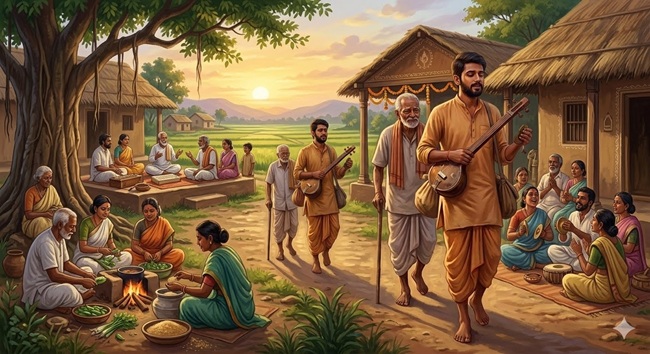
That guru’s name was Poornananda Swami. Folk people address him as Piluraaka Swami, and by his old name, Rajayya Ayyagaru. Taking meals one time at one disciple’s house in that village, accepting the alms they gave, now and then in the evenings they would hold philosophical songs and discourses at someone’s house.
"These worldly bonds of life are illusion.
These sorrows and joys are illusion.
This body is just a leather bag;
Why foster ego looking at it?
All will merge into the earth.
Only our goodness is what we leave behind. That alone is truth"
— those words of the guru attracted Gangadhari greatly.
Humming with those ideas the whole day, that evening in the satsang he sang his songs.
The guru was astonished at the intelligence of Gangadhari, who asked so many questions.
He requested him to stay with him.
Gangadhari traveled to many villages with the philosophical gurus.
He gathered many experiences.
When the guru’s wife fell ill and passed away, Gangadhari became his main support.
Now and then, when his health was not good, he would send Gangadhari along with the disciple group.
In philosophical discussions with people, they would mention so many mathas and ashrams.
Feeling a desire to visit the gurus there, the ashrams, and the philosophies, he took leave from Poornananda Swami.
He began to travel, earning money for fares and expenses by doing manual labor. In that wandering, he gained many experiences.
Now Gangadhari knows some Sanskrit shlokas, some Hindi and Marathi songs, a little English. He sings the dohas of Kabir and Guru Ravidas melodiously.
Ratna, whom he met in an international ashram in the country, began to admire him.
Gangadhari did not notice that at first.
Ratna, belonging to a Telugu family settled in Maharashtra, had lost her husband in an accident.
Her parents had tried everything for her peace of mind.
Ratna invited Gangadhari to her village.
Her parents yearned that it would be good if Gangadhari filled light into Ratna’s life.
But Gangadhari’s mind had not yet turned toward marriage.
After a few days, his mind turned toward his first philosophy guru, Poornananda Swami.
He didn’t know the address.
Bidding farewell to Ratna, he set out alone.
He wandered through many villages.
Once, in the villages, he came across Naxalites.
Gangadhari refused to give his details.
Thinking he might be a secret police, they beat him badly and left him.
Singing some sorrowful philosophical songs, he lost consciousness.
After the squad left, the people of that village took him in, saying ‘Oh, poor fellow’.
After that, some days later in another village, the police suspected Gangadhari.
"Who are you?"
"I am a living being."
"What’s your name?"
"I don’t know yet."
"Which village?"
"That is what I’m searching for," he answered.
Thinking he was a Naxalite courier, they thrashed him.
To their beatings, singing his philosophical songs, he lost consciousness.
One policeman who heard such philosophies said, "He seems like some philosophy guru, let’s leave him," and with that he escaped with his life.
One evening, after drinking water at a borewell and leaning against a tree, singing to himself, Gangadhari was noticed by an Integrated Tribal Development Officer who had stopped for water for his jeep radiator.
Saying it would be good if he sang songs for the people, that they would give him some remuneration, he took him along.
He went around for some days giving programs wherever they told him.
But feeling it was all mechanical, like a laborer who had lost his freedom under their authority, he took leave from them and set out in search of his guru.
One morning in some village, another squad confronted him.
Someone in the squad recognized him.
"Anna, is your name Gangadhari! Don’t mind, my classmate in our village used to be like this.
It’s been a long time since I saw him. I don’t even know if he’s alive or not," he asked.
Gangadhari could not recognize him.
Childhood matters had faded like a previous birth.
Unable to decide whether to say yes or no, he remained silent.
After some time, when he started a philosophical song, that squad member
decided ‘this is Gangadhari’.
As soon as the song ended, he hugged Gangadhari tightly,
"It’s me, ra Gangadhari! I’m Sudhakar ra…
We used to roam the trees and hillocks grazing goats," he said, shedding tears of joy.
Through Sudhakar, Gangadhari came to know many things about home.
Father Ellayya had died two years ago.
Mother Boodavva is always raving about Gangadhari.
Gangadhari’s sister got married, has two children.
Her husband went to Arab countries for livelihood.
Achayya Sir got promoted as Lecturer.
That Sir remembers Gangadhari now and then.
Lachayya Sir’s wife Malleshwari got elected as Mandal President in the women’s reservation seat.
In the village they built a new Shirdi Saibaba temple.
Gangadhari’s close friend Rajayya, from centering work, took contracts and grew into a big contractor who builds houses. He became the Sarpanch of that village.
Venkatrao Dora died a long time ago.
Venkatrao’s granddaughter Haritha has two children.
The squad killed her husband.
She now runs a private school in Venkatrao Dora’s house, which is her grandmother’s house. Haritha remembers Gangadhari now and then.
Sudhakar had thought of marrying Haritha in a widow remarriage.
Haritha agreed. But the Party did not agree.
As soon as Haritha’s matter came up, Ratna flashed in Gangadhari’s mind.
"Doesn’t this lonely life, belonging to no one, feel tiresome to you?
How are you able to live such a lonely life?
Can’t you join with ten people and do some good work for the people?" said Sudhakar.
Gangadhari smiled. It was not sorrow, nor was it sarcasm; it was a serenity.
"Is the revolutionary struggle you are waging for the people?
If so, what place do the likes and dislikes of the people have in it?"
Gangadhari asked directly. He continued again himself.
"Revolution is your desire.
Your entire ideological struggle is to turn your desire into the people’s desire.
Will you deny it? You are imposing your desires on the people.
Because some of the people say yes, you are deluding yourself that it is the people’s desire.
What does it mean for you to work for the people?
Isn’t it only when you reach a state where you have no desires of your own that you can possibly work for the people?
That is, have you conquered your desires?
Have you conquered yourself? Are you experiencing the joy that is in conquering your mind, your desires?
What are comfort and happiness?
Is desiring objects happiness?
If I and others are the way you want us to be, that becomes happiness for you.
How does that give me joy?
Have you read the teachings of the Buddha?
What actually are freedom, love, compassion?"
Sudhakar, stammering a bit, recited everything he knew.
He stressed that there is no life beyond this material life.
"I didn’t deny that, did I?
I too am discussing material life, am I not?
I am discussing about the human being," said Gangadhari.
Since that discussion was interesting, and since it was not the time now, the squad requested him to stay with them for a week and discuss, and Gangadhari walked along with them.
In that one week, every single person in the squad was haunted by the questions, "Have you conquered your mind?
What is mind?
What is freedom? What is society?
What are these bonds?
Without liberation from these bonds of worldly existence and feeling, is true liberation, freedom really possible?"
Gangadhari made no attempt to give them any answers.
The squad commander called those discussions idealism.
"When mind is consciousness, when from consciousness itself perspectives, ideologies, desires are born, how does discussing the mind become idealism?" questioned Gangadhari.
Once, the Division Secretary of the area squads participated in those discussions.
No one could get to the bottom of them, and Gangadhari too did not explain conclusively.
It was the first time they experienced that these philosophy gurus who looked like idealists, like sanyasis, could discuss so deeply.
When the Division Secretary said there were some forest area divisional-level meetings, Gangadhari realized they were asking him to take leave, and he bid farewell to them.
Again he set out in search of his first philosophy guru.
In some village he learned about the guru.
He had come to that village last year. He had remembered Gangadhari.
His health had deteriorated badly.
"I may not be able to come to your village again," he was said to have said.
All the disciples from here and there got together and built an ashram for him.
Gangadhari soon reached that ashram.
Guru Rajayya had grown very thin.
Age had advanced on him.
Seeing Gangadhari, he shed tears.
"My child came searching for me," he said, shedding tears of joy.
In the ashram, altogether there were about ten people.
A fine peaceful atmosphere.
All around were trees, and in the middle were four rooms with all facilities, one hall, one pandal.
The ashram was such that one would say an ashram should be like this.
In the evening, someone began devotional songs.
The guru stopped them.
"Where is God, son! Why search for a God who doesn’t exist?
God is an illusion. Only those who have not conquered the mind created God and fulfilled their desires.
From your desires alone your God is born.
Your mind itself is God. Your goodness itself is God.
Your mind itself is Satan. These two are not somewhere else, they are in your mind itself, son."
Gangadhari was overjoyed at this change in the philosophy guru.
This is what the Buddha said.
With this same philosophy, Gangadhari melodiously rendered some songs he had been writing and singing, beating the kanjeera.
Days were passing.
Disciple friends kept coming and going.
The philosophical discussions Gangadhari was having with them gave the guru great happiness.
How much Gangadhari had grown!
In the ashram he looks after garden work, cleaning work, cooking work.
He chops and brings firewood, washes toilets.
What one thing… seeing Gangadhari’s enthusiasm, his joy, the guru’s health began to improve.
All these days he had been worried that he had no successors.
Now that worry was gone.
One morning in the ashram, in the presence of Guru Poornananda Swami, the disciples held deep discussions on the duties of household life and renunciate life.
On that occasion, Gangadhari expressed his desire to share his life with Ratna.
In this discussion, differing opinions were expressed on the brahmacharya taught by Buddhism,
and on the greatness of living as a renunciate while remaining in household life.
Especially, the opinion that ‘to be able to live household life like a renunciate is the real life’ stirred interest.
While one said, ‘The household life that this being does for living itself is renunciation,’
another said, ‘Living for the illusion of household-worldly bonds is household life.’
Finally, the discussion concluded that living as a renunciate within household life is the best, and that in practice, that is what stands.
One morning they were drinking hot ambali. The disciples were seated around the guru.
Someone raised a discussion on the topics of household life and renunciation.
"The difference between restraint and infatuation is the difference between renunciation and household life," said one disciple.
"To be able to live household life like a renunciate is the real life," said another.
"If that were to happen, how full of love this world would become," said yet another.
Debates went on.
The guru sat listening.
Seeing the occasion, Gangadhari placed before everyone the matter in his heart.
"I feel like Ratna and I should live together. What is your opinion?"
"If Ratna can leave her children with her parents and come, she will become one of us here."
"What about the brahmacharya that Buddhism taught?" someone raised the question.
"The household life that this being lives for the sake of living is renunciation.
Living for the illusion of these household-worldly bonds is household life.
The renunciation that Buddhism taught is great. Living as a renunciate within household life is even greater. That is why Buddhism perished and Hindu dharma survived and could move forward."
Debates went on over this.
Nothing was conclusively decided.
Concluding it that way would be a partial view, so they left it at that.
Gangadhari brought Ratna to the ashram.
With Ratna’s arrival, a new light entered the ashram.
Knowing that he was alive, the mother’s heart of Avva was set at ease. Gangadhari placed a proposal before the guru that he would go to the village for a few days with Ratna and return.[Boodavva]
"If you go there, so many of your old relatives and friends will meet you.
How long before you return! Your absence will be hard for me, son.
In this old age, why shouldn’t your mother stay here with you?
If you write a letter, won’t she fly here with wings? Or else let’s send another disciple and bring her," said the guru.
Boodavva packed her clothes, came, joined the ashram, and became an ashramite.
Knowing Gangadhari’s whereabouts, Haritha too came to the ashram once or twice and left.
Lachayya and Lakshmayya came together, congratulated Gangadhari and the guru, and left.
On Karthika Pournami day, disciples came from here and there.
Ratna and Gangadhari became busy with arrangements for everyone’s accommodation.
That day, a disciple group of three hundred gathered in assembly with the guru.
With mutual greetings, that entire area turned lively with commotion.
"After you are gone, how do you intend to run this ashram?"
asked one among the senior disciples, a man as old as the guru.
The guru gently avoided answering that discussion.
After some discussion, Gangadhari, who came that way in the middle of work, placed before everyone the matter in his heart.
"Human beings are yearning only for real freedom.
Shall we start a school right here like a world where real freedom, pure love, and compassion flourish?"
Gangadhari said, keeping his life in view.
"Do you think those who come to know and experience real freedom, pure love, and compassion here can survive in the outside world?"
a disciple doubted.
Gangadhari was surprised that that thought had occurred to him.
Immediately he requested the guru to give a message.
"Son! The way you are thinking is not right.
This world is truth. This selfishness, envy, bonds of worldly existence,
domination, the state — all these are truth.
Yet all these are illusion.
To sink into these with one’s selfishness is illusion.
To live like a renunciate while being in all these, freed from selfishness, is liberation from this illusion.
That itself is real freedom, pure love, compassion.
To grow fat like some, running mathas and ashrams without doing any work, increasing the ashram properties and exploiting disciples — that is selfishness.
The joy that comes in work [in laboring] is Brahmananda.
However great a philosophy guru Guru Ravidas was, he was a humble man who traveled the country preaching philosophy while stitching sandals for a living.
Brahmajnana is not with someone. It is not somewhere.
It is in the Shudras, in these petty castes.
Brahmajnana means the joy obtained in creating.
It is the lower caste people who create all objects, all wealth.
Therefore, the lower caste people themselves are the true Brahmins.
No one knows Brahmananda as much as they do."
"There is a saying that those who attain Brahmajnana are Brahmins, isn’t there?" some disciples questioned.
"That is wrong, son. Those who have attained Brahmajnana are the Shudras, the petty castes.
How is it possible for the Brahmin caste, which does not do any occupation that merges with this nature, to attain Brahmajnana, Brahmananda?
They could not even conquer the boundaries of the feeling ‘this is mine, my caste, my caste is great, my birth is great.’
For these pretensions, Brahmajnana and Brahmananda remain miles away.
It is possible only for those who give up this superiority, this ego.
That itself is Brahmajnana, that itself is liberation from this illusion.
Living amid all these — selfishness, envy, bonds of worldly existence and feeling, ‘I am great, this is mine, this is not mine’ — in this world, and yet escaping from this illusion is the real nirvana, that itself is the real renunciation.’
‘When nothing is yours, you become the property’ — that word of the Buddha is a great word.
What Gangadhari is asking for is an ideal world that exists separately.
That can never be possible."
What we must speak about is conquering one’s soul and mind to the state where, while being in everything in this world and doing all work for the welfare of the world, nothing is one’s own.
Reaching that state of absence where there is no property right of ‘this is mine’ even over these wife and children, these assets, authority, name and fame, caste, religion… along with this body, over your feelings too — that is liberation from this illusion.
Only then do real freedom, pure love, compassion, the ideal world, true socialism come into experience.
This is the essence of what the Buddha, Kabir, Guru Ravidas said, son. That itself is this Karthika Punnami message," said the guru.
Debates went on over this.
Everyone came to the consensus that the right way is to be one that creates interest and taste in situations and opportunities where one freely learns by oneself,
that itself is the natural education system.
The disciples promised to cooperate with the arrangements for that school.
The guru said "Shubhasya sheeghram" [Good things without delay].
Arrangements moved briskly.
On Buddha Pournami day, all the disciples reached the ashram.
The school was inaugurated at the hands of Boodavva.
The guru lit the lamp.
On the suggestion of Lachayya and Lakshmayya, that school was named ‘Vidya Parishodhana Kendram’ [Education Research Centre].
That school, limited to poor students, is running well.
Lachayya made efforts to get sanctioned the mess charges stipend given to hostel students from the Social Welfare Department.
Officials appreciated that school.
After some days Boodavva passed away contentedly.
With the encouragement of Lachayya and Lakshmayya, week-long seminars on education were arranged in the ashram.
As Lakshmayya had reached the position of Registrar in a university, he not only got grants for that seminar but also shaped it as a program conducted jointly with the cooperation of their university.
In those seminars, so many topics were discussed — Russell, Pavlov, Mendel, Marx, JK, Eric Hobsbawm, Tagore, Gandhi, Ambedkar, Mao, Gijubhai, Buddha, the gurukulam in the varna system, the caste system, Phule, and so on. Many books came up for reference — from ‘Railu Badi’, ‘Pantulammaku Premalekha’, to ‘Bala Sahityam’.
Along with the ashram students, their parents, and the ashram’s disciple lineage, many participated in those discussions. Amid so many experiences, experiments, and feelings, a new school understanding clearly took shape in everyone.
Traveling across the country visiting many educational institutions, collecting donations from the guru’s disciples and from those who had respect for the ashram, Gangadhari toured the country for some days.
They bought forty acres of fallow land adjoining the ashram.
For that good work, the farmers also cooperated by reducing the price.
The ashram students fenced it around and developed it into a fruit and vegetable garden.
The ashram blossomed into a natural botanical garden.
The ashram education, where play and work were mixed, instilled in the students a joyful perspective that ‘life itself is a game’.
They learned all work as if it were a game.
One day, having worked all day with the children and tired, Gangadhari complained of breathlessness and went to bed earlier than usual.
In that fatigue there was some contentment. Some kind of radiance seemed to flow through his whole body.
It suddenly occurred to Gangadhari that a flame of unfulfilled dissatisfaction, of a search, had been driving him all this time.
‘Can no one achieve anything in life without some intense, mysterious dissatisfaction burning like a desire at the very bottom of the heart?’
a new question entered him.
Was it that flame that drove the Buddha, Kabir, Ravidas, Vemana, Pothuluri, JK, Phule, Ambedkar… all of them?
Did they find the way to transform that flame of dissatisfaction into the radiance, the perspective called contentment?
How long he kept thinking like that that night, when sleep took him, when in sleep itself he closed his eyes forever — no one knows.
Some said it was a heart attack, some said the nerves in his brain burst.
Ratna, who tried to get up in the morning, broke down crying helplessly.
The cremation rites were conducted in the philosophy-songs ashram itself.
The ashram students paid tribute with Gangadhari’s favorite songs.
"The one who had to give light to the world left while the world was still in darkness," the guru said, shedding tears.
"The one who had to develop this into a university left the school itself," Lachayya and Lakshmayya said, tears in their eyes.
With the grief of Gangadhari’s loss, the guru too did not live many days.
In the ashram they built Gangadhari’s tomb and a hall for the guru. After that, slowly, Ramakrishna and Sai bhajans began there.
Ratna became completely alone.
Ratna began to understand that the school in this ashram would not run for long if everyone gave up.
Ratna asked Haritha to come as support.
Haritha expressed her inability.
The school she was running had developed greatly,
thriving with three hundred students.
She did not wish to come out of those bonds for these ideals.
Ratna asked Lachayya and Lakshmayya to take voluntary retirement and dedicate the rest of their lives to the ashram.
But they could not get ready for that.
Ideals are different, practicing them is different.
They could not get out of the illusion of wanting more recognition in society, the infatuation with comforts.
With that Ratna became disappointed.
The lone Ratna’s heart trembled at the taunting words of the guru’s old disciples.
Finally, leaving the ashram to the rest of the disciple group, Ratna went away from there.
After some days the ashram fell into ruin.
The board ‘Vidya Parishodhana Kendram’ lay broken beside the ashram gate as if waiting for someone.
It got buried in trash. The students scattered.
The garden became fallow.
Now that ashram appears to passersby like old ruins. Now and then the guru’s old disciples come that way for a darshan of the guru’s tomb. Then, to those going along the road, some devotional bhajan songs are heard faintly from the ashram.[fading]
(Dedicated to the brother Rajavarsayya Peddanana Mittapalli Rajayya garu, who is the matrix of the leather-worker Sant Ravidas, who traveled the country philosophizing the value of labor, who gave initiation to Delhi emperor Sikandar Lodi, disciple of Ramananda, Kabir, devotee Meerabai’s guru, and Narsanna, the philosophy gurus)[Korutla]
First Published in May 1997, Vipula monthly magazine. (Time of writing: November 1996)
Image generated using AI by the author.
11-Jul-2026
More by : B.S. Ramulu