Oct 09, 2026
Oct 09, 2026
The Taittiriya Upanishad, one of the principal Upanishads embedded in the Yajurveda, offers some of the richest expressions of Vedic pedagogy and philosophical insight. Among its many sections, the dialogue between the Guru and the disciple — Guru–Shishya samvad — stands out as a luminous model of teaching and transmission. In the ancient Guru-Shishya parampara (tradition), upon completing their education at the Gurukul, the Guru traditionally delivers a Samavartana (convocation) address.
| Truthfulness is not merely accuracy of statement but alignment with the inner integrity that harmonizes individual will with cosmic order. Duty, similarly, is not blind obedience but a conscientious fulfillment of roles, that sustains community and self-discipline. |
The most famous and foundational version of this is found in the Taittiriya Upanishad. (Shikshavalli, 11th Anuvaka).The Guru’s parting words are designed to guide the student from a life of study to a life of righteous action in society.
"Last lesson" (antim vachan) in this context, is not merely the final instruction before a student leaves the guru’s ashram; it is a condensed map for living, a culmination of ritualistic knowledge, ethical training, spirituality and aspiration that aims to transform the student's understanding of Self and world. These prescriptions are loaded with wisdom where knowledge transcends the physical world and enters the spiritual world empowered by practical knowledge.
The Taittiriya Upanishad is structured as a series of lessons and admonitions addressed to students of the Vedic school. It blends liturgical detail with metaphysical reflection, practical rites with metaphors that traverse cosmology, language, and ethics. The Guru–Shishya relationship is central: the teacher speaks with authority, accumulated through practice and lineage; the disciple listens, questions, and internalises. This communicative dynamic (Samvad) is not a mere transmission of facts but an initiation into a way of seeing — a disciplined attention to meaning, relationship, and purpose.
The "last lesson" or the "parting words" of a Guru to his Shisya emerges most poignantly in the Upanishad’s final exhortations. The teacher’s words shift from technical instruction to counsel on living rightly: the importance of truth, hospitality, self-control, and the cultivation of inner wealth. Here the Upanishadic Guru offers a distillation of the entire curriculum into ethical imperatives and metaphysical postulates. The emphasis is not on terminal knowledge — what one can declare as final—but on the mode of being that sustains wisdom: humility, generosity, and reverence for the cosmic order (rta).
Core themes of the final teaching encapsulates several interwoven themes. Taittiriya Upanishad’s concluding teachings have been enumerated in Shikshavali. Guru emphasises experiential learning. He suggests food, speech, and breath as vehicles of practice. The Upanishad teaches the art of connecting outer acts with inner states or consciousness. What you ingest, how you speak, and the attention you bring to breath become mirrors of the self. The Guru instructs the disciple to treat food with sanctity, to speak truthfully and kindly, and to cultivate pr??a as the subtle life-current that knits body and mind.
The text reshapes common notions of prosperity, distinguishing between material riches (artha), classically valued possessions, and higher forms of wealth — speech (vac), conduct (acharan), and Self-knowledge (Atman). The final lesson shifts the disciple’s aspirations from accumulation toward refinement; of speech, of refined action, and of refined being. This is transformative and traditional, adding new dimensions to the disciple's personality.
The primacy of truth and duty is of utmost importance and the Guru never fails to pass on it to his sishya . To quote from the text:
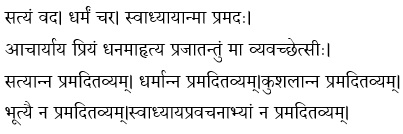
Satyam vad. Dharmam char. Swadhyanma pramad.
Acharyan priya dhanmatya prajatantu ma vavyachchhchaitsi.
Satyam pramaditvyam. Dharmam pramaditiyavyam. Kushlann pramaditvyam.
Britaye na pramamadityam. Swaadyay pravachannavyam na pramadityam.
– (Tettriya Upanishad, Shikshavalli, 11,1).
The Guru underscores satya (truth) and dharma (duty) as stabilizing forces. "Satyam vad", "Dharamam charah". Truthfulness is not merely accuracy of statement but alignment with the inner integrity that harmonizes individual will with cosmic order. Duty, similarly, is not blind obedience but a conscientious fulfillment of roles, that sustains community and self-discipline. The alignment of ethical principles with duty is remarkable which transcend the mundane traps. The Guru's counsel to his disciple to indulge in self-study is significant in this context for retrieval, renewal and remoulding ." Never stop learning" ," never get lethargic" in pursuit of learning , these words emphasise the quest for knowledge and learning, renewal of life as an eternal spirit. "Swadhyanma parmad" sounds as a lighthouse to a disciple who is going to embark on the journey of life. A journey which is filled with joy of learning with unending passion.
Tetttriya Upanishad teaches how to internalise these teachings and practice these in day to day life. While ritual continues to have a place, the Taitttriya Upanishad’s final counsel points to inward journey without seeking The ultimate teacher becomes the Self. The Guru’s role is to awaken the disciple to this inward teacher through instruction, example, and the catalytic force of question and silence. This pedagogy further reinforces transformation, awakening the disciple to a new life to know, to seek , to question and learn.
The Upanishadic Guru is less a deliverer of information and more a guide for transformation. The last lesson crystallizes this role. It is a pedagogy of paradox: the teacher instructs the student to go beyond all instruction. The teaching methods are varied — direct declarations (Shruti), analogies, ethical injunctions, and meticulously framed rituals that, when properly performed, lead to inner clarity. Silence also plays a role; at times the most profound teaching is the sober pause that invites the disciple to sit with an unanswerable question until insight arises. This induces intuitive and meditative knowledge based on critical thinking.
This approach contrasts with modern mass education’s emphasis on measurable outcomes in terms of grades and numbers. Where contemporary systems prioritize coverage and credentialing, the Taittiriya model seeks character and discernment. The last lesson therefore reads as a corrective: education should cultivate a capacity for wise action, self-knowledge, and service, not simply the possession of facts.
The Guru’s final counsel in the Upanishad carries social weight and spiritual upliftment. Instructions on hospitality, respect for elders, and generosity signal a vision of social life grounded in reciprocal care. The ethics of the text are practical: they apply to family life, civic relations, and religious practice alike. Instructing the disciple to honor guests and ancestors positions personal spiritual growth within an interdependent web of obligations and affections. The last lesson thereby resists the privatization of spirituality; it insists that realization be reflected in one’s duties and in one’s treatment of others.
Why should a contemporary reader care about the Taittiriya Upanishad’s Guru–Shishya samvada? First, its emphasis on the inner life remains crucial at a time when external stimuli and transactional relationships crowd out depth. The last lesson’s call to steady attention, ethical speech, and careful consumption of food and media is a powerful antidote to impulsive living.
Second, the model of pedagogy as formation rather than information transfer has practical relevance for educators, mentors, and leaders. The Upanishadic teacher cultivates discernment, models integrity, and invites students into responsibility. These are precisely the qualities modern institutions often seek but struggle to produce.
Third, the text’s insistence on relational ethics—care for guests, elders, and community—speaks to contemporary needs for social cohesion. In a world of fragmented ties, the final lesson’s stress on hospitality and mutual respect offers a blueprint for rebuilding trust.
One of the memorable exhortations reads like a compact final exam for life: honor your parents (pitra devo bhav, matri devo bhav) and teachers (Guru devo bhav), (Satyam vad), welcome guests (atithi devo bhav) as gods, and seek the inner teacher. This litany compresses ritual piety, social ethics, and metaphysical aspiration into actionable guidance. It asks the disciple not merely to know the right thing but to inhabit it, day by da Tettriya upanishad teaches wisdom; wisdom of living, and wisdom of art of living.Today, we have lost wisdom for knowledge and knowledge for information, the last lesson beckons us to understanding and pragmatism of knowledge.
The Taittiriya Upanishad’s Guru–Shishya samvada culminates in a last lesson that functions as both a moral compass and spiritual map. It joins ethical conduct with metaphysical insight, ritual with introspection, and social duty with personal realization. Far from being an obsolete relic, this final counsel speaks urgently to modern readers: the aim of learning is not credentialing but transformation, the measure of wealth is inner refinement, and the highest teacher is the Self that awakens when speech, action, and breath are aligned with truth. In an age of information overload, the last lesson of the Taittiriya Upanishad offers a serene, challenging invitation—to learn in order to become , and see the difference between being and becoming.
11-Jul-2026
More by : Prof. Chandra Shekhar Dubey
