Sep 15, 2026
Sep 15, 2026
Wanderer, Rajender Krishan, Setu Publications , Pittsburgh, 2021, pp276.
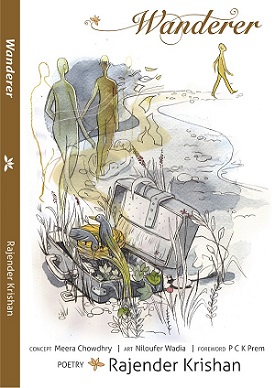 Rajender Krishan's "Wanderer" teased my memory to muse over two texts namely Tennyson's "Ulysses" and Rahul Sanskritayatan's "Gummakad Shastra". In both of these texts life is a journey, a tireless adventure that neither knows a pause nor is it an end in itself. It is a quest for knowledge, meaning and purpose of life.
In "Ulysses," the adventure and quest for knowledge are not just hobbies; they are the fundamental reasons for human existence.
Ulysses views living as a continuous act of moving forward, famously stating, "I cannot rest from travel." He is driven by a desire "To follow knowledge like a sinking star," pushing past the traditional boundaries of human thought and safety. Ulysses uses a powerful metaphor comparing a person to a metal tool: "How dull it is to pause, to make an end, / To rust unburnish'd, not to shine in use!" To Ulysses life is broader, and more meaningful. Rahul Sankrityayan presents travel as a source of knowledge, courage, and freedom, not just entertainment. Travel awakens curiosity and a love for learning. It helps a person gain both book knowledge and real-life experience. It makes the mind open, bold, and independent. Adventure teaches a traveler to face hardship without fear. This book shows that wandering can become a way of life and self-growth. My musings on these text leads me to Rajender Krishan's "Wanderer". Mandira Ghosh rightly describes the poet "The poet is indeed a wandering mystic". (Blurb of the book).
Rajender Krishan's "Wanderer" is a remarkable collection of reflective poems that chronicles the journey of a sensitive mind in search of meaning, identity, and spiritual fulfillment. In the preface to this book, the poet writes
"Wanderer covers poems that have their genesis in the same environment with the churning of fleeting thoughts and are an attempt to find answers to uncertainties and complex questions arising therefrom".
In a poem titled "Wanderer" Rajender Krishan evokes the feelings of tireless journey that resonates with Ulysses
"Times are uncertain
Life unpredictable
Yet, desires abound
Seeking fulfillment...
walk and wander with me
On the new voyage, instead
I pray, keep me blessed
to be true to myself".( p91).
 Rajender's journey cannot be seen insolation with the mundane world rather it evolves from it engaging a man with the process of learning. To quote him
"Life teaches
in her own
mysterious ways
No one is spared" (Learning, p.101).
The poet's journey is replete with the challenges of the world but he transforms this journey into his quest for learning and spirituality. His mystic vision leads the readers to see more subtle aspects of human existence. Playing between strings of consciousness and cognition he creates philosophical insights. The Wanderer is not lone journey man but a seeker, a knower and a learner.
 To quote from his poem "Fulfillment",
"The mystic-drowned
in his wandering self,
leaves marks of footsteps
as expression of fulfillment
On a known journey
with no beginning and end" (75).
Here the Wanderer doesn't seek materialistic fulfillment but spiritual fulfillment. It is a known journey that spells eternity. Simplicity of words, purity of feelings and emotions take the readers closer to Nanak, Kabir and Sufis weaving a magical world of spiritual tranquility.
Written during the unprecedented crisis of the Covid-19 pandemic, the collection captures not only the anxieties of a troubled world but also the enduring human quest for wisdom and inner peace. Through a series of meditative lyrics, Rajender transforms personal experiences into universal reflections, making "Wanderer" an engaging and thought-provoking contribution to contemporary Indian English poetry. The "Wanderer '' is not merely a traveler's diary through geographical spaces. Here the Wanderer is a seeker traversing the landscapes of memory, consciousness, and existence. These poems repeatedly return to themes of movement, exploration, and discovery. The act of wandering becomes a metaphor for life itself—a continuous process of questioning, learning, and evolving. Unlike the Romantic Wanderers who often seek solace in nature, Rajender's Wanderer journeys inward, exploring the depths of the self and attempting to reconcile the material and spiritual dimensions of existence. If you churn out the poems in this collection you get the nectar of wisdom and philosophical insights.
Rajender Rajender addresses a host of issues related to love, life, relationship and human emotions in this volume. Poems like "Stimulus", "Approach", "Accord", "Colleague" and "Cursory" underline the emotional and psychological dimensions of a Wanderer in alleys of life. "Wanderer" is an odyssey of a man through a series of trials and errors culminating in tranquility of mind and peace. The poet doesn't pause and ponder but keeps moving on picking up the jewels of wisdom stringed into his verses.
 In "Encounters", the poet feels
"lonely amidst crowd
listening sounds in solitude
Being abruptly halted
to experience, out of blue"(233).
There are a plethora of such meditative moments in this volume where thoughts mingle with emotions creating a pensive mood.
Dr. Jaipal Singh in his preview writes,
"The present anthology is comprised of precisely hundred poems reflecting various moods and attributes of the much enlightened and mature poet, who perhaps as Wanderer goes on to exploring philosophical concepts, spirituality and aspects of mundane life in some places as a mere observer and at others as a wise pedagogue."
Nature occupies a significant place in the collection. The poet often turns to natural imagery to illuminate abstract ideas and emotional states. The changing seasons, flowing rivers, birds, flowers, and landscapes become symbols of life's continuity and transformation. Nature functions not merely as a decorative backdrop but as a living presence that guides the poet toward wisdom and serenity. These images contribute to the lyrical beauty of the poems and reinforce their meditative character.
The language of the poet is simple and suited to the themes of the poems. The language of "Wanderer" is simple, lucid, and highly evocative. It combines poetic elegance with emotional depth, allowing readers to connect easily with the narrator's thoughts and experiences. The author's use of vivid imagery and expressive metaphors enriches the narrative and creates a reflective mood. Structurally, the poems are generally short and reflective. Their brevity contributes to their effectiveness, allowing individual insights to emerge with clarity and immediacy.
Many poems possess an aphoristic quality, resembling meditative reflections or philosophical observations. This compactness enhances the collection's accessibility and invites repeated reading. Each poem functions as a moment of pause, encouraging readers to contemplate its implications before moving on. style is simple and introspective, conveying themes of solitude, self-discovery, and the beauty of life's journey. Despite its simplicity, the language carries profound philosophical insights, making the work both engaging and thought-provoking. One can notice the Wordsworthian elegance and simplicity in his language that easily gets connected with the readers.
One of the remarkable features of this anthology is beautiful thematic illustration of each poem. The sketches, contours and symmetry of these illustrations lead the readers to the poem that follows. These further lend an aura of elegance and grace to the poems.
Rich in insight and accessible in expression, Wanderer stands as a testament to the enduring relevance of poetry as a medium for understanding oneself and the world. It is a collection that deserves the attention of both general readers and scholars of Indian English literature. I invite readers to take a walk to these poems, wading through its landscapes of thoughts, feelings, philosophical insights and ecstasy of feelings, you would be never the same person. The joy is yours.
Finally, I would sum up " Wanderer" in these words
"The splendor of beauty
Caged in the magic casement
Reminds us of unbidden memories
Sedimented in the oyster bed
Rushing in multiplied waves of currents
Rippling, rolling and beating about
Where our eyes cannot see."
I recommend this book to the readers of all age groups, to read explore, learn and muse.
All illustrations (c) Niloufer Wadia
01-Aug-2026
More by : Prof. Chandra Shekhar Dubey
Top | Book Reviews | Home