Oct 20, 2026
Oct 20, 2026
The Greatest Sweepstake by Hema Ravi, 2026
Annai Prints, Chennai - 600 017, ISBN: 978-93-5759-262-8.p.142.
I am excited to read The Greatest Sweepstake, a captivating collection by the brilliant author, poet and story writer, Hema Ravi. The collection comprises colorful images representing the central theme of every story. It would encourage readers, especially children, to enjoy reading these kinds of ‘Photo Stories’.
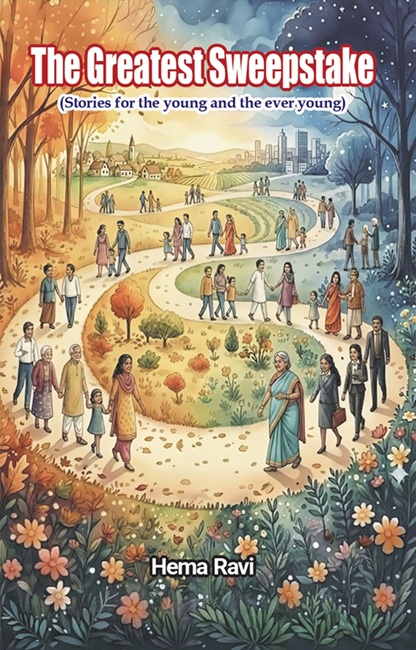
A total of 22 short stories of varying lengths) captivate the readers’ curiosity till the end.
She writes in her preface:
“This book is a collection of short stories and micro-tales that explore various facets of human experience. The stories cover a wide range of themes, from childhood wonder and fantasy to real-life issues such as injustice, identity struggles, and hardship. Varying in length, these narratives are rich in emotion and meaning. As you read, I hope you enjoy guessing which tales are based on real events and which are fictional and contemplate how storytelling can sometimes reveal truths …”
She is candid in sharing her experiences.
The collection embodies the scenarios of cross-cultural life, the beauty of joint family, village life, childhood memories and a wider spectrum of narrations. The unique aspect of the collection lies in its touring across wide geographical areas, being a vivid part of their history, cultural dimensions and family-centric tales.
With a voice of pragmatism, Hema reiterates,
‘History is not merely a set of facts about happenings of the past; there is most certainly a link that helps us to build emotional connections with the people who lived in those times.’
Stories like “The Beautiful One” are one of the examples that speak to the life sketches of the people in a remote Africa village.
Hema, with precision, qualifies the aspects of Indian identity and its many-faceted socio-consciousness. The collection embodies the thread of moral values and at times she explores philosophic traits subtly. The flow and lively narration, with lyrical infusion, keep the reader asking “what next.” That is the beauty of Hema’s creation: short, sweet, with a human touch.
In Hema’s storyline, women serve as the central character in different capacities. The story is reformative at times and infused with a motivational spirit. One of the striking stories “Epiphanic Moment,” narrates the balance maintained by Sonya, the pragmatic working woman, between job and family life with care and dedication. Hema pens, “One last word- the working woman runs a marathon day after day, but she finds time and self-gratification in whatever she does.”
Cross-cultural Issue:
Hema vividly reflects the emotional storm the immigrants feel in another country. People lead different lifestyles. New York, for example, is known as the city that never sleeps! There exists a cultural difference between the Western and the Oriental regions. There has been an emotional feeling of the country of origin. This is reflected in the story “Anugraha” (the name of the house that was built by Srinivas’s grandfather). On returning to India from the USA, Srinivas’s wife feels solace and remarks: “Anugraha has conferred monetary benefits, taught us that life is transient; and most importantly, has made us understand how incredible life is...”
Hema’s story parallels Jhumpa Lahiri's and Bharati Mukherjee’s works on cultural alienation of Indian immigrants and cultural displacement etc. She, as an immigrant to the USA, recalls her childhood memories of her place of origin, the Coromandel Coast of South India and the cultural dichotomy, psychological frictions etc she encounters. She recounts the Pallavas culture of South India: “I vividly recall one verse that I had penned eons ago in neat handwriting.”
Treasure forever to possess
Cherish memories with caress
First Sketchbook.
Touch of Indianness
The beauty of Hema’s collection is the way she brings to light the aesthetic values by instilling a sense of Indianness. She refers to Indian family culture, historical aspects, socio-religious functions etc. and uses words from regional languages in literature. The unified family life, cohesive culture, emotional affinity towards nature etc. are some of the hallmarks of Indian life style. The stories like “Bear Behind the Glass Door”, “Ramya Celebrates Golu...”, “The Girl Who Loved Flowers” embody family narration, Indian tradition, and mention of Amar Chitra Kathas in the story. In the family-oriented tale, “Pendulum,” she reiterates, “Success is not measured by accolades and recognitions from distant lands; staying rooted in tradition, culture, and customs brings a greater sense of fulfilment.”
References to Nobel laureate CV Raman and the Indian philosopher J. Krishnamurthi (JK) in “Bear Behind the Glass Door” are some of the added dimensions to her reverence for the Indian thoughts and spirit. She highlights the noble works of Gandhi, Kasturba, and poet Nizzim Ezekiel.
Enumerating the universal Indian culture of oneness she cites: “The reference of Indian culture …”And finally, understand the concept of “Vasudhaiva Kutumbakam.” The world is one family, regardless of “ethnicity, religion,” or “culture” in the story, “It’s One World, One Life...”
The village well acts as a central spot for family discussion amongst women, children’s education, weddings, joy etc. Indian culture and the vivid images of the rural landscape are portrayed in the story “The Well.” The story revolves around making the village a place of happiness with traditional South Indian customs, although it occasionally feels overloaded with many characters.
Interestingly, the collection is endowed with words like yoga, kolam, Mahamaham festival , brewed chai, Pujas, Ishta devata, hinnai (sipping filter coffee), Payasam, palak paneer, rotis, Paavadai-chattai ,ghagra-choli Sari, Kurta –pyjama, Thambulam ( Goodie bag with betel leaves), and respectful references of Appa (Father) and Amma (Mother).
Poetic Style and Tenor
“Bitter-Sweet” is an interesting story about Pinky, who worked as a ‘chocolate taster’ in a factory. A beautiful assimilation of poetry with prose in between reminds me of the influence of Prosimetrum writings. She experiments with an inventive way of combining prose with poetry in the short story.
In the character, Pinky distributes chocolates to children during sale time. After some time, the factory closed unexpectedly, and Pinky lost her job. Hema expresses agony:
bitter-sweet chocolates satisfying
to the palate
trials in life agonizing
to psyche and body
broken nest – bird begins with intensity
failed career – a sorrowful propensity
anything but sweet!
Later, Pinky gets a new job in a nearby school, and the story ends on a positive note for the readers to rejoice.
Hema is an embodiment of a brilliant writer and poet. Hema is a mainstream poet and also a writer of Japanese short form of poetry. Precisely so, the Photo-story, analogous to the haiga ( a combination of image and haiku) is an extension of it. She prefers to be simple in narration, gently keeping the dialogue with the readers. She enriches the story with poetic idioms creating soothing resonance.
She is very critical about war and conflict. In “Gossamer Threads...” Hema firmly expresses with poetic shade, “Little do these narcissistic rulers know that flowers will continue to bloom, and birds will begin to chirp...and they will go just as the way other arrogant rulers have gone, leaving behind “Wreck, boundless and bare” while the “lone and level sands stretch far away.”
Expressions like “a silent prayer escaped his lips”; “The large peepul tree nodded to the gentle wind as birds began to chirp gaily from the large trees overlooking the sunlit pond” (in the story “Anugraha”) etc add a poetic nostalgia to the stories.
Environmental Issues
Often Hema’s stories pivot educational flavor and importance. The one that stands out in prominence is her concern regarding climate change, wildfires etc. enumerated in “Whispering Park.” She is vocal in voicing: “The earth does not belong to man; man belongs to the earth.” She describes the beauty of banyan trees and poetically resounds: ‘Listen to the rustling leaves...Listen to the chirping birds.... Listen to the splashing waves. Listen... Listen... Listen to Nature’s Song...’ Painfully, she adds: “Trees are poems the earth writes upon the sky, we fell them down and turn them into paper, that we may record our emptiness.” In a micro poetry competition by children, she cites the winner’s entry:
banyan tree-
memories of grandma
stitching banyan leaves
The story of a bird lover, Glory, a chief librarian of a Govt. Library and the way she takes care of the geese has been nicely portrayed in the story “Geese Lover’s Tale.” This augments Hema’s concern and love for other creatures and their preservation with care.
Philosophical Attributes
Hema brings the essence of life and spiritual feelings, into her story. She conjures her inner urge through the family-centric landscape with delicacy. I believe the nostalgic approach depicted in the collection will resonate with readers for a long time. The journey of the widowed young, Kanika, in “Walks of Life” and her emotional exchanges with friends evoke profound emotions.
Recalling the days of joy, agony and resilience, association with her friends, Shanti and Mini, she feels: “The sun was rapidly descending to the horizon, and the golden hue around was mesmerizing, quietening all thoughts.
Is this the transcendental truth that ancient sages have revealed?”
Narrating a story of a Station master, Hema uses a mirror as a metaphor in the story “A Mirror Reflects” and infuses a subtle philosophical line: “We take what life offers!” With due importance to travelling and mingling with people of different cultures, she quotes “A journey of a thousand miles begins with a step” in the story “It’s One World, One Life...”
The collection is a literary souvenir for every family and Hema’s creation of ingenuity and intriguing elixir would add an exotic substance to every bookshelf.
05-Sep-2026
More by : Dr. Pravat Kumar Padhy
Top | Book Reviews | Home