Sep 19, 2026
Sep 19, 2026
The Nepal Flash Floods and the Fragile Balance of Life
When nature speaks in the language of floods, it does not whisper; it roars a reminder of who holds the ultimate power.
Nature rarely announces its anger in words. It speaks through changing seasons, receding glaciers, restless rivers, landslides, droughts and floods. Most of the time we fail to hear it. Sometimes, however, its message arrives with a force we cannot ignore.
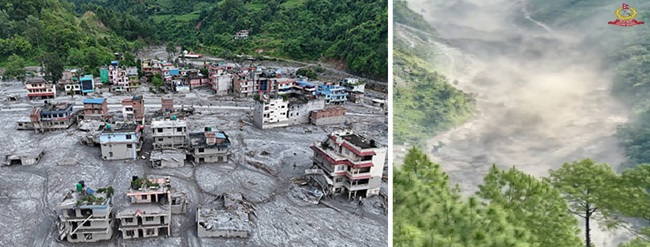
The catastrophic flash floods that struck Nepal on 26 August 2026 were one such message. Communities along the Bhote Koshi and Trishuli river corridors were devastated by a sudden surge of water, associated with an upstream ice avalanche and the temporary damming of the Lhende River. Yet this tragedy is more than a story of water overflowing its banks. It is the story of an ecological system under growing stress, and the human choices that have added to it. To understand it, we must begin where the water began: high in the mountains.
When the Himalayas Become Vulnerable
The Himalayas are often called the “Third Pole” because of their enormous stores of snow and ice. They regulate water systems that sustain millions of people across South Asia. Nepal lives more intimately with these mountains than almost any other nation; its rivers, agriculture, forests, tourism and communities are all bound to Himalayan ecology.
But the mountains are changing. Rising temperatures are destabilising glaciers, snowfields and frozen slopes, and scientists have repeatedly warned of the dangers of glacial instability, ice avalanches, glacial lake outburst floods and landslides.
The Nepal disaster shows how quickly a disturbance in the high mountains becomes a catastrophe downstream. A slope collapses. A river is suddenly blocked. Water accumulates behind the debris until the natural barrier gives way, and a torrent rushes down the valley. Within minutes, homes, roads, bridges and livelihoods can disappear. This is the frightening speed at which an ecological process turns into a humanitarian disaster.
Climate Change: The Invisible Background
It would be simplistic to blame every flood directly on climate change. Floods are part of natural hydrological cycles, and the Himalayas have always known landslides, avalanches and extreme rainfall. What the changing climate does is alter the conditions in which these natural events occur.
Warmer temperatures weaken glaciers and mountain permafrost. Shifting precipitation patterns raise the likelihood of intense rainfall and sudden runoff. The result is an increasingly unpredictable Himalayan environment, and recent scientific reporting has linked the region’s growing risks to warming, glacier instability and extreme weather.
The lesson, then, is not that nature has suddenly become dangerous. It is that humanity has changed the conditions under which nature operates. And climate is only one of those changes; what we do to the land itself matters just as much.
The Forest Is Nature’s Flood Barrier
Forests are among the most effective natural guardians of watersheds. A healthy forest intercepts rainfall, slows surface runoff, binds the soil, reduces erosion and regulates the flow of water into streams and rivers. When forests disappear, rainwater races across exposed slopes, carrying soil and debris with it.
Recent research on the transboundary Siwalik region of Nepal and India has found a strong relationship between forest loss and rising flood frequency, while stressing that flooding results from a complex interaction of rainfall, fragile geology, land-use change and river management. This is why environmental protection cannot be separated from disaster management. A tree planted today may well be a flood-prevention measure for tomorrow.
The Himalayan region understood this long before modern hydrology did. In the 1970s, the villagers of the Chipko movement embraced trees to save them from felling, and gave the world a principle that remains strikingly relevant:
“Ecology is permanent economy.”
— Sunderlal Bahuguna, Chipko movement
Development Must Not Become Ecological Destruction
This does not mean the mountains should be left untouched. Nepal needs development. Its people need roads, bridges, electricity, tourism facilities, housing and employment. But development in fragile mountains demands a different philosophy from development on the plains.
Roads cannot be built without understanding slope stability. Hydropower projects cannot ignore river ecology. Tourist infrastructure cannot disregard carrying capacity. Settlements cannot spread indiscriminately along vulnerable river corridors. The recent floods, which also damaged Nepal’s hydropower infrastructure, have raised hard questions about how resilient our investments in fragile valleys truly are.
The choice, therefore, is not between development and environment. The real question is whether development can work with nature rather than against it. Four centuries ago, Francis Bacon put it simply:
“Nature, to be commanded, must be obeyed.”
— Francis Bacon, Novum Organum (1620)
Where Science Meets Traditional Knowledge
Working with nature begins with understanding it, and here Nepal has two great resources. The first is traditional knowledge. Himalayan communities have long read the language of mountains, forests and rivers; their understanding of seasonal change, water channels, slopes and local ecosystems has been built over generations.
The second is modern science. Satellite monitoring, glacier observation, river sensors, weather forecasting and artificial intelligence can greatly strengthen early-warning systems. Neither resource is sufficient alone. Local communities offer ground-level insight that no satellite can fully replace, while technology can detect dangers that no villager can see from the valley floor.
Early warning matters because a disaster cannot always be prevented, but its human toll often can be reduced. The scientific community has already called for stronger monitoring and warning systems across the Himalayan region. Such systems, however, stop working at the edge of a map unless nations choose otherwise.
The Himalayas Do Not Recognise Political Borders
The Himalayas belong geographically to several nations, but ecologically they form a single interconnected system. Water carries no passport. Glaciers, rivers and polluted air do not stop at international frontiers. A disturbance in the mountains can ultimately affect Nepal, India, Bhutan, Bangladesh, China and communities far downstream.
Protecting the Himalayas therefore requires cooperation in data sharing, glacier monitoring, flood forecasting, river management and disaster preparedness. Isolated national policies cannot safeguard a shared mountain system. And cooperation raises a further question: who should bear the cost?
Climate Justice: Those Who Contribute Least Often Suffer Most
Nepal’s tragedy is also a question of climate justice. Countries and communities that have contributed relatively little to global greenhouse-gas emissions are often among those facing the harshest consequences. Recent reporting has highlighted how small Nepal’s share of global emissions is compared with the scale of the climate risks it faces.
This places a moral responsibility on the international community. Climate action cannot mean merely asking vulnerable nations to adapt. It must also mean providing technology, finance, scientific cooperation and support for disaster resilience. Mahatma Gandhi’s often-quoted observation captures the imbalance at the heart of the crisis:
“The Earth provides enough to satisfy every man’s needs, but not every man’s greed.”
— Mahatma Gandhi
Learning to Live with Nature
The Nepal floods should not leave us with only photographs of destruction. They should leave us with questions. Are we building too close to rivers? Are we cutting into mountain slopes without adequate scientific assessment? Are our forests sufficiently protected? Are our infrastructure projects climate-resilient? Do vulnerable communities receive warnings in time? Are we listening to indigenous and local ecological knowledge?
Beneath all of these lies a deeper question: have we forgotten that human beings are a part of nature, not its masters?
Indian and Himalayan traditions never forgot it. Rivers have been worshipped as mothers, mountains revered as abodes of the divine and forests treated as living communities. More than three thousand years ago, the Bhumi Sukta of the Atharva Veda declared:
“Mata bhumih putro aham prthivyah
The Earth is my mother, and I am her child.”
— Atharva Veda, 12.1.12
Modern civilisation has gained extraordinary technological power. What it must now rediscover is ecological humility.
Conclusion: Restoring the Balance
The answer to the Nepal tragedy is not to fear the mountains, but to respect them. Every thread of this story, from melting ice and vanishing forests to careless construction, fragmented cooperation and unequal responsibility, leads to the same conclusion: the floods were a natural event made more destructive by human choices. That is sobering, but it is also hopeful, because choices can be changed.
The path forward is clear. It calls for climate-resilient infrastructure and land-use planning that respects slopes and rivers; scientific monitoring of glaciers backed by early-warning systems that reach the last village; forest protection and responsible tourism; hydropower designed around river ecology; and transboundary cooperation supported by fair climate finance from those who have contributed most to the problem.
Policies alone, however, will not be enough. What is needed above all is a change in consciousness, a shift from seeing nature as a resource to be conquered to seeing it as a community to which we belong. The conservationist Aldo Leopold offered a test for every decision we make:
“A thing is right when it tends to preserve the integrity, stability, and beauty of the biotic community. It is wrong when it tends otherwise.”
— Aldo Leopold, A Sand County Almanac (1949)
Nature does not need humanity to survive; humanity needs nature. The families who lost their homes along the Bhote Koshi and Trishuli deserve more than sympathy. They deserve a region that learns from their loss and rebuilds with wisdom.
Nature rarely speaks in words, but in Nepal it has spoken clearly. The mountains are warning us, the rivers are reminding us, and the forests are calling us. The measure of our civilisation will be whether we finally choose to listen and to act, before the next warning arrives. Hence, it concludes that “When mountains weep and rivers rage, Nature is not seeking vengeance—she is simply restating her laws to a world that forgot how to listen."
19-Sep-2026
More by : Prof. Dr. Mahammad Ghouse Shaik
Top | Environment | Home
