Oct 03, 2026
Oct 03, 2026
S. R. Dongerkery’s poem “To the Trimurti” explores the Hindu concept of the divine trinity—Brahma, Vishnu, and Maheshwara—artistically carved into rock. Each deity is inseparable from the others: Brahma cannot be imagined without Vishnu and Maheshwara, and all three are interconnected. They are not separate figures but three aspects of one divine entity.
The word, ‘Trimurti’ is of special charm for us, meaning ‘tin murtis’, three idols, faces of the Divine.
How to feel the entity closing the eyes! It is really pleasure-giving to think about the Trimurti and what can be it more endowing than to receive the blessings collectively?
What an amazing performance! What an amazing accomplishment in art as a mural, an engraving, an inscription! Brahma Vishnu Maheshwara, how the three form as one entity, one emblem!
When we read the poem, we appear to be moving under the shadow of the Trinity, Brahma Vishnu Maheshwara, the Trimurti art overlooking us.
How was the hand which engraved it, chiselled it, inscribed upon? The engraving is as such it belies it withstood everything, the wind, the rain, and the scorching sun. Such is the engraving that it surpasses the statues in the temples so meaningfully in this land of gods and heroes, stone art, and artefact.
Brahma is the Creator who created it all. Vishnu the Preserver who keeps preserving, overseeing, and maintaining. And Maheshwara is the Destroyer who destroys for new and fresh creation, which is but our process of cyclic life.
How beautiful is it to talk of Brahma Vishnu Maheshwara! What is the story behind? How to understand it?
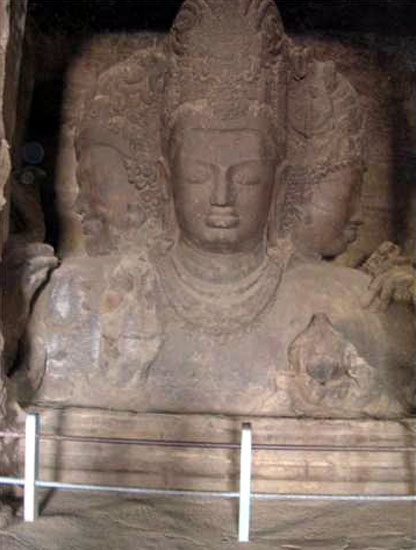
To the Trimurti
Great Trimurti! embedded in the rocks,
Symbolic of creation, three in one,
Whose ageless form in sheltered silence mocks
The waves, the wind, the rain, the scorching sun;
What daring heart conceived thee and what hand
Designed thee in thy formless form divine.
Unequalled elsewhere in this hallowed land
Of sculptured gods enthroned in many a shrine?
As men upon thy threefold aspect gaze,
Creator first, Preserver next and last
Destroyer, each an ever-changing phase
Of evolution’s circle wheeling fast,
In peace eternal wilt thou kindly smile
Upon their sorrows from thy wave-lashed isle.
While we talk of Nataraja, an emblem of Nataraja Shiva dances before the eyes, an art symbol of Nataraja Shiva reflecting upon the inner mind with an artistic posture and imagery of own. The poet tries to explain the pose of Shiva, and its significance! How does the word Nataraj impact! How were the artisans who make the statues of Shiva as Nataraja? How were the painters who draw the images and sketching as Nataraja shiva?
O God of Dance, how the symbol of Yours! O You Cosmic and Creative Force! We the men do not know how the recesses of Yours. It is You who sustain the universe. It is You whose rhythm and movement are in it and without which the things cannot keep going.
The legs held tell of Your thoughts and ideas, the rhythm and thud of music and the movement and gait of the world.
Without going deep into, taking into consideration South Indian replicas and art motifs, how to explain the ring, we mean the circle and the demon lying under? How to hold aloft from selfhood and greed? How to keep it going? The wheel of time keeps it rotating.
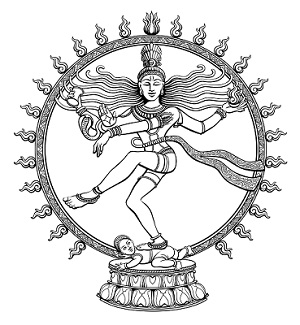
Nataraja
O god of dance, true symbol Thou
Of cosmic and creative force!
We, puny men, still know not how,
Or where, to trace thy hidden source.
The universe by thee sustained
With rhythmic motion of thy dance,
By laws harmoniously enchained,
Could not have sprung from whim or chance.
Is thy right foot pressed down to curb
The ugly thoughts that crowd the mind,
And does thy left, in pose superb,
The dancer’s pleasure seek to find?
Natarja image (c) istock.com
03-Oct-2026
More by : Bijay Kant Dubey
Top | Literary Shelf | Home