Oct 10, 2026
Oct 10, 2026
and the Unfinished Quest for Liberation
Decades after the establishment of democracy, one question refuses to disappear from Indian society: Whose life is considered valuable? Whose voice is heard by power? Whose existence still has to struggle for recognition? The Constitution promised equality, the law prohibited discrimination, and universal suffrage gave every citizen a formal political voice. Yet beneath these constitutional guarantees, older structures of power continue to shape social life through caste, property, land, wealth, status, institutional access and political influence. Power may have changed its language, its institutions and even its appearance. But has domination fundamentally changed?
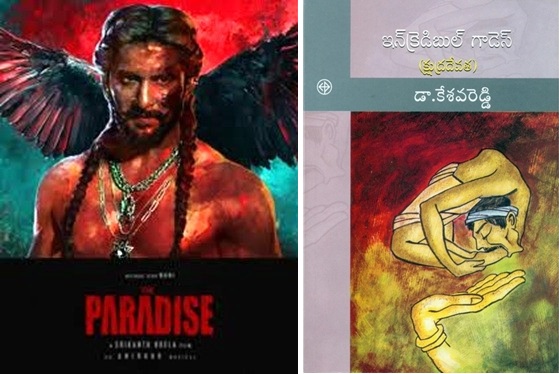
This is the deeper question through which the contemporary Telugu film The Paradise can be read alongside Keshava Reddy's Incredible Gods. The two works belong to different artistic worlds: one to literature and the other to cinema. Yet both can be approached as inquiries into the relationship between human beings and the structures that dominate them. In Keshava Reddy, the idea of the “god” can be read not simply as a religious figure but as a metaphor for an authority that human beings themselves construct and subsequently begin to obey. In The Paradise, the oppressed are not merely presented as passive victims of history. Their struggle for recognition, dignity and collective existence gradually becomes a struggle over power itself.
The connection between the two should not be understood as a claim of direct literary influence. Rather, they provide two different artistic languages for examining a common philosophical problem: How does domination become legitimate in the minds of both the ruler and the ruled?
That question takes us immediately beyond the simple distinction between oppressor and oppressed.
When Domination Becomes “Natural”
Oppression is easiest to understand when it appears as open violence. A powerful person beats a powerless person; a landlord controls a labourer; a ruling authority suppresses dissent. But modern power is often more complicated. It does not always need to announce itself as oppression. It can operate through custom, law, social status, economic dependence, institutional procedures and ideas about what is “normal.”
This is where the philosophical significance of Keshava Reddy's “kshudra devata” becomes particularly important. A social order can become so deeply embedded in collective consciousness that people cease to experience it as an external force. They begin to regard it as destiny, tradition, morality or even divine order.
The most powerful form of domination, therefore, may not be the command that says, “You must obey me.” It is the social structure that persuades the individual that obedience is simply the way the world is.
Karl Marx provides one route into this problem. For Marx, material conditions are central to understanding social power. Ownership of land, control over production and access to economic resources create relationships of dependence. Those who control the material foundations of society acquire power over those whose labour sustains that society. Economic domination can consequently become social and political domination.
But Marx also makes us ask a deeper question: why do social relations created by human beings appear to possess an existence independent of human beings? Once institutions, property relations and economic hierarchies become established, they can appear almost natural. Human beings create the structure, but eventually the structure confronts them as an external necessity.
This is one possible philosophical bridge between Marx and the metaphor of the “god.” The god is powerful because human beings have collectively given power to something they themselves created.
Ambedkar: Caste as a Structure of Social Power
Yet an Indian reading of domination cannot stop with class and economics. This is where B. R. Ambedkar becomes indispensable.
Ambedkar's analysis of caste exposes a form of hierarchy that cannot be reduced to economic exploitation alone. Caste is a system of graded inequality in which social status is attached to birth. It regulates not merely economic opportunity but social interaction, dignity, marriage, occupation, public space and recognition.
The crucial point is that caste survives not simply because some people exercise power over others, but because hierarchical distinctions can become embedded in social consciousness. The individual learns where he or she supposedly belongs. Society teaches people whom to respect, whom to avoid, whom to command and whom to serve.
This gives the question of internalized domination a distinctly Ambedkarite dimension.
Political equality on paper does not automatically produce social equality in everyday life. A person may possess the formal rights of citizenship and yet encounter social structures that constantly remind him of an inherited position.
This is why The Paradise can be read as a story about more than physical survival. The struggle for recognition is also a struggle against the condition of being socially invisible. To be recognized is to assert: I exist not merely as labour, a body, a caste location or an administrative category, but as a human being possessing dignity and political agency.
For Ambedkar, democracy cannot be reduced to elections and institutions. It also requires a social relationship among human beings based on liberty, equality and fraternity. Without social democracy, political democracy remains vulnerable to the persistence of hierarchy.
Foucault: Power Beyond the Palace
Michel Foucault takes the question in another direction.
Foucault's central contribution is to make us look beyond the conventional image of power. Power is not located exclusively in the hands of a king, government or ruling class. It circulates through institutions, knowledge systems, classifications, surveillance, discipline and everyday relationships.
This perspective is particularly useful for understanding modern state power.
The state does not exercise power only through police or physical coercion. It also identifies, records, classifies, regulates and makes populations visible to institutions. The citizen becomes legible through documents, categories, databases, schools, hospitals, courts, welfare systems and administrative records.
To be recognized by the state can therefore become a political question.
Who has documents? Who possesses land records? Who has citizenship papers? Who is counted? Who is excluded from a list? Who is considered legitimate? Who becomes visible to the state and who remains administratively invisible?
These questions reveal a dimension of power that is less dramatic than violence but potentially just as consequential.
Foucault's concept of disciplinary power deepens the argument further. A society does not always need someone standing over an individual with a weapon. If people internalize the rules of surveillance and discipline, they begin to regulate themselves.
The prison, school, factory, hospital and bureaucracy can therefore become spaces where power operates through observation, classification and normalisation.
This is where the “god” metaphor becomes philosophically provocative. The modern “god” need not be supernatural. It may be an institution, a social norm, a bureaucratic category, a caste hierarchy or an economic order that people obey because they believe there is no alternative.
Gramsci: When the Oppressed Consent
Antonio Gramsci introduces another important dimension: hegemony.
Why do unequal societies not constantly collapse into rebellion?
One answer is that domination is maintained not only through coercion but also through consent. The dominant order presents its own values as common sense. Its assumptions become so ordinary that questioning them appears unreasonable.
This is particularly important in understanding caste and class societies. A hierarchy becomes more stable when people do not experience it as hierarchy but as tradition, merit, culture, social order or necessity.
The oppressed may therefore participate, consciously or unconsciously, in reproducing the very structure that disadvantages them.
That is why liberation cannot be merely a change of rulers. If the old consciousness remains intact, the structure can reproduce itself under a new leadership.
Fanon: From Humiliation to Revolt
Frantz Fanon brings the psychological and existential dimension of oppression into the discussion.
Colonial and racial domination, in Fanon's analysis, does not merely control territory and labour. It attacks the dignity and self-perception of the oppressed. Prolonged humiliation can produce anger, alienation and a desire to recover agency.
This does not mean that violence is automatically liberating or politically desirable. Fanon's importance lies in showing how systematic dehumanization can create conditions in which resistance becomes psychologically and politically unavoidable for those experiencing it.
In The Paradise, rebellion can therefore be read as a transformation of consciousness: the person who was expected to remain an object of power begins to imagine himself as its subject.
The movement is crucial:
victim → consciousness → resistance → collective identity → leadership.
But there is a philosophical danger here as well.
When the Victim Becomes the New Authority
Every revolution faces a fundamental question: Does liberation mean replacing one ruler with another, or transforming the structure that makes rulers and subjects possible?
This is where the symbolism of the “god” becomes particularly significant.
If an oppressed community defeats an old authority but subsequently creates a new hierarchy in which some become powerful and others become subordinate, then domination has not disappeared. It has merely changed hands.
Marx helps us ask whether material relations have changed. Ambedkar asks whether caste hierarchy and social inequality have been dismantled. Foucault asks whether new forms of surveillance and discipline have emerged. Gramsci asks whether the old common sense has been replaced by a genuinely emancipatory consciousness. Fanon asks what happens to the human being after a long experience of humiliation.
Taken together, these questions prevent us from reducing liberation to the spectacular moment of rebellion.
The Political Meaning of The Paradise
Seen through these philosophical lenses, The Paradise becomes more than a story of an oppressed community confronting an established power structure. It becomes a meditation on citizenship, dignity, identity, social hierarchy and political agency.
Its deeper political question is not merely: Who controls power?
It is: What makes one human being believe that another human being has the right to control his existence?
And beyond that: What happens when the person who has been taught to obey discovers that obedience is not destiny?
This is where cinema and literature become politically significant. They do not merely tell us what oppression looks like. At their most powerful, they force us to examine the invisible structures through which oppression becomes ordinary.
The contemporary relevance of this question is difficult to ignore. Inequality today may not always present itself in the vocabulary of traditional hierarchy. It may appear through access to land, employment, education, housing, documentation, technology, institutions, political networks or the unequal ability to make one's voice heard. The language changes. The underlying question remains: Who possesses the power to define reality for everyone else?
The answer cannot simply be “the government,” “the rich,” “the upper caste,” or “the ruling class.” Modern power is more dispersed and complicated. State institutions, economic structures, social customs, cultural narratives and public opinion can reinforce one another. This is precisely why Foucault, Ambedkar, Marx, Gramsci and Fanon remain useful when read together, despite the significant differences among their theories.
Liberation Beyond the Transfer of Power
The most profound lesson emerging from this philosophical journey is that liberation cannot be reduced to the transfer of power from one group to another.
A society is not emancipated merely because yesterday's ruler has been defeated. It is emancipated when the conditions that produce permanent rulers and permanent subjects begin to disappear.
That requires economic transformation, but it also requires social equality. It requires political rights, but also meaningful recognition. It requires institutional reform, but also a transformation of social consciousness. It requires resistance to external domination, but also an examination of the forms of domination that individuals have internalized.
Perhaps this is the deepest connection between the “kshudra devata” and The Paradise.
The “god” is not necessarily something that exists above human beings. Sometimes it is something humans have created and then surrendered themselves to: caste, property, authority, tradition, status, fear, bureaucracy, ideology or the belief that hierarchy is inevitable.
The ultimate question, therefore, is not simply whether the oppressed can destroy the old god.
It is whether they can build a social order in which no human being needs to become a god in order for another human being to become free.
That is the philosophical challenge at the heart of the journey from Incredible Gods to The Paradise: not merely to change the occupants of power, but to question the very architecture of domination.
And perhaps genuine freedom begins at precisely that moment—when human beings stop treating the structures they themselves have created as eternal, sacred and unchangeable, and begin to recognize that what history has constructed, history can also transform.
10-Oct-2026
More by : Ch. V. Prabhakar Rao