Oct 17, 2026
Oct 17, 2026
by B.S. Ramulu
A Sovereign Welfare Model for Rural Empowerment, Migration Mitigation, and the KG-to-PG Socio-Educational Paradigm in Telangana
Abstract
This paper outlines a transformative structural framework for comprehensive socio-economic development, built upon three decades of field-level research and high-level policy design in Telangana. Centralized economic planning has inherently fueled intense wealth inequality and drove continuous rural distress migration. To reverse this structural failure, this study introduces an integrated model driven by a seven-point objective matrix: radical economic decentralization, structured migration mitigation, total liquor prohibition, household living standard elevation, scientific thrift budgeting, state-guaranteed free healthcare, and universal residential KG-to-PG education.
By analyzing Telangana’s annual fiscal budget (Rs.2.75 Lakh Crore) against the massive public expenditure on liquor (Rs.1.1 Lakh Crore), this paper exposes a critical 40% equivalent structural drain of aggregate public wealth. While the state has successfully deployed over 1,000 elite Residential Schools sheltering 5.5 lakh underprivileged students alongside the double-bedroom public housing grid, the absence of prohibition remains a critical missing link.
This paper mathematically demonstrates that scaling the residential framework to absorb 20 lakh students and legally anchoring universities within dedicated, non-divertible BC, SC, ST, and Minority budget sub-plans will fully realize the universal KG-to-PG dream. Furthermore, the fiscal deficit from prohibition is proven to be systematically self-recovering, with 80% returned via enhanced multi-tier GST collections driven by redirected household purchasing power.
1. Introduction and Philosophical Foundation: The Theoretical Framework of Ramulism
Traditional macroeconomic models firmly dictate that household living standards and intergenerational social mobility are strictly proportional to nominal cash inflows. This structural dogmatism completely ignores internal leakages within working-class groups and the crushing financial burdens imposed by the privatization of essential public goods.
To challenge this, this paper introduces—a subaltern philosophical framework that synthesizes Marxist materialist analysis, Ambedkarite institutional equity, and Buddhist evolutionary principles. [1]
The Critique of Marxist Teleology and the Evolutionary Sublation Grid
A core limitation of classical Marxist dialectics lies in its reductionist adoption of Hegelian negation while discarding the crucial dual process of sublation (Aufhebung). Marxist historical materialism often presumes a violent, cataclysmic leap to resolve class contradictions. In contrast, bahujanism posits that nature, human societies, and economic structures operate on an evolutionary, continuous timeline. Class and caste contradictions cannot be resolved by raw negation alone; they demand structural sublation—where the historical skills, labor rights, and cultural spaces of subaltern communities are preserved, elevated, and legally synthesized into state structures.
Under bahujanism, caste is recognized not merely as a superstructural feature of consciousness, but as a rigid relation of production that enforces a strict division of labor and a division of laborers. Social transformation, therefore, requires a tri-centric structural engine: [1]
Domestic Co-Responsibility: Shifting from patriarchal single-earner dominance to dual-income egalitarian production.
De-Commodification of Critical Human Capital: Removing the elements of physical and intellectual survival (healthcare and education) entirely from the marketplace.
Socio-Political Discipline: Enforcing state prohibition to instantly transform destructive consumption into active consumer purchasing power.
2. Rural Mechanization and the Dual-Crisis of Labor Displacement
The unmonitored adoption of farm mechanization, corporate-scale logistics, and industrial mass production has dismantled traditional agrarian occupations and village-level artisan industries without building alternative local labor markets.
The Disguised Unemployment Index: Empirical field data gathered across Telangana reveals that out of every 1,000 rural residents, approximately 450 individuals suffer from chronic disguised unemployment or complete loss of traditional ancestral livelihoods due to automated shifts.
The Gulf Migration Dynamic: This local wage vacuum creates an intense domestic distress loop, forcing nearly 3.5 million workers from Telangana to migrate to the Gulf region. These workers endure volatile geopolitical environments to send back basic survival remittances.
Inter-State Wage Depressive Loops: Compounding this issue, an incoming wave of low-wage migrant labor from Bihar, Odisha, Madhya Pradesh, and Chhattisgarh is absorbed by local contractors to keep rural construction and agricultural wages artificially low. This process displaces local youth, forcing them into further circles of urban migration.
3. The Telangana Fiscal Paradox: Alcohol Drainage vs. The GST Correction Theory
A severe macroeconomic contradiction exists when a state seeks long-term growth while actively depending on the financial destruction of its own working-class populations through commercial excise systems.
The Macro-Scale of Wealth Leakage
Evaluating the current macro-fiscal data of Telangana reveals a profound structural imbalance:
Total Annual State Fiscal Budget Boundary: Rs. 2,75,000 Crore (Rs. 2.75 Lakh Crores) [2]
Total Public Capital Expended on Alcohol Consumption: Rs. 1,10,000 Crore (Rs. 1.1 Lakh Crores) [2]
This proves that the capital burned by the public on commercial liquor constitutes an amount equivalent to a massive 40% of the state's total public budget. This represents a devastating internal leak of aggregate public wealth away from nutritional investments, child development, and local savings.
The social externalities of this drain are catastrophic: an explosion in domestic violence and gender-based physical trauma, intense workplace negligence, chronic absenteeism that weakens the grassroots economy, and elevated public health crises. Furthermore, fatal road accidents put an immense burden on the state's emergency medical systems and flood law enforcement with avoidable police cases.
The GST Fiscal Re-balancing Mechanism
Conservative bureaucratic setups frequently claim that prohibiting alcohol will collapse the state treasury. This paper totally refutes that claim through the Indirect Tax Multiplier Cycle:
4. Socio-Economic Household Budgeting & 360° Equilibrium Model
At the family level, true financial security and dignity are achieved by applying a scientific 360-degree capital distribution formula, contrasting a working-class couple's potential against typical middle-class realities.
Structural Publication Graphics & 360° Models
(Note for Journal Editors: The following text diagrams represent the exact mapping for infographic insertions. They are clean of any hyperlinks and structured directly for publication layout conversion).
Graphic 1: The Macroeconomic Impact & Revenue Recovery Cycle (Flow Diagram)
[Total Liquor Prohibition Enforced]
|
(Retains Rs.1.1 Lakh Crore Capital inside Family Bank Accounts)
[Direct Diversion into Consumer Retail Market]
|
(Increased Velocity of Spending on Groceries, Apparel, & Housing)
[Multi-Tier GST Collection Slabs (5%, 12%, 18%, 28% Fractions)]
|
[Systemic Recovery of 80% of Lost Excise Revenue back to State Treasury]
Graphic 2: 360° Couples & Family Budget Equilibrium Model (Pie-Chart Matrix)
An optimal monthly allocation grid for a dual-earner working-class household (Base: Rs.25,000/-) to achieve middle-class parity:
A cornerstone of Ramulism is its radical departure from upper-class, elite patriarchal frameworks of domestic management through a distinct Bahujan Feminist Lens. Elite feminist theories frequently isolate gender oppression from the relations of production, focusing primarily on glass ceilings within corporate structures. [3]
Conversely, Bahujan Feminism repositions domestic uncompensated labor as a primary site of economic extraction and demands its formal structural equalization. [3, 4]
Graphic 3: Dual Spheres of Marital Life (Tri-Sector Role Division Framework)
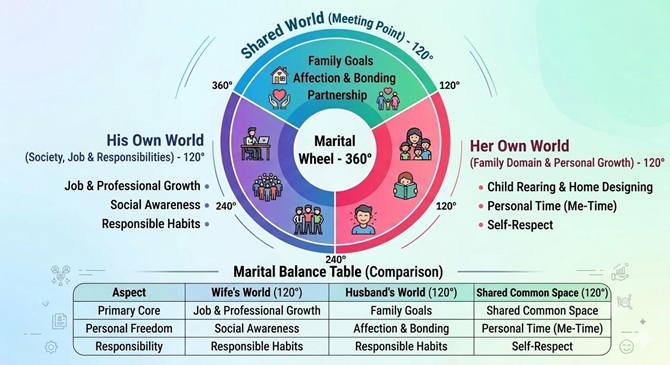
To operationalize this gender equity, the household structure must balance across three interconnected, equal 120-degree spheres:
By allocating an absolute 120 degrees to the wife’s autonomous personal and career development, the model deconstructs the traditional patriarchal grid. It asserts that the wife is not a subservient economic unit tasked with uncompensated domestic upkeep, but an equal producer and decision-maker within the sovereign micro-economy of the household.
6. The Universal Equalization Platform: Welfare Impact Matrix
When the state successfully executes a strict policy of de-commodifying human capital survival lines, the household budget ledger stabilizes completely, as illustrated below:
| Resource Parameter | Working-Class Couple (Rs.25,000 Income + State Welfare) | Government Employee Family (Rs.40,000 Income) | Structural Equalization Dynamics |
| Primary Income Base | Rs. 25,000/- (Egalitarian Dual Earners) | Rs. 40,000/- (Single Source Dependency) |
Balanced distribution of labor vs. volatile single-source strain. |
| Education & Health Cost | Rs. 0/- (Fully State-Funded Welfare) |
Rs. 6,000/- (Commercial Out-of-Pocket) |
Universal public provision removes the Rs.3,750 burden, fully matching the middle-class cash advantage. |
| Alcohol Spending Leak | Rs. 0/- (Secured via State Prohibition) |
Variable Discretionary Leakage | Prohibition prevents household income degradation. |
| Generational Growth Index | Absolute Middle-Class Parity |
Standard Middle-Class Parity |
Identical developmental platforms for children. |
7. The Ultimate Destiny: The KG-to-PG Residential Revolution
Telangana has laid a historic foundation by operationalizing over 1,000 elite State Residential Schools (Gurukulams), currently providing high-quality education and housing to 5.5 lakh marginalized students. Combined with the Double-Bedroom Public Housing Grid, the state has built the physical foundation for social equality. However, to fully realize this 35-year vision, this framework must scale up to absorb 20 lakh poor students. This expansion will ensure that no child from a backward or marginalized community is left at the mercy of commercial private education markets. [5]
A Concrete Policy Roadmap for Institutional University Sub-Plans
The KG-to-PG continuum frequently breaks down at the higher education stage due to the privatization, ad-hoc funding, and institutional neglect of public universities. To permanently bridge this gap, this paper outlines a concrete legislative roadmap:
[Legislative Mandate via State Assembly]
|
[Amending the State Higher Education Council (TSCHE) Framework]
|
[Creation of Legally Guarded Autonomous University Accounts]
|
[Direct, Non-Divertible Funding from BC, SC, ST, & Minority Budget Sub-Plans]
|
[Absolute Zero-Cost Advanced Research & Post-Graduate Professional Ecosystem]
8. Conclusion and Policy Recommendations
References
17-Oct-2026
More by : B.S. Ramulu
