Oct 24, 2026
Oct 24, 2026
by B.S. Ramulu
A Historical Materialist Analysis of Socio-Economic and Philosophical Trajectories from the Indus Valley Civilization to the Vijayanagara Empire
 Abstract
This paper challenges the conventional, idealist historiography that attributes the origins of Indian classical music (Saptaswaras) and foundational epics (The Ramayana and The Mahabharata) to divine revelation or isolated Vedic mysticism. Utilizing a historical materialist framework, this study argues that musical structure, linguistic grammar, and literary corpuses are organic superstructures arising from human collective labor, social production, and the evolving economic base of ancient and medieval India.
By tracing archaeological evidence from the Indus Valley Civilization through the socio-economic transitions of the Magadhan urbanization, and the imperial aggregations of the Satavahana, Gupta, Chalukya, Kakatiya, and Vijayanagara eras, this paper demonstrates how material surplus, class contradictions, and state patronage historically institutionalized folk and tribal oral traditions into codified classical systems.
1. Introduction
In traditional cultural discourses, the evolution of Indian classical arts has long been dominated by metaphysical frameworks. The Saptaswaras (the seven foundational musical notes) are frequently attributed to divine inspiration or the unmediated liturgical chanting of the Samaveda. However, historical materialism demonstrates that cultural superstructures—including language, grammar, and musical scales—do not emerge in a socio-economic vacuum. They are deeply rooted in the physical struggles of human societies against nature, collective labor processes, and changing modes of production.
This paper delineates the institutionalization of the Saptaswaras and the epic traditions, illustrating that their transformation from amorphous oral ballads into structured, codified canons was impossible before specific historical epochs defined by material surplus and political centralization.
2. The Archetypal Acoustic Foundation: Material Evidence from the Indus Valley Civilization (c. 2500–1900 BCE)
The materialist trajectory of Indian music finds its earliest empirical validation in the urban remains of the Indus Valley Civilization. The archaeological strata of Harappa and Mohenjo-daro reveal that acoustic and performative traditions emerged alongside the development of a bronze-age mercantile economy:
3. Nature Mimicry and the Materiality of Tribal Folk Chants
Following the decline of the Indus urban centers, the foundational matrix of Indian music shifted back to the oral traditions of nomadic and forest-dwelling indigenous tribes (Adivasis). The nominal nomenclature of the Saptaswaras (Sa, Re, Ga, Ma, Pa, Dha, Ni) structurally mirrors the acute material engagement of these communities with their natural environment. The Natya Shastra itself implicitly acknowledges this eco-materialist genesis by noting that the notes simulate the sounds of animals and birds:
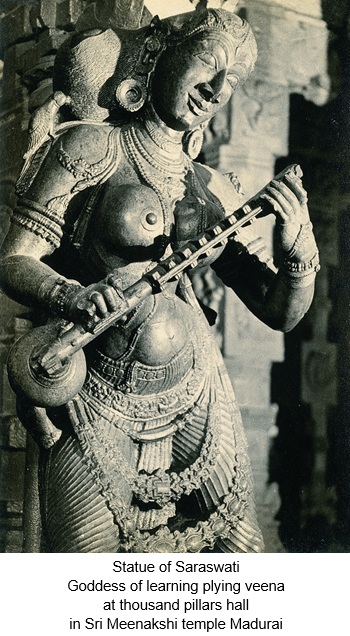
Furthermore, stringed instrumentation evolved directly from tool production; the taut bowstring used in hunting gave birth to early chordophones like the Kinnera and the Veena, while the hollow bamboo stalks through which wind whistled inspired the flute. Classical ragas like Sabari, Chenchu Kambhoji, Gurjari, and Todi bear the ethno-geographical names of the indigenous communities (such as the Chenchus and Sabaras) whose organic folk tunes were later annexed, refined, and institutionalized by dominant social classes.
4. The Magadhan Empire and the Second Urbanization: The Material Base of Codification (c. 6th–4th Century BCE)
The transition of raw acoustic sounds into a rigorous, mathematical system (Musical Notation and Fixed Scales) required a distinct socio-economic catalyst. The early pastoral Vedic society, characterized by subsistence farming and frequent migration, lacked the material surplus necessary to support a class of full-time, non-producing intellectual elites who could calculate the 22 Shrutis (microtones) or establish stable tonal intervals.
This structural transformation occurred during the Second Urbanization under the hegemony of the Magadhan Empire. The widespread adoption of iron technology and the iron plowshare yielded a monumental agricultural surplus in the fertile Indo-Gangetic plains. This economic surplus funded the rise of large urban metropolises like Rajagriha, Pataliputra, and Varanasi.
For the first time, society could sustain a dedicated intelligentsia. The democratization of expression brought by Buddhism and the collective acoustic synchronization practiced within Buddhist monastic structures (Monastic Chanting) demanded structural uniformity in sound. Just as the centralization of state administration and pan-regional trade under Magadha necessitated Panini's codification of grammar via the Ashtadhyayi, it similarly fostered the systematic codification of musical scales. Consequently, the institutionalization of the Saptaswaras as a formal science was chimerical prior to the Magadhan urban economy.
5. The Satavahana and Gupta Epochs: The Textual Stratification of Epics
The historical materialist timeline demonstrates that the national epics—The Ramayana and The Mahabharata—could not have achieved their comprehensive, standardized forms before the Satavahana and Gupta eras.
6. The Imperial Cholas: The Temple Economy and Performance Regularization (c. 9th–13th Century CE)
In medieval South India, the Imperial Chola Empire repositioned the site of cultural codification from royal courts to monumental temple complexes (such as the Brihadisvara Temple in Thanjavur):
7. The Chalukya and Kakatiya Dynasties: Venularization and the Canonization of Desi Arts
8. The Vijayanagara Empire: The Apex of Musical Taxonomy and the Mela System (c. 14th–16th Century CE)
The final historical phase of classical regularization occurred during the Vijayanagara Empire, an era defined by aggressive monetization, international horse trade, and vast urban wealth. The extreme material prosperity achieved during the reign of Krishnadevaraya created the structural leisure necessary for exhaustive academic taxonomies:
9. Conclusion
A rigorous tracking of historical trajectories demonstrates that Indian musical and literary traditions are characterized by unbroken continuity, driven not by static mysticism but by dynamic socio-economic transformations.
This cumulative material heritage passed through regional Samsthanams to survive as the oral tradition of the Sharadakandru (Sharada Kallu) in Telangana. By preserving the epics and local histories through their Tamburas, these subaltern artists protected the bedrock of people's culture. When 20th-century artists like Suddala Hanumanthu and Sheikh Nazar adapted this form into the modern Burrakatha for peasant mobilization, they were not creating a new medium from scratch, but deploying a historically evolved weapon of popular resistance. The story of music is the story of human labor, and this historical materialist reality forms the structural core of Pata Puttuka (The Birth of the Song).
24-Oct-2026
More by : B.S. Ramulu
