Oct 24, 2026
Oct 24, 2026
There is a question inspired by Franz Kafka that has haunted me for years, becoming more disturbing the longer one reflects upon it: : If you were no longer useful to the people around you, how many of them would still recognize your humanity?
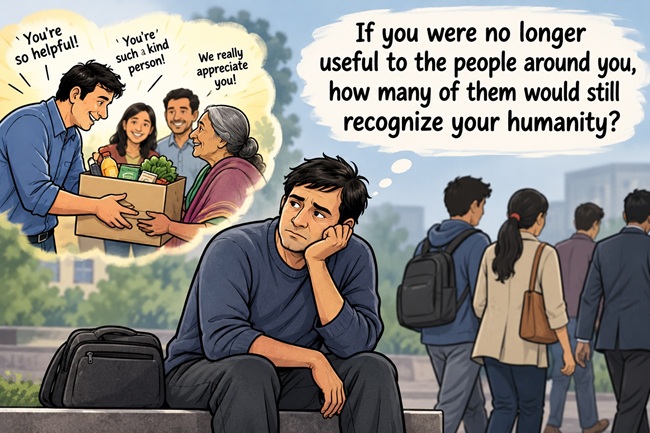
The key word is useful. Simple as it sounds, it exposes something unsettling about how human beings perceive, value, and treat one another. Kafka explored this dark truth with extraordinary insight in his celebrated novella, The Metamorphosis.
Gregor Samsa is a hardworking travelling salesman who has sacrificed his life to support his family. One morning, he awakens transformed into a gigantic insect. Yet his first concern is not the horror of his condition but the fact that he is late for work. The reaction is profoundly revealing: his identity has become so entangled with duty, productivity, and usefulness that even his monstrous transformation initially matters less to him than his failure to perform his role.
For years, Gregor has surrendered his dreams, comfort, and happiness for his family. He is their provider and financial security. But once his transformation renders him incapable of working, their attitude gradually changes from concern to frustration, resentment, and finally rejection.
His sister Grete, who initially cares for him with affection, eventually loses patience. The brother she once loved slowly disappears from her perception. She no longer calls him Gregor but refers to him as “it.” This change in language is crucial. Once he ceases to be useful, he is progressively stripped not only of affection but of human identity itself.
Confined to his room and cut off from ordinary life, Gregor watches his family learn to survive without him. As they become increasingly self-reliant, his sacrifices are forgotten. His years of devotion are eclipsed by his present inability to contribute. Crushed by loneliness and rejection, he quietly dies.
Perhaps the most disturbing element is what follows. His family feels relief rather than grief. Instead of mourning Gregor, they begin contemplating a better future. His death has removed what they had come to regard as a burden.
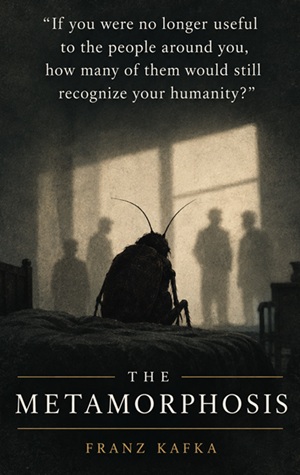 Kafka leaves Gregor’s transformation open to interpretation. It may symbolize illness, disability, depression, alienation, or the dehumanizing machinery of modern society. Beneath these interpretations, however, lies a disturbing universal truth: we often value people less for who they are than for what they can provide.
This is where Kafka’s fiction becomes a mirror of ordinary life.
Every individual occupies some role—provider, parent, friend, employee, caregiver, teacher, adviser, or companion. We contribute labor, knowledge, affection, emotional support, or service. Yet when that contribution disappears, the attitude of others can change with surprising speed. It is as though usefulness has quietly become a measure of human worth.
We see this in relationships sustained only while a need exists. The moment the need disappears, attention fades and intimacy wanes. The person has not changed; only his utility has. His feelings, memories, dignity, and capacity for suffering remain intact, but the eyes through which others see him have changed.
This reveals a troubling tendency in human psychology: we often become so preoccupied with what we can obtain from others that we overlook who they actually are. Kindness, honesty, loyalty, compassion, integrity, and sincerity become secondary to convenience and advantage. We stop asking, Who is this person? and begin asking, consciously or unconsciously, What can this person do for me?
More disturbing still is the transition from use to exploitation. Once relationships become primarily transactional, manipulation and misuse can easily follow. Greed does not merely seek benefit; it often seeks advantage without regard for the humanity of the person being used.
Kafka understood this psychology intimately. His writings are saturated with alienation, inadequacy, isolation, and the painful sense of being misunderstood. Perhaps his own experience of emotional estrangement enabled him to portray Gregor’s gradual dehumanization with such unsettling authenticity.
In ordinary life, we readily discard objects that no longer serve a purpose. Broken machines are thrown away; obsolete devices are replaced; worn-out possessions are abandoned. But why should the logic of utility be transferred to human
A person is not a tool.
A human being is not a commodity.
A human being is not disposable.
The elderly, the sick, the unemployed, the disabled, and those passing through periods of weakness or failure do not become less human because they can no longer produce, perform, or provide. Their dignity is intrinsic. It does not have to be earned through usefulness.
Yet we should also examine the other side of the equation. Even service is not always as selfless as it appears. Many acts of assistance are accompanied, consciously or unconsciously, by expectations of gratitude, recognition, reciprocity, influence, or future advantage. We often call something “selfless” simply because its hidden transaction has not yet become visible.
The obsession with utility has therefore infiltrated almost every sphere of existence—family, friendship, employment, politics, bureaucracy, religion, education, and even charity. People are frequently judged by productivity rather than character, achievement rather than integrity, status rather than humanity.
Such a mentality impoverishes both individuals and society. It converts relationships into transactions and communities into marketplaces of mutual advantage. A civilization may become highly efficient while becoming progressively less humane.
The enduring power of The Metamorphosis lies precisely here. Kafka compels us to ask whether our love, respect, and concern for others are unconditional or merely dependent upon what they contribute to our lives. He exposes the uncomfortable possibility that most relationships survive not through genuine affection but through convenience.
A truly humane society must therefore recognize the intrinsic worth of every person, regardless of status, wealth, productivity, age, illness, or usefulness. We must learn to see human beings as ends in themselves, never merely as means to our own ends.
Perhaps the true test of humanity is not how generously we treat those who serve our interests, but how we treat those who can no longer serve them.
Until we learn that distinction, Kafka’s haunting question will continue to echo through the corridors of human conscience:
If you were no longer useful, would people still recognize your humanity?
Images ChatGPT generated
24-Oct-2026
More by : Dr. Dalip Khetarpal
Top | Book Reviews | Home
