Oct 31, 2026
Oct 31, 2026
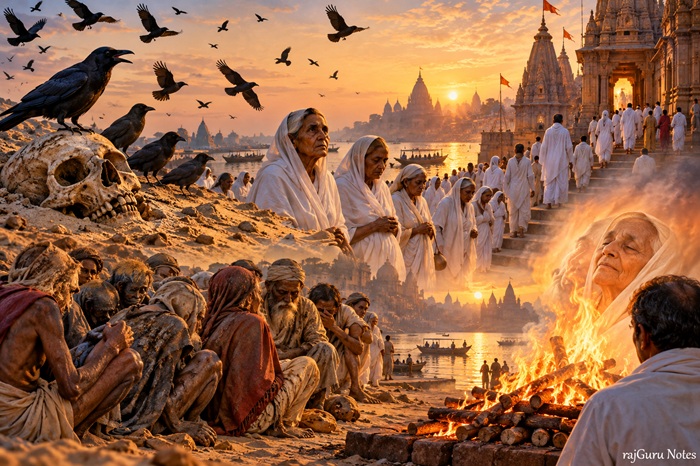
Endless crow noises
A skull in the holy sands
tilts its empty country towards hunger.
White-clad widowed Women
past the centers of their lives
are waiting to enter the Great Temple
Their austere eyes
stare like those caught in a net
hanging by the dawn's shining strands of faith.
The fail early light catches
ruined, leprous shells leaning against one another,
a mass of crouched faces without names,
and suddenly breaks out of my hide
into the smoky blaze of a sullen solitary pyre
that fills my aging mother:
her last wish to be cremated here
twisting uncertainly like light
on the shifting sands
We do not know what pulls us and why do we want to read and re-read the poem again. Is it brevity of the poem or thought it contains within? What is the crux? Is it the image it carries with or for the metaphysics it clutches along? Jayanta Mahapatra’s Dawn at Puri is one such poem drawing us close to for meaning and interpretation. The more we read the more we get attracted to and thereafter a reading and re-reading continues until the end till we get exhausted with our reading and sitting.
To read the poem is to be reminded of the Puri Temple, the Jagannath Puri Temple, not only that, but also the rock-built temples of India. But here the sea adds to landscape and scenery. We feel it impelled from within to see the statues of Jagannath, Balabhadra and Subhadra. How the idols carved and chiseled, hewn out of the wooden logs?
The crows so many in number keep cawing and dotting the space together with the human skull lying on the sands adjacent to the temple telling of human remains and our last rites. Where have we come to? We are compelled to ponder. How is the country raked by hunger, want and scarcity? How to quench thirst? How to quench the fire of the belly? How to douse the flames of hunger burning it all? A country bereft of, laid bare of, how to view it? How is the wasteland imagery and barrenness? What does it stay here
The white-clad widows past their center of life are waiting to enter the Great Temple in rows with bhakti and shraddha, the flowers of reverence and piety so strictly held, faith so sacrosanct. But still, something goes missing. We do not know what ails them or what is it that their hearts ache?
Their austere eyes seem to be caught in the net of the strands of faith flashing like frail sunlight. All these hints towards what it is remnant in their life, what it has withstood. Their hardship and misery, we cannot relay it, their pity and tribulation.
Again, frail light shifts to flashing over the leprous shells crouching against one another. How horrifying is it to see them! How horrendous the imagery is! Here the poet contrasts in between faith and doubt, faith which is so sacred and sacrosanct while doubt is so full of dilemmas, and you have to choose between the godly and the ungodly.
Again, something keeps him on tenterhooks, appalls him awe-struck to see the solitary pyre burning on the vast holy sands of the sea beach adjacent to the temple space, smokes trailing and blazing upon and the things going into flames, burning to ashes. On seeing the scene, he gets reminded of the last of wish of his ageing mother of being burnt here as every Hindu wishes to be cremated as it is the Swargadwara, the Gateway to Heaven. An Odia Christian he has just presented the wishes of the ageing folks and the feelings connected with as light falls upon the sea sands and keeps shifting to different spaces thereafter.
Dawn at Puri is first of all a Puri poem, a Jagannath Puri temple poem seen under the dawn light so frail and shifting, the seascape so vast and wide with the beach sands in its vicinity. Secondly, it is a poem of faith and doubt, faith sustaining us, doubt raking us. We are just caught in between. Light, imagery, mass, matter and metaphysics are the things deliberation.
A dawn at Puri, a dawn lighting the skies of Puri temple area is the thing of deliberation and the things getting pictured and illustrated under that light or flashing. Faith and light are abstract things and so are the myth and mythology. The human skull lying on the sands tells of our existence, what do we become finally in the end? The solitary pyre burning is a fine example of imagery, and such a picture knocks us inwardly. The path of life is almost the same. We have to read the same path in life. The holy sands denote it the myth connected with Lord Jagannath.
Image from the collection of rajGuru Notes - ChatGPT generated
31-Oct-2026
More by : Bijay Kant Dubey
Top | Literary Shelf | Home
