Oct 31, 2026
Oct 31, 2026
by B.S. Ramulu
A Historical Materialist Critique of Subaltern Cultural Production, Class Appropriations, and the Erasure of Garividi Lakshmi in the Telangana Folk Tradition
Abstract
This paper examines the evolution of Burrakatha, the premier oral ballad tradition of the Telugu-speaking regions, through the lens of historical materialism and subaltern studies. Moving away from standard cultural historiography that attributes the modernization of folk arts solely to mid-20th-century political movements, this study traces the structural roots of Burrakatha back to the caste-defined occupations of the Sharadakandru and Jangam lineages. It highlights how these subaltern communities sustained the art form through centuries of feudal oppression. The paper further analyzes the structural appropriation of this indigenous medium by the Praja Natya Mandali during the Telangana Peasant Armed Struggle (1946–1951), evaluating how the radical shift from subaltern lore to class-conscious propaganda altered the form’s intrinsic sociology. Finally, the paper critiques the systemic erasure of traditional female performers, focusing on the historic life and marginalization of the legendary balladeer Garividi Lakshmi, thereby advocating for a reclamation of subaltern agency in the documentation of folk histories.
1. Introduction: The Dialectics of Folk Epistemology
Folk art forms are rarely static aesthetic choices; they are active battlegrounds of social history, economic relationships, and ideological hegemony. In the Deccan plateau, particularly within the ethno-geographical terrain of Telangana, no oral performance medium has mirrored the socio-political contradictions of the subaltern masses as profoundly as Burrakatha. Synthesized from the words Burra (referring to the specialized shell-shaped gourd stringed instrument) and Katha (story), this tripartite performative medium—comprising a central chronicler (Kadhakudu) flanked by two contrapuntal commentators (Vanthalu)—has historically functioned as a living newspaper for the illiterate agrarian masses.
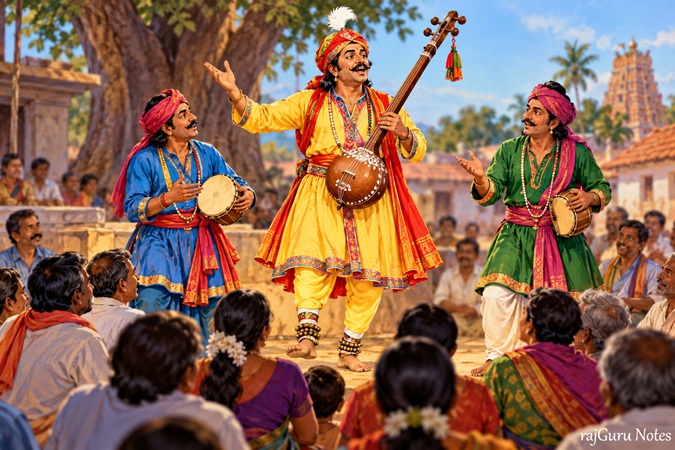
However, mainstream academic history has frequently committed serious chronological errors when documenting Burrakatha. It routinely credits modern political organizations, specifically the communist cultural fronts of the 1940s, as the "creators" of the medium. This paper utilizes a historical materialist framework to correct this distortion. By examining the material base of folk production, this study demonstrates that Burrakatha did not emerge from a twentieth-century ideological vacuum. Rather, it represents the structural evolution of ancient, caste-anchored oral practices that survived through the ancestral labor of marginalized communities.
2. The Ancestral Material Base: The Sharadakandru and the Jangam Lineages
Before the term Burrakatha was popularized in the modern urban lexicon, the art form existed across the Deccan as Jangam Katha and Sharada Katha. The structural and organological foundation of the medium belongs entirely to specific subaltern castes whose hereditary livelihood was tied to oral genealogies and bardic performances:
The survival of these stories across generations was a triumph of subaltern labor. These bards operated under harsh feudal arrangements, facing severe economic insecurity and systemic caste oppression from upper-caste landlords (Doras and Zamindars). Despite these obstacles, they kept the flame of regional memory alive. To ignore this foundational phase and label modern political adopters as the "inventors" of Burrakatha is a form of cultural colonialism. It erases the actual creators who sustained the art form through centuries of uncredited labor.
3. Feudal Co-optation vs. Subaltern Dignity: The Telangana Context
A critical aspect of Burrakatha in Telangana is its historical resilience against systemic degeneration. Unlike several courtly arts that surrendered to the decadent patronage of the Nizams or local Deshmukhs, the core of the Sharada tradition retained a fiercely democratic, community-centric character.
4. The 1940s Transmutation: The Praja Natya Mandali and Class Appropriation
The decade of the 1940s marked a major structural turning point for the medium. As the Telangana Peasant Armed Struggle (1946–1951) escalated against the oppressive feudal regime of the Nizam and his predatory landlords, the communist cultural wing, the Praja Natya Mandali (People's Theatre Association), recognized the unmatched communicative power of Burrakatha.
Led by iconic cultural figures like Suddala Hanumanthu and the legendary Sheikh Nazar (frequently called the father of modern Burrakatha), the movement systematically adopted the acoustic format of the Sharadakandru. They replaced traditional mythological narratives with immediate, high-stakes class-conscious themes:
This intervention brought Burrakatha to the center of national and international anti-feudal politics. It proved that the medium possessed incredible ideological flexibility. However, from a historical materialist standpoint, this transformation was also a complex process of class appropriation. While the political left elevated the art form into a revolutionary tool, the historical memory of the Sharadakandru and Jangams as the original designers was pushed to the margins. The intellectual ownership of the medium was largely credited to party theorists and urban cultural organizers, leaving the traditional subaltern practitioners economically marginalized and historically invisible.
5. Gender Contradictions and Institutional Erasure: The Case of Garividi Lakshmi
If the class appropriation of Burrakatha marginalized subaltern men, it resulted in the complete institutional erasure of subaltern women. The mainstream archives of the progressive cultural movement extensively document male icons like Suddala Hanumanthu, Sheikh Nazar, and Subbarao Panigrahi. Yet, they remain completely silent regarding the monumental contributions of traditional female balladeers who broke patriarchy to perform in public spaces.
The most glaring example of this historical neglect is the life and work of Garividi Lakshmi. Hailing from the culturally vibrant but economically depressed terrain of Uttarandhra (the Vizianagaram-Srikakulam coastal belt), Garividi Lakshmi was an extraordinary, pioneering exponent of traditional folk ballads and Burrakatha:
Despite her prolific career and unmatched popularity among working-class audiences, Garividi Lakshmi was systematically ignored by both elite bourgeois historians and progressive cultural chroniclers. While radical male writers who died for the cause were deservedly immortalized, female practitioners like Lakshmi—who fought a daily battle against starvation, patriarchal violence, and social isolation while keeping the art form alive—were reduced to mere footnotes or completely forgotten. Her recent cinematic portrayal has finally brought some public attention to her name, but academic history has yet to properly recognize her status. Her erasure demonstrates that cultural documentation is deeply influenced by gender and caste biases, which routinely value urban political status over lifelong subaltern commitment.
6. Typology of Performative Elements in Burrakatha
To understand the intricate mechanics of this art form, it is helpful to look at how different roles function together during a performance:
|
Performative |
Acoustic Instrument |
Social/Narrative |
Ideological |
|
Kadhakudu |
Tambura (Gourd Lute) & Andelu (Brass Thumb Rings) |
Leads the central narrative, sings the core verses, and maintains the emotional tone (Rasa). |
Represents the historical memory and continuity of the epic text. |
|
Rajkiya Vanthadu (Political Commentator) |
Dakki / Dikki (Clay or Brass Hand-Drum) |
Interrupts the main story to ask sharp questions, linking the past to contemporary local politics. |
Represents class consciousness, contemporary critique, and subaltern awareness. |
|
Hasyam Vanthadu (Comic Commentator) |
Dakki / Dikki (Clay or Brass Hand-Drum) |
Uses sharp satire, double entendres, and street-smart humor to break tension and mock authority. |
Represents the subversive folk spirit, anti-authoritarian critique, and public laughter. |
7. Bhakti Movements, Subaltern Appropriation, and the Reclamation of History
The historical evolution of Burrakatha must also be contextualized within the wider history of Indian Bhakti movements. As established in our broader materialist framework, when dominant social classes sought to consolidate their power, they routinely appropriated subaltern folk expressions to popularize their scriptures. The inclusion of Sharada Katha techniques into mainstream religious festivals was part of this historic trend.
However, the subaltern masses did not remain passive recipients of this process. They actively engaged in reverse appropriation. When the Sharadakandru sang the Ramayanam, they did not chant the elite, Sanskritized text of Valmiki. Instead, they sang the Sharada Ramayanam—a deeply humanized, localized folk version where Sita's pain reflected the daily struggles of a subaltern woman, and the corporate arrogance of Ravana mirrored the tyranny of the local landlord.
Therefore, when modern cultural movements treat followers and adapters as the sole creators, they break the true chain of history. The Sharadakandru, the Jangams, and forgotten figures like Garividi Lakshmi are the true architects of this performative science. They took the raw elements of nature, combined them with collective labor, and built a resilient acoustic system that resisted both feudal oppression and elite erasure.
8. Conclusion: The Task of Pata Puttuka
The task of any progressive history of song, such as Pata Puttuka (The Birth of the Song), is to strip away the layers of romantic idealism and elitist bias that obscure the true roots of folk expression. Burrakatha did not lose its way in Telangana precisely because its roots were anchored deep within the subaltern soil. Its history belongs to the anonymous Sharada singers, the nomadic street performers, and the marginalized women who sang through poverty and social exile.
By restoring the Sharadakandru to their rightful place as the primary creators, and by writing the struggles of pathbreakers like Garividi Lakshmi into our permanent archives, we rescue the history of folk art from the monopoly of elite institutions. Burrakatha survives not because it was patronized by states or political parties, but because it is an authentic product of human labor—a living, breathing voice of resistance that continues to demand historical justice.
Image (c) rajGuru Notes
31-Oct-2026
More by : B.S. Ramulu