Oct 31, 2026
Oct 31, 2026
A common intonation of love and devotion blossomed during the Bhakti Movement of Medieval India. It was a collection of linguistic and regional movements that was influential in determining the cultural and religious diversity of India. It is still powerful.
Women played a significant role challenging societal norms and rituals, pushing for a personal and direct relationship with the divine. Even today devotees find their poems inspiring and worthy of reverence. Their unwavering devotion, their messages of love and equality and their defiant spirituality make them celebrities in their own right.
One such bhakti saint-poet was Dalit Soyarabai from the Mahar caste of Maharashtra. She was the faithful spouse of Sant Chokhamela, a great devotee of Lord Vithala. They lived in Mangalvedhe, a few kilometers away from Pandharpur. Marginalisation only fortified her courage and love for Vothoba, giving us deeply spiritual and thought provoking poems.
So who were the Mahars?
During the 14th Century in India, the Mahars were a tightly defined, inferior community in the rural economy of Maharashtra. Categorized as untouchables, they were forced to live in isolated quarters known as maharwadas, located outside the main village periphery (traditionally to the east or downriver).
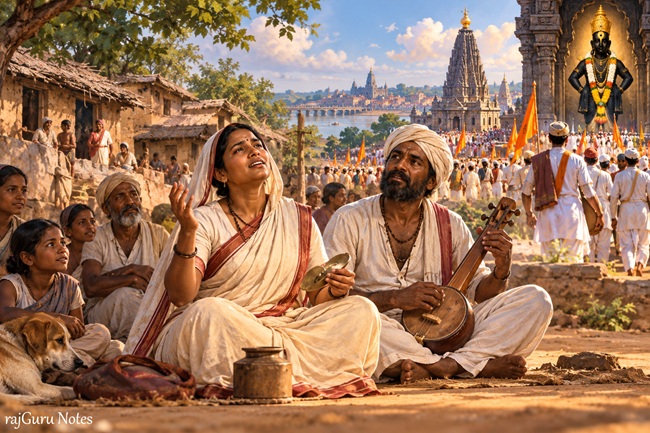
Sorayabai, with Chokhamela. was connected to the Warkari tradition, the popular Pandharpur yatra of Maharashtra centered on the worship of Lord Vithoba. This is a thousand-year-old custom —a fantastic tradition of Maharashtrian culture that unfolds every year in the Hindu month of Ashadha. It is an astounding pilgrimage of twenty-two days, a mind-blowing walkathon of 250 kilometres! Dindis of Warkaris singing, dancing, chanting ‘Vithoba, Vithoba’ non-stop, gather from villages and towns miles away in the Pune suburbs of Dehu and Alandi. From here the padukas of venerated Sants Tukaram and Dnyaneshwar, enthroned in Palkhis are reverently escorted to the holy place of Pandharpur in a procession that’s both, intimidating and inspiring to behold!
Sorayabai took this annual pilgrimage with her husband. They were warmly welcomed into that wonderful alliance of bhaktas in Pandharpur; Sants – Namdev, a tailor; Janabai; Gora, a potter; Narahari, a goldsmith; Savata, a gardener and foremost among all of them – Sant Jnaneshvar and his siblings! The brahmins though could not accept that a mahar could rise spiritually and be revered by others socially superior! But their faith was so enormous that no amount of hounding made them lose their peace of mind. Below is an abhanga from her perspective, telling us about the harassment:
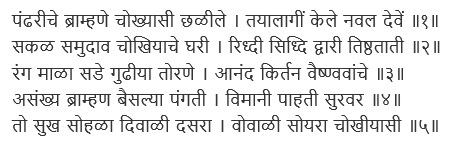
Here is the English translation of this poignant and powerful abhanga.
Translation (Gemini AI)
The Brahmins of Pandhari tortured Chokha;
Yet see the wondrous miracle the Lord performed for him. (1)
A vast gathering is assembled at Chokha's house,
While divine wealth and spiritual powers (Riddhi-Siddhi)
stand waiting at his doorway. (2)
Garlands of colors, freshly swept courtyards,
celebratory banners, and arches of leaves are set up;
There is the joyous kirtan (devotional singing) of the Vaishnavas. (3)
Countless Brahmins are seated in rows for the feast,
While celestial beings (Suravars) watch in wonder
from their heavenly chariots (Vimanas). (4)
That festival of joy surpasses Diwali and Dussehra;
Soyara lovingly waves the lamp of blessing (Ovali) over her Chokha. (5)
Context and Meaning
This abhanga highlights a profound social and spiritual reversal orchestrated by divine grace (Lord Vitthal). Despite the caste-based oppression and mistreatment (chhal) Sant Chokhamela faced from the orthodox Brahmins of Pandharpur, Lord Vitthal's grace transforms his humble home into a place of supreme honor, celebration, and spiritual abundance, where even Brahmins sit in rows to partake in a feast, witnessed by the heavens.
Sorayabai was a disciple of her husband Sant Chokhamela, a prominent Mahar bhakti poet of the above mentioned Warkari movement. She wrote many abhangs but only about 62 of them are available today. She staunchly believed that inner purity and devotion mattered more than caste or custom. That is what she taught through her poems and songs which were socially reformative and deeply spiritual. She strongly condemned untouchability and spoke out against the pretense of caste-based hierarchies. Through her simple devotional Abhangs in the vernacular she expressed the ideas of equality, dignity, challenging patriarchy and emphasising a direct connection with the divine giving access of worship to the common people.
For the 14th century, the following is a bold, progressive and revolutionary poem where Soyarabai audaciously challenges the caste system and untouchability
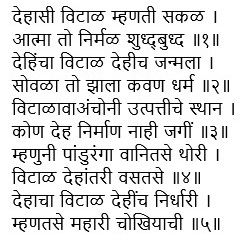
All call the body impure, But the soul is pure, stainless, and enlightened. ||1||
Impurity is born of the body itself, So by what religion did it become pure? ||2||
The very origin of creation is untouched by impurity;
Is there anybody in this world not created thus? ||3||
Therefore, I praise the greatness of Panduranga,
For impurity dwells within the body itself. ||4||
The impurity of the body resides within the body for certain,
Says the Mahari of Chokha,. ||5||
Context and Notes
This Abhanga challenges social notions of ritual purity and pollution (vitaal). Saint Soramaya argues that since everyone's physical body is born from the same natural origins, physical "impurity" is inherent to the human body itself, making discrimination based on bodily birth and caste status meaningless. True purity lies in the immaculate soul and devotion to Lord Panduranga (Vitthal).
Another of her Abhangs with translation by Gemini AI
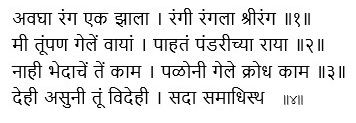
Everything has become one single color;
Sri Rang (Lord Vishnu/Vitthal) has merged into all colors. (1)
My sense of "I" and "you" has vanished completely
As I gaze upon the Lord of Pandhari (Vitthal). (2)
There is no room left for duality or division;
Anger and desire have both run away. (3)
Though residing in the physical body, you are beyond it (Videhi);
Behold, always established in inner divine absorption (Samadhi). (4)
The act of seeing and the object seen have both disappeared far away,
Says Chokha’s Mahari (Soyarabai). (5)
Context and Meaning
This abhanga describes the state of Advaita (non-duality) and profound devotion where the illusion of individuality ("I" and "you"), anger, and worldly desires dissolve. When the devotee experiences the divine presence of Lord Vitthal everywhere, all boundaries and dualities melt into a single divine essence
Some of the abhangs reflect on the hardships and indignity of daily life suffered by the Mahars and on her awareness of her marginalised status in society. Yet her commitment to Vithoba was such that it helped her create her own spiritual space to rise above materialistic concerns.
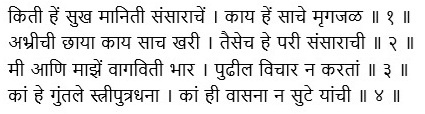
Translation (Gemini AI)
How people consider this worldly life to be true happiness;
Is this reality, or is it merely a mirage? (1)
Is the shadow of a cloud ever truly real?
The nature of this worldly existence is just like that. (2)
They carry the heavy burden of "I" and "mine,"
Without ever thinking about what lies ahead. (3)
Why are they entangled in wife, children, and wealth?
Why does this worldly desire never leave them? (4)
Soyara says, "Who will rescue you at the very end?"
Your dignity will be ruined life after life. (5)
Context and Meaning
In this abhanga, Sant Soyarabai reflects on the illusion (Maya) of worldly attachments. She compares worldly happiness and the illusion of ownership ("me and mine") to a fleeting mirage or a passing cloud's shadow. She laments how human beings remain trapped in desires for family and material wealth, urging them to look beyond temporary pleasures toward ultimate spiritual liberation, lest they suffer repeated cycles of suffering over lifetimes.
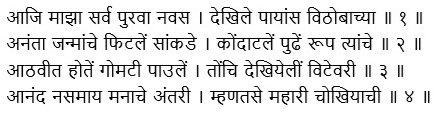
Translation (Gemini AI)
Today, all my vows and prayers have been fulfilled,
For I have beheld the sacred feet of Vithoba. (1)
The bottleneck/crisis of endless births has been resolved,
And His divine form is radiant all around me. (2)
I was constantly meditating upon His beautiful feet in my mind,
*And lo, I have actually beheld them standing upon the brick (Vit`). (3)
Joy cannot be contained within the depths of my heart,
Says the Mahari (wife) of Chokha. (4)
Context and Meaning
This abhanga captures the culmination of a devotee's spiritual longing and patience. Soyarabai expresses an overwhelming sense of completion and liberation (Mukti). The cycles of repeated births have ended because she has finally experienced the direct, physical and spiritual vision of Lord Vitthal standing on the brick at Pandharpur, bringing an unmatched, uncontainable wave of divine joy (Anand) to her heart.
*There is an interesting legend about Soyarabai. The couple intensely longed for a son, and Vitthala finally granted their wish. In the late stage of Soyarabai’s pregnancy Chokha left to fetch his sister from another village to help in the delivery. Chokhamela however, immersed in Vitthala, joined a bhajan procession and forgot all about it. Soyarabai was left all alone in that state. Then Panduranga himself assumed the form of Soyarabai’s sister-in-law, delivered the child and thus became a midwife for the sake of his bhaktas! When Chokha finally returned, their son was already born and the soiled clothes washed! It is also stated that at the name-giving ceremony Vitthala was present and named their only son Karmamela. Upajata Karmamela, vace Vitthal savala . . . . “Karmamela was born, a promise from black Vitthal. As soon as everyone exalted in Vitthala’s name, the husband of Rukmini came running to perform the 12th day name-giving ceremony with all the necessary materials – so says Chokha’s Mahar-wife.”
*Vitthala bhakti with its tradition of sants, the pride of Maharashtra, stands for equality for all, to embrace all mankind in one single ‘caste’ of Vitthalaprem. Choka and Soyara never used their abhangs as a means of public protest, but as a means of self-expression. Theirs was a peaceful revolt against untouchability, to change the mentality of the oppressors through prembhakti and knowledge.
* VivekVani
Ashadha - 4th Month of the Hindu Calendar
Wari - Yatra
Paduka – Foot wear
Palkhi – Palanquin
Dindis – Groups of Warkaris
Warkari – Pilgrim
Image courtesy rajGuru Notes.
31-Oct-2026
More by : Shernaz Wadia
Top | Spirituality | Home
