Oct 31, 2026
Oct 31, 2026
... in Rajasthan, India:
Geological Setting, Resource Potential,
Exploration Status and Strategic Significance
1. Introduction
Critical minerals have become strategically important because modern economies depend on secure supplies of minerals used in energy technologies, electronics, defence, aerospace, transportation and advanced manufacturing.
The transition towards electric mobility, renewable energy, energy storage, digital technologies and advanced manufacturing has particularly increased the importance of:
lithium,
cobalt,
nickel,
graphite,
rare earth elements,
tungsten,
niobium,
tantalum,
titanium,
zirconium,
vanadium,
tin and other strategic minerals.
For India, domestic exploration of these commodities is important because several critical-mineral supply chains are internationally concentrated.
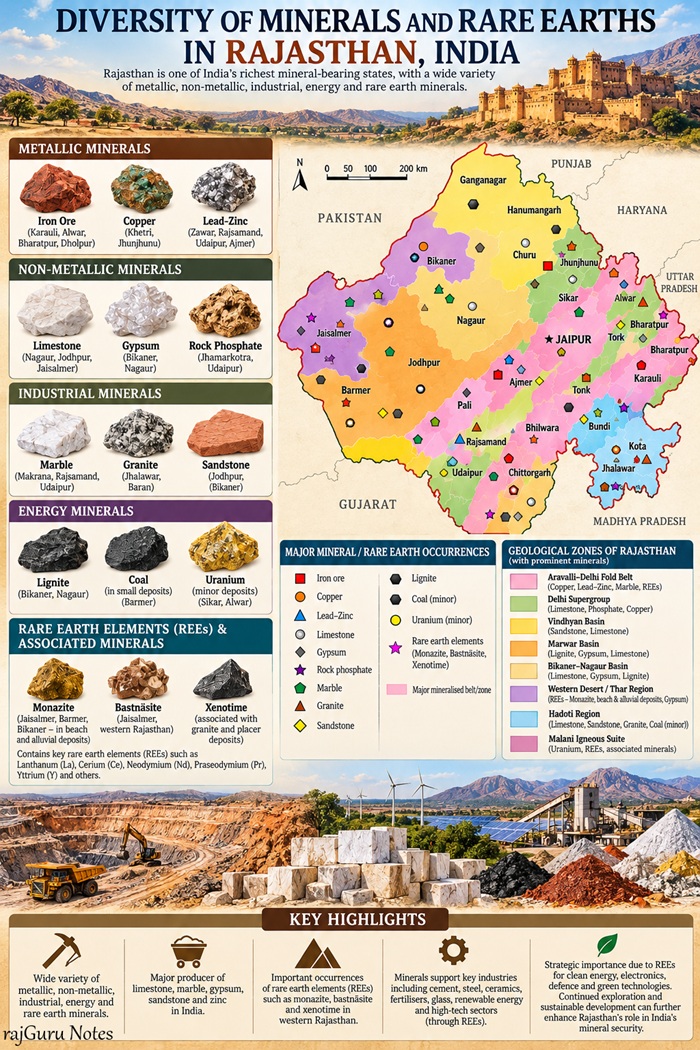
Rajasthan is particularly interesting because its geological diversity provides favourable environments for several of these commodities. The Rajasthan Mineral Policy 2024 explicitly identifies strategic and critical minerals as a priority and proposes increased exploration, auctioning, processing, research facilities and development of rare-earth industries.
2. Objectives of the study
The principal objectives of this review are to:
3. Methodology and data sources
This review is based primarily on information published by Indian government scientific and mineral agencies, including:
Particular emphasis has been placed on exploration-stage classification because a mineral occurrence, exploration target, resource and economically mineable reserve are different categories.
The most recent government information available indicates that India had established approximately 1.29 million tonnes of in-situ REO in hard-rock terrains at Ambadungar, Gujarat and Bhatikhera-Dantala, Rajasthan, as reported by the Department of Atomic Energy in March 2026.
4. Geological framework of Rajasthan
Rajasthan contains one of India's most complex geological assemblages.
Major geological provinces include:
4.1 Archaean basement
The ancient basement provides the foundation upon which younger Proterozoic belts developed.
4.2 Aravalli Supergroup
The Aravalli belt contains a variety of metasedimentary and metavolcanic rocks and hosts important metallic and non-metallic mineralisation.
4.3 Delhi Supergroup
The Delhi Fold Belt is particularly important for:
base metals,
tungsten,
tin,
rare metals,
uranium-associated systems,
pegmatite-related mineralisation.
4.4 Malani Igneous Suite
The Malani Igneous Suite is exceptionally important for Rajasthan's critical-mineral story.
Its felsic volcanic and intrusive rocks are associated with the Siwana Ring Complex, which is now recognised as an HREE-rich REE province.
4.5 Vindhyan and younger sedimentary formations
These formations host important industrial and fertilizer minerals and contribute to Rajasthan's overall mineral diversity.
4.6 Desert and alluvial cover
Large parts of western Rajasthan are covered by Quaternary desert sediments. This creates an important exploration challenge because potentially mineralised bedrock may be concealed beneath sand.
5. Classification of critical minerals relevant to Rajasthan
The following commodities are particularly relevant to Rajasthan:
The GSI exploration programme demonstrates that the state's potential is substantially broader than the historically recognised mineral districts.
6. Rare Earth Elements: significance
Rare earth elements comprise 17 chemically related elements:
Light REEs
Lanthanum
Cerium
Praseodymium
Neodymium
Samarium
Heavy REEs
Europium
Gadolinium
Terbium
Dysprosium
Holmium
Erbium
Thulium
Ytterbium
Lutetium
Yttrium is conventionally grouped with HREEs in many geological and industrial contexts.
Among them, Nd, Pr, Dy and Tb have particular strategic significance because of their applications in high-performance permanent magnets.
These magnets are important in:
electric motors,
wind turbines,
robotics,
advanced electronics,
aerospace,
defence systems.
Consequently, an REE deposit should not be evaluated solely by total REE grade. The individual-element distribution and mineralogy are equally important.
7. The Siwana Ring Complex
7.1 Location
The Siwana Ring Complex lies in western Rajasthan, in the present Balotra district, with the broader exploration region extending towards Barmer and Jodhpur.
The area forms part of the Malani Igneous province.
7.2 Geological character
The complex consists predominantly of evolved felsic and alkaline/peralkaline igneous rocks. Important rock types include:
alkaline granite,
peralkaline granite,
rhyolite,
rhyolitic tuff,
felsic pyroclastics,
microgranite dykes.
These rocks are favourable for concentration of incompatible elements during magmatic differentiation.
8. REE and Rare-Metal association of Siwana
The Siwana Ring Complex is particularly significant because it contains a multi-element critical-mineral association.
The principal elements of interest include:
REE + Y + Nb + Zr + Hf + Sn
and locally other associated elements.
AMD specifically characterises the Siwana peralkaline granite-rhyolite system as HREE-rich and identifies it as an important REE and rare-metal province.
This makes Siwana fundamentally different from simply being a conventional light-REE deposit.
9. Bhatikhera deposit
The Bhatikhera block represents one of the two principal G2-level REE resources currently established by AMD in the Siwana Ring Complex.
AMD reports:
≈94,000 tonnes RE oxide
associated with:
niobium oxide,
zirconium oxide.
The mineralisation is hosted by alkaline granite.
The figure represents an exploration-stage resource estimate and should not automatically be interpreted as a recoverable mining reserve.
10. Dantala deposit
The second major established resource occurs at Dantala.
AMD reports:
≈74,900 tonnes RE oxide
with associated:
Nb oxide,
Zr oxide.
The mineralisation is hosted principally in rhyolite tuff.
Like Bhatikhera, Dantala is classified at G2 exploration level in the AMD information.
11. Combined significance of Bhatikhera and Dantala
The two deposits together contain approximately:
168,900 tonnes of reported RE oxide
at the stated exploration level.
This is a significant hard-rock REE resource for Rajasthan and contributes to India's broader domestic REO resource inventory.
The Government of India reported in March 2026 that approximately 1.29 million tonnes of in-situ REO had been established in hard-rock terrains including Ambadungar in Gujarat and Bhatikhera-Dantala in Rajasthan.
12. Additional Siwana exploration targets
AMD reports on going exploration in:
Ramaniya,
Nal,
Phulan,
Magreshwar,
Buriwara.
Further GSI projects have investigated areas such as:
Sainji Ki Beri–Meli,
Indrana–Siwana,
Nimale Ki Pahari–Dantala,
Kundal–Dhiran,
Kaluri–Tapra–Buriwara,
Gugrot,
Nakoda,
Jhak–Khimpar,
Kitpala–Sinli.
Several are at G3 or G4 levels, illustrating that the broader province is still under delineation rather than being a fully developed mining district.
13. Chaba–Nawatala–Patoli Rare-Metal target
A particularly interesting exploration area occurs around Chaba–Nawatala–Patoli, near the Siwana Ring Complex and extending towards Barmer and Jodhpur.
The Rajasthan Department of Mines and Geology reports encouraging analytical results from nearby bedrock samples, including maximum values of approximately:
Total REE: 1,258 ppm
Nb: 169 ppm
Hf: 93 ppm
Y: 289 ppm
Zr: 1,700 ppm
Sn: 54 ppm
W: 33 ppm
These results are exploration indicators rather than a defined economic resource.
The significance of this area is that it suggests the REE–Nb–Zr–Hf–Sn system may extend beyond the currently defined Siwana deposits.
14. REE potential outside Siwana
Rajasthan's REE potential is not restricted to western Rajasthan.
GSI programmes have identified REE and rare-metal targets in:
Sikar,
Sirohi,
Bhilwara,
Udaipur,
Jalore,
Dungarpur,
Ajmer,
Pali,
Jaipur,
Alwar,
Jaisalmer,
Tonk.
The 2021–22 through 2024–25 GSI programme includes numerous G3 and G4 projects for REE, rare metals and associated commodities.
15. Sikar: REE–uranium association
Northern Rajasthan provides another scientifically important REE environment.
AMD investigations around Sikar have identified uranium- and REE-bearing pyroxenites and albitites.
Identified minerals include:
uraninite,
davidite,
brannerite,
monazite,
allanite.
AMD reports anomalous REE concentrations in association with these rocks. The geological setting is related to a broader albitite–pyroxenite–microclinite belt extending for more than 320 km across parts of Rajasthan. This is scientifically significant because REE mineralisation here is associated with a very different geological environment from the Siwana peralkaline system.
16. Sirohi: REE, tungsten and rare metals
Sirohi represents another important strategic-mineral province.The district has potential for:
tungsten,
tin,
rare metals,
REEs,
neodymium,
dysprosium.
GSI has investigated the Jirawal–Sanpur area specifically for neodymium and dysprosium. Other Sirohi exploration blocks include Wan–Mochhal–Bhev, Punawa–Ranela–Kooma, Malawa–Nagani and several additional rare-metal targets.
17. Bhilwara: neodymium and REE potential
GSI exploration has also targeted the Bhilwara region.Important blocks include:
Mahendragarh–Gundli–Bawri, Kodukota–Raser–Lulas–Kallyakhera.
The exploration commodities include:
Neodymium, REEs, associated rare metals. This is particularly interesting because it demonstrates that Rajasthan's REE exploration is targeting individual high-value elements rather than merely total REE content.
18. Tungsten resources of Rajasthan
Tungsten is one of Rajasthan's best-established critical minerals.The Rajasthan Department of Mines and Geology reports approximately 23.92 million tonnes of tungsten ore resources, representing about 27% of India's reported tungsten-ore resources in its cited state compilation.
The two major areas are:
1. Degana, Nagaur
2.Balda–Udwaria, Sirohi
Historically, Degana and Balda were among the few Rajasthan locations where tungsten concentrate production occurred, although the operations were closed because of economic non-viability.
19. Degana–Rewat Hill tungsten province
The Degana region is associated with granite intrusions containing:
quartz veins,
pegmatites,
stockworks,
wolframite-bearing structures.
GSI drilling at Rewat Hill encountered tungsten mineralisation in quartz and pegmatite veins. Same agency reported tungsten values from approximately:
86.60 ppm to 4,924.37 ppm with an average of approximately:
782 ppm W in the cited sample population.
Mineralogical studies also identified following minerals
Ferberite,
Hübnerite.
20. Sirohi tungsten–tin province
The Sirohi region contains a separate tungsten–tin system.
Exploration around:
Dewa-ka-Bera,
Saliyon-ka-Bera,
Bara-Bera,
Balda,
Udwaria
has identified tungsten and associated rare-metal mineralisation.
Scheelite occurs in association with intrusive contacts between granite and calc-silicate rocks, while tourmaline-rich pegmatites have been investigated for tin and tungsten.
21. Lithium potential
Lithium is strategically important because of its use in rechargeable batteries.
Rajasthan has several lithium exploration targets, although its lithium story should currently be described primarily as an exploration opportunity rather than an established large commercial lithium reserve.Recent GSI programmes include:
Sibagaon North, Alwar — Tin, Lithium and rare metals
as well as numerous other REE/RM projects in the state.
The geological association of lithium with pegmatitic and rare-metal systems makes the state's granitic and metamorphic provinces particularly interesting for further investigation.
22. Graphite
Graphite is another critical mineral with potential relevance to battery manufacturing.
Rajasthan has graphite occurrences, particularly in southern Rajasthan.
GSI's exploration programme includes the Bhungra–Bargun area of Banswara for:
graphite,
rare metals.
Graphite's significance is particularly high because natural graphite is an important feedstock for battery-anode materials.
23. Potash
Rajasthan possesses extensive subsurface evaporite sequences containing potash.
The Rajasthan Department of Mines and Geology reports potash-bearing evaporites across approximately 30,000 km², extending through parts of:
Sri Ganganagar,
Hanumangarh,
Bikaner,
Churu,
Nagaur.
The department identifies several potash sub-basins, including:
Satipura,
Bharusari,
Lakhasar.
At a stated cutoff of 3% K, resources in these three sub-basins are estimated at approximately 2,476.58 million tonnes.
Potash is particularly important because of its direct relationship with fertilizer security.
24. Rock phosphate
Rajasthan is also India's major rock-phosphate province.
The state DMG reports approximately:
98.64 million tonnes of rock-phosphate resources.
Important deposits occur around:
Jhamar-Kotra,
Matoon,
Kanpur,
Dhol-ki-Pati,
Dakan-Kotra,
Kharbariyon-ka-Gura,
in Udaipur, together with occurrences in Banswara, Jaisalmer, Jaipur and Alwar.
The Jhamar-Kotra deposit is identified by the state as the country's largest rock-phosphate deposit.
25. Manganese
Manganese is another strategic commodity occurring in Rajasthan.
The principal manganese belt is in Banswara district, extending approximately 22 km from Guraria to Rathimuri.
Important deposits include:
Sivania,
Kala-Khunta,
Ghatia,
Lilwani,
Itala,
Tambeshra,
Kheria.
The state DMG reports approximately 5.78 million tonnes of manganese resources.
26. District-wise critical-mineral exploration matrix
District/region Principal commodity Exploration/resource status
The GSI programme provides the basis for many of the REE/RM exploration entries in this table.
27. Geological models for Rajasthan's REE deposits
Rajasthan's REE occurrences can broadly be grouped into several geological environments.
Model I — Alkaline/peralkaline igneous system
Example: Siwana Ring Complex
Typical elements:
HREE + Y + Nb + Zr + Hf + Sn
Model II — Albitite–pyroxenite system
Example: Sikar and northern Rajasthan
Potential commodities:
REE + U + Th + Zr-bearing minerals
Model III — Pegmatite/granite-associated system
Potential commodities:
Li + Sn + W + Nb + Ta + Be + REE
Model IV — Alkaline complexes and associated rocks
Potential commodities:
REE + Nb + Zr + Y + rare metals
The coexistence of these models makes Rajasthan particularly favourable for multidisciplinary exploration.
28. Mineralogical considerations
An important research priority is determining exactly which minerals host the REEs.
Potential REE-bearing minerals in Rajasthan include:
monazite,
xenotime,
allanite,
britholite,
fergusonite,
zircon and other accessory phases.
AMD studies from northern Rajasthan have documented monazite and allanite along with uranium-bearing minerals.
At Siwana, mineralogical characterisation is particularly important because the economic value of an HREE-rich resource depends strongly on the distribution of individual elements and their host minerals.
29. Exploration challenges
29.1 Desert cover
Large areas of western Rajasthan are covered by sand.
This makes traditional geological mapping difficult.
Consequently, exploration requires:
airborne geophysics,
magnetic surveys,
radiometric surveys,
remote sensing,
geochemical surveys,
drilling.
The Chaba-area DMG report specifically notes the difficulties created by scattered outcrops and Thar Desert cover.
29.2 Low-grade mineralisation
Many REE deposits contain relatively low concentrations of total REE.
Therefore, economic viability depends on:
tonnage,
grade,
mineralogy,
beneficiation recovery,
separation costs,
infrastructure,
product prices.
29.3 Complex mineralogy
A deposit containing several REE-bearing minerals may require complex processing.
This is particularly relevant to HREE extraction.
30. Radioactivity and environmental considerations
Some REE minerals, particularly monazite and certain associated minerals, can contain uranium and thorium.
The Government of India notes that a significant part of India's REE resources is associated with radioactivity and that extraction can therefore be complex and expensive.
Consequently, Rajasthan's REE development will require:
radiometric characterisation,
appropriate regulatory controls,
safe tailings management,
groundwater monitoring,
occupational health measures,
responsible waste management.
31. Water requirement
Water is one of the most important constraints on mineral projects mentioned above so this aspect like availability of enough water resource should also be taken into account while planning for exploration and development such prospects
Image courtesy rajGuru Notes
31-Oct-2026
More by : Prof. Rakesh Goswami
Top | Environment | Home
