Oct 31, 2026
Oct 31, 2026
Introduction: Defining Intangible Cultural Heritage
Intangible cultural heritage is not easy to define, yet its forms are recognisable, especially for communities that form part of it. Very often, intangible cultural heritage consists of non-physical aspects such as social and ritual practices, oral traditions, performing arts, folklore, and the language that carries these art forms. Traditional crafts and countless other manifestations of living culture also belong here. Intangible cultural assets are not commodities. No one can buy, sell, barter or otherwise inherit them in any simple legal sense. Their worth does not lessen because they lack a physical form. They define a community and lend it identity and meaning.
Across the world, one may mention, among still practised intangible cultural forms, Traditional Hand Puppetry in Egypt, the Carnival of Granville in France, the Coaxing Ritual for Camels in Mongolia, the Saman Dance of Indonesia, the Dragon Boat Festival in China, Barkcloth Making in Uganda, and Reggae Music in Jamaica. In India, the sphere of intangible cultural heritage includes many music and dance traditions, architectural practices, sculptures, paintings, pottery, handicrafts, textiles and allied crafts. One can observe from such a list that intangible cultural heritage does not belong to one region alone, whether wealthy or poor. A cultural form usually rests with a particular community. That community feels that it owns the form and feels proud of it, whatever opinion outsiders may hold.
Intangible cultural heritage of a group often gives those from outside a deeper sense of its history, social arrangements, language, psychology and worldview. This heritage passes from generation to generation. Each generation introduces changes and adjustments because the environment keeps changing and history does not stand still. Intangible heritage therefore always remains in motion. New versions appear, fresh meanings arise, and yet a link with older memory persists.
The contemporary world has witnessed cultural homogenisation encouraged and at times imposed by globalising forces. Intangible cultural heritage faces a serious threat in such circumstances. The loss of languages, customs, folk arts and oral traditions, among many other shared values, points towards this danger. Preservation of intangible heritage, together with tangible cultural heritage such as monuments, inscriptions and historic sites, has great importance for the cultural variety of the world. Such preservation maintains dialogue across cultures and breeds respect for different ways of life.
Many scholars, activists and community leaders argue that a comprehensive policy on the listing and protection of intangible cultural heritage in India has become necessary. Public bodies in India need to frame such a policy and then carry it into practice with patience and conviction. Any such measure must keep in mind the generations yet to come in India. Young people will one day enjoy the fruits of the labour of their elders. They deserve encouragement so that they can contribute actively to the growth of the country and take responsibility for its cultural memory. The presence and support of local people in different regions also calls for attention. They hold a deeply valuable stake in the working of any cultural project. Decisions at the level of government ought to draw strength from their experience and attachment. The policies and steps that the Indian state adopts in this sphere should hearten the local population and appeal to them in spirit and practice. If this happens, then the rich heritage of India need not face the risk of slow extinction.
This article attempts to touch upon various aspects of the intangible cultural heritage of India and to point out its importance and continued relevance in present times.
Oral Traditions of India
There is much discussion about the oral traditions of India, not only because they abound in every region, but also because a remarkable culture lies within them. This culture has carried the practice of oral tradition far beyond national borders. Many people in other parts of the world now recognise, study and enjoy it.
When people speak of the oral traditions of India, they often link them at once to religion. A clearer picture emerges when one notices that these practices do not belong to one religion alone. They do not pertain to a single faith, and they are not tied to one sacred system. These practices influence the manner in which people in the country worship many deities and saints. Oral forms accompany rituals, yet they also move beyond formal worship and enter daily talk, stories in the courtyard, songs during work and lullabies at night.
The oral traditions of India connect with many kinds of practices. Some of these concern the traditional process of washing the mouth and using sacred mud as part of a ritual. Other practices involve acts of blessing or the offering of sweets as tokens of welcome to gods, guests or elders. At times the tradition may include a set sequence of actions during the last moments of a person on earth. Those who remain carry out a ritual that demands words of blessing and the offering of sweetmeats to a chosen deity. These traditions form part of the oral heritage of India because they grew within the Hindu religion and then entered the pattern of daily life.
Another feature of these oral traditions deserves notice. They form part of many religions in India. Practitioners often take an oral form from one faith and give it a new shape within another religious setting to suit their own customs and beliefs. Oral tradition thus acts as a bridge across communities. It helps people pass on a practice at a stage when age or distance weakens physical ability. The practice then shapes the beliefs and social habits of the next generation.
From a cultural perspective, the oral traditions of India carry many treasures. One can see in them values, fears, humour and wisdom that have moved from age to age. They have passed from one generation to the next, from ancestors whose names may be forgotten to young people who continue the performance today.
Performing Arts of India
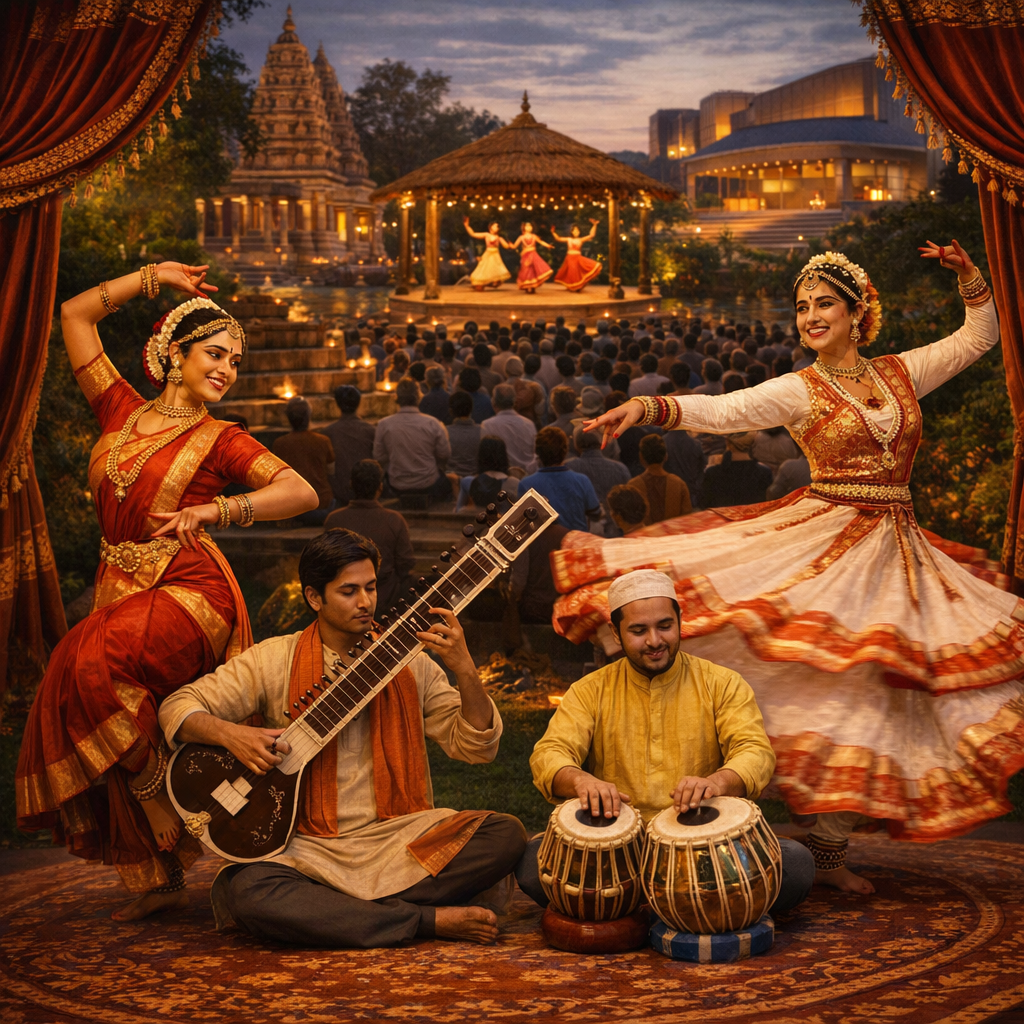
The performing arts of India form an ancient and rich field. They bring together many practices, from dance to music, from theatre to recitation. Practitioners have always aimed at delight and relaxation for the audience. When performers reach a high zenith, they also lift the mood and thoughts of those who watch. Audiences gather in many places and venues in India. The country attracts visitors from across the world partly because these arts remain alive.
The performing arts of India concern teaching in a broad sense, since they spread knowledge of movement, rhythm, painting, music, writing and many other skills. These arts entertain spectators with varied forms of performance. The artists come from different regions of India, yet they share a strong base of talent. Their creativity and skill draw people towards them.
Many venues in India host performances by different kinds of artists. A viewer can spend memorable evenings in theatres, open grounds and temple courtyards while watching these performances in different parts of the country. One may obtain tickets for shows in major cities such as Delhi, Bengaluru, Mumbai and Chennai. A person who wishes to attend has to make sure that the particular show draws enough interest. People now turn to online services to find details about performances in their area. Digital ticketing helps buyers pay less, because they avoid queues and middle agents.
Rituals of India
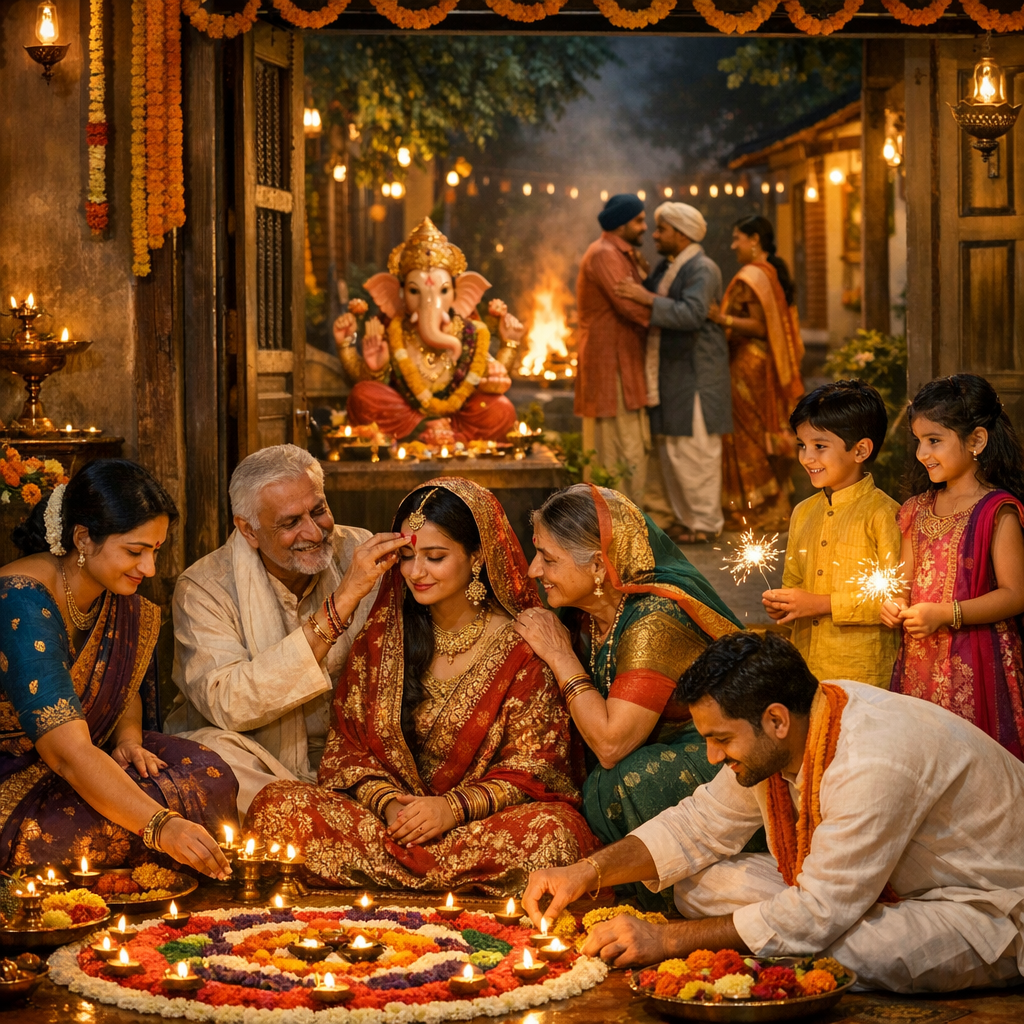
Rituals in India have been handed down from one generation to the next over a long span of time. When people hear the word ritual, they may think at once of love, prayer or a wish linked to an important event in life. The culture and traditions of this large country contain many other aspects. Every state in India has its own set of rituals. An observer can understand much about the culture, religious background, traditions and social habits of a particular state by looking at these acts.
Domestic rituals at home perhaps form the most familiar category. One may mention the bride who prepares for her wedding, the household that celebrates Diwali, the images of Ganesh Chaturthi, the bonfires of Lohri, the bonding of Bhai Dooj, the grandeur of Durga Puja and the ceremonies of marriage in temples. Each region of India has its cultural and religious practices in this sphere. These customs keep changing in detail, yet communities often strive to preserve their guiding spirit. Many states also present themselves as progressive in front of investors worldwide. They seek economic growth and at the same time uphold the rituals that give them a special identity.
Traditional Crafts of India
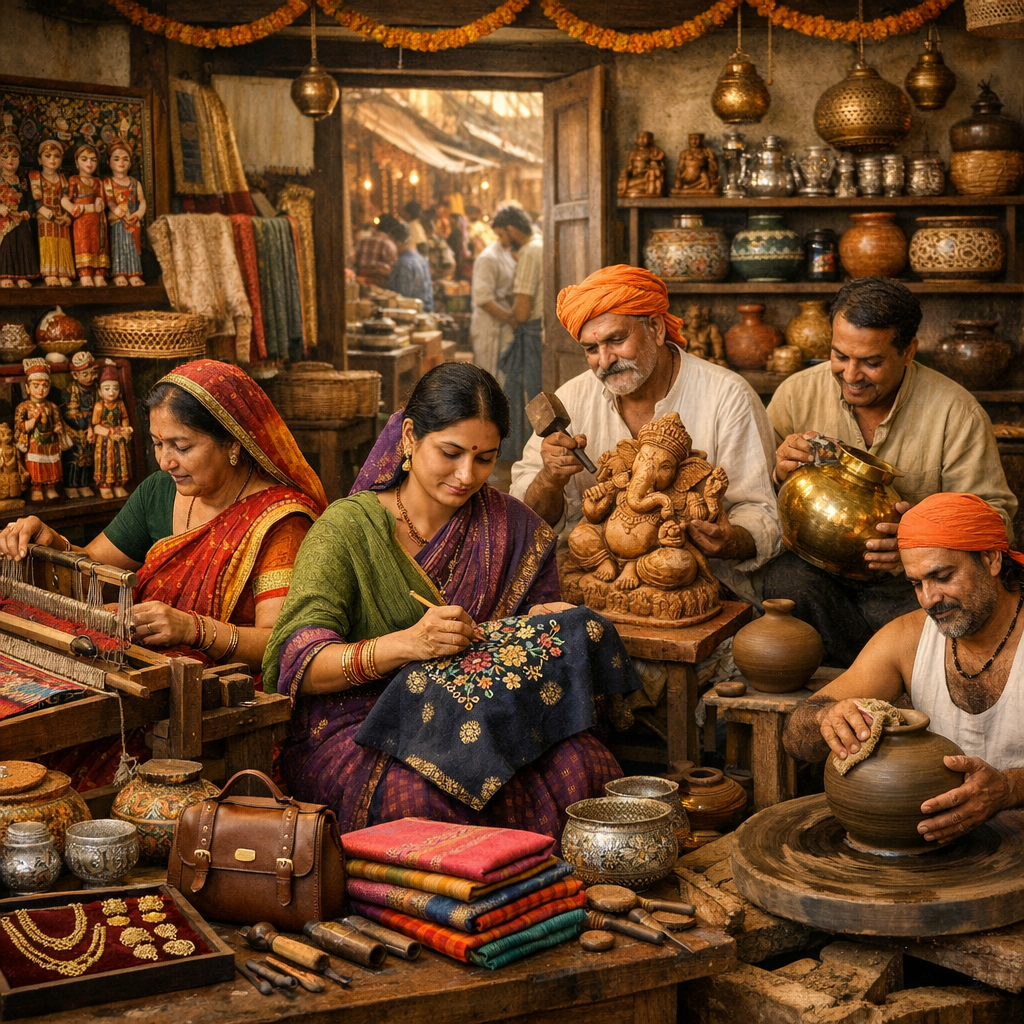
Traditional crafts of India date back many centuries, extending as far as the Indus Valley Civilisation, where wooden objects of craft already enjoyed great fame. Over time, these crafts have entered daily life in almost every part of the country. Every region and every state has its own outlook in this field and its own stock of traditional products that local people design and fashion with skill, patience and imagination. Among the crafts of India one may mention wood carving, metal art, ceramic work, leather goods, textiles, handloom weaving, khadi fabric and embroidery. The intricate workmanship of these crafts has risen in quality through continuous innovation, and the demand for such objects has grown over the years. This sector forms an important part of the Indian economy, contributes a noticeable share to national income and commands a large market both within the country and abroad.
India has many craftsmen and craftswomen who are known for their skills in this area. Across the country, there is a category of artisans who create objects with unique character and a strong sense of beauty. They make decorative pieces for houses, articles for home decoration, fine silverware, elaborate handwoven fabrics, gold ornaments, wooden dolls, paintings on cloth and wood, silk art, metalwork, leather goods and ceramic objects. Such artists receive appreciation for their innovation, and for the grace their work adds to the villages and towns where they live. Within each region certain craftsmen acquire special respect, and people in the country view their work with pride.
Many stories and beliefs surround these traditional crafts as heritage. Certain craftsmen are thought to be among the most skilled and creative, and many of them now regard themselves, and are regarded by others, as heirs to a long line of traditional workers in crafts of India. Anyone who seeks traditional objects and products can meet such craftsmen in markets, fairs and small workshops, where many of them sell their creations at prices that buyers from modest backgrounds can afford. While modern technology has made the production of many kinds of handicrafts easier and less costly, these artisans continue to treat their work not only as a profession but also as a tradition that they follow with almost religious devotion. Thus, the traditional crafts in India touch almost every field of art and design and remain a living expression of the country’s cultural identity.
Onam the Colourful Festival of Kerala
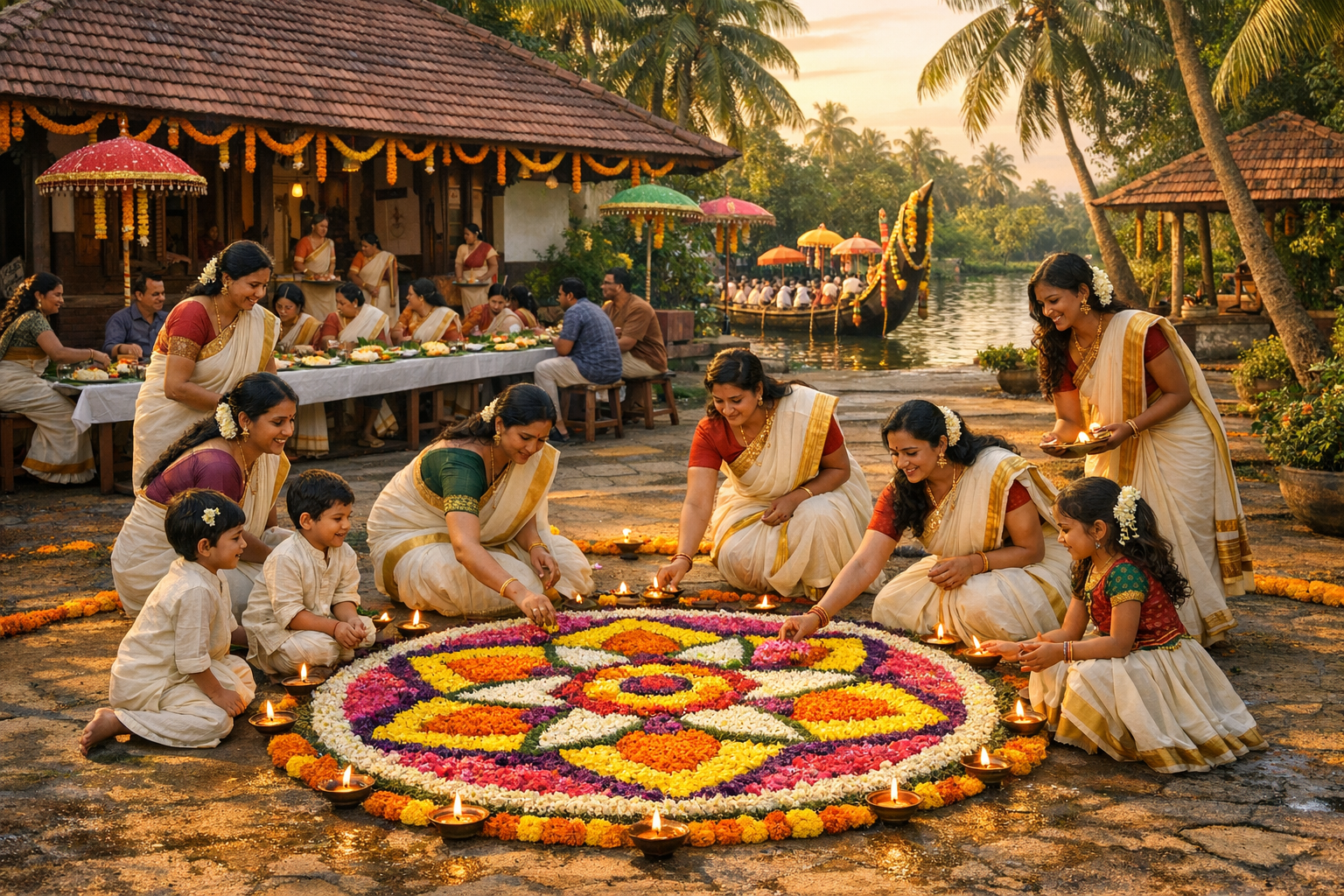
Onam, the most colourful and joyous festival of Kerala, is celebrated with great enthusiasm and energy throughout the state. The celebrations take place during the season when nature appears in full splendour. Flowers bloom in courtyards, fields turn green and water bodies fill. These aspects of nature form part of the chief attractions of Onam. People often describe Onam as the festival that marks the victory of good over evil.
Onam has also become one of the central points of tourism in Kerala. Many travellers plan their visit to experience this auspicious occasion with full passion and fervour. During the first two days, heavy showers often fall on alternate days. In the evenings, the air cools, and the celebrations adopt a gentler pace. Every district in the state prepares its own decorations. People wear traditional dress, sing songs linked with Onam and dance together in groups.
The region appears wrapped in a colourful atmosphere. The influence of Onam celebrations covers the entire state. An air of merriment and fun marks the days. Nearby regions also celebrate Onam with energy and excitement, though the scale may differ. In some places, the scale of the festival in terms of crowds remains relatively modest. Certain other regions commemorate Onam with great pomp and show, yet the celebration outside Kerala does not always match the depth of feeling that people in Kerala attach to the festival. All these regional observances recall the triumph of good forces over evil spirits. The festival on this day also carries meaning linked to the historical backwaters and agrarian past of Kerala.
Classical Dance Traditions of India
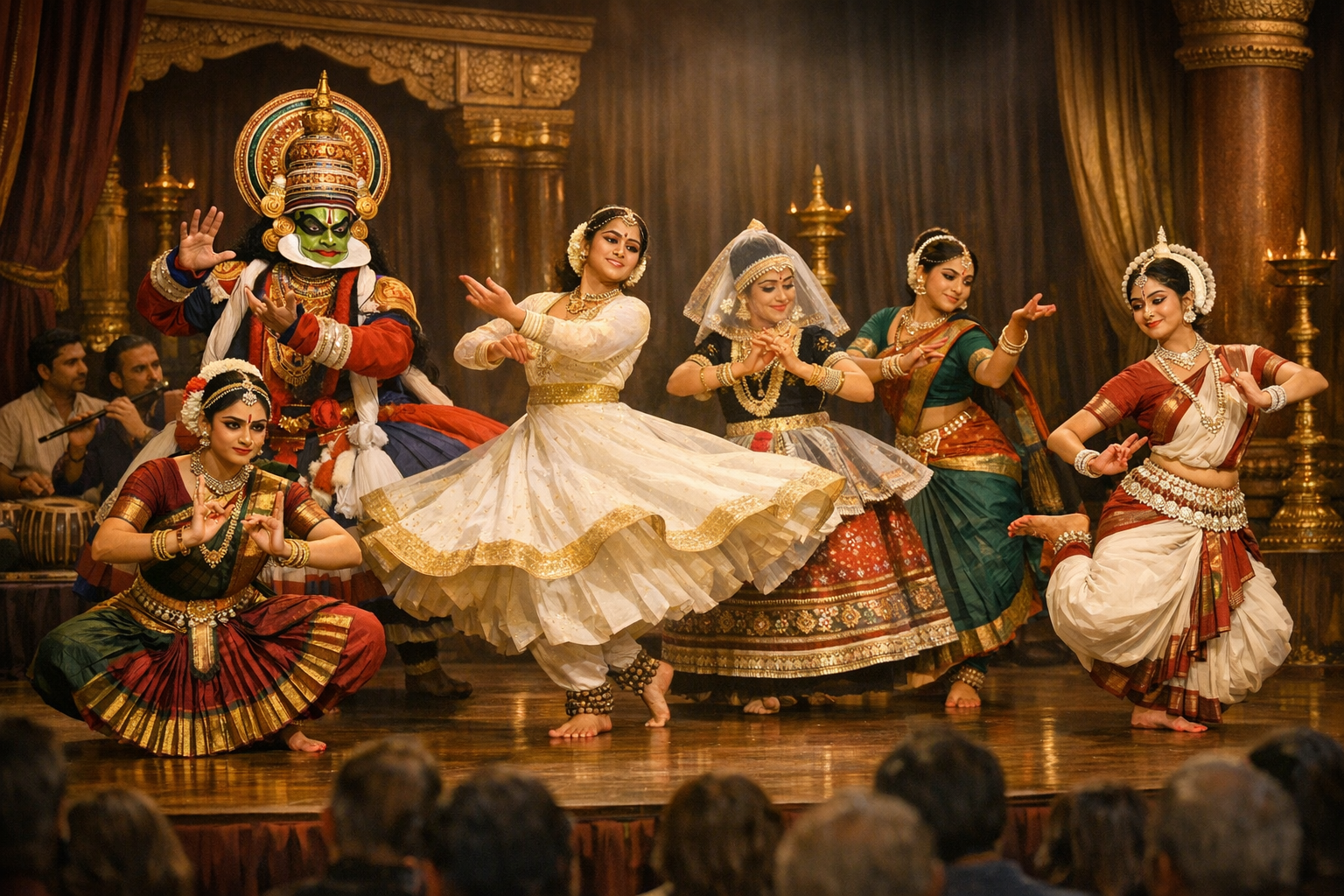
Classical dance traditions of India have moved from one generation to another over long stretches of time. These traditions have also undergone various changes and improvisations. They now include several main forms such as Bharatanatyam, Kathakali, Kathak, Manipuri, Kuchipudi and Odissi. Each has its own grammar and philosophy.
Bharatanatyam ranks among the oldest and most respected forms of Indian classical dance. Practitioners describe it as a complete art. The dance makes intense use of body movements and facial expressions. Many consider it the ultimate form of pure dance, free from the need for material gain. Bharatanatyam took shape in Tamil Nadu around the third century before the common era, at least in its early form. In the present age, Bharatanatyam is practised not only within India but also across the world.
Kathakali holds a central place among artistic traditions of Kerala. In this form, there are different sets of movements that match with one another in a careful pattern. Scholars trace many strands of Kathakali to early traditions in what is now Tamil Nadu and Kerala. Over time, the form travelled to other regions of the country. It has gathered a following in the United States and other foreign lands. Kathakali displays the labour of artists who choreographed it through centuries. It also presents traits such as courage, strength, romance, charm, chivalry, sensuous appeal and idealism. All these appear through a special style of dance. Costumes in Kathakali are highly colourful and often heavy, with rich jewellery. The movements are graceful and fluid. The dancer controls each limb with care.
Kathak is one of the main branches of classical Indian dance. A Kathak performance usually begins with the dancer walking in a circular pattern. Spins follow. There are movements in mid-air and a sequence of intricate footwork. The dancer often ends a sequence with a movement that begins on one leg and turns sharply onto the other. Footwork lies at the centre of Indian classical dance. This applies to Kathak and to other related forms. Properly executed footwork remains a key part of every performance. The sound of ankle bells, known as ghungroo, adds another dimension.
Manipuri dance is considered an art form that belongs especially to the state of Manipur. Many observers hold that this form of dance arose from close observation of local culture and the everyday life of residents in valleys and hills. Movement entered the daily routine and then took on a more formal shape. Tribal communities in the region have practised this art for centuries and keep it alive today. The dance contains movements that express worship, emotion and community feeling. Dancers perform rhythmic steps and other cultural items that serve both religious and social purposes. Manipuri dances bring traditional values and the lifestyle of the people of Manipur onto the stage. Their gentle movements add grace and beauty to scenes from everyday life that the dances portray.
Kuchipudi creates a bridge between inner spirit and outward body. The art takes its origin from a village named Kuchipudi in the state of Andhra Pradesh in southern India. Four basic elements form the core of Kuchipudi. These are the main theme, the central posture, the secondary themes and the hand gestures. The main theme stands for face, body and soul. It emerges through the dancer in poses, gestures and tone. The secondary themes include movements of the head and arms. Hand gestures guide the dancer through various parts of the theme. They add meaning to the emotion and thought that the dancer wishes to bring before the audience.
The Odissi dance of Odisha has formed part of eastern Indian culture for many ages. As happens with several ancient dances that link with religious ceremonies and philosophical ideas, the earliest stages of Odissi appear to have taken the form of mythological drama. Over centuries, Odissi grew and formed its own pattern of presentation. Many people today wish to learn this traditional form of Indian dance. It draws from classical Sanskrit plays and from poetry in the Odia language, yet it has found countless admirers worldwide.
Folk Music of India
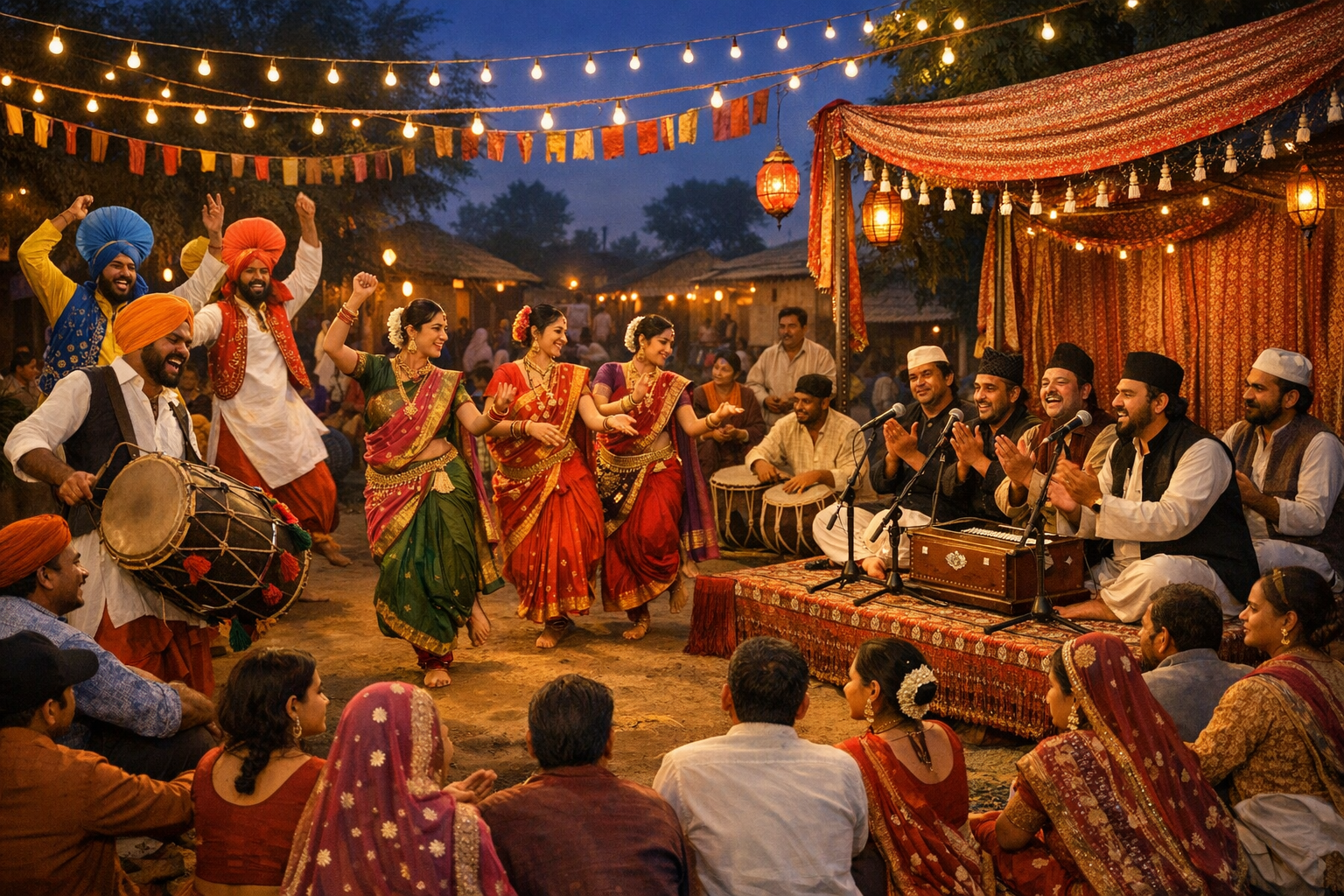
Folk music of India includes many kinds of rural, traditional and religious songs. India consists of many ethnic groups. Each has its dialects, local languages and regional customs. This variety allows a music lover to enjoy many types of Indian songs. Folk music forms such as Bhangra, Dandiya, Lavani, Qawwali and Sufi spiritual music all claim space. Indian folk music offers much richness because of the cultural variety of the country. It is sung in many languages and dialects across the length and breadth of India. In modern times, such music has reached other continents through migration and recording.
Among the popular categories of Indian music, one may mention Bhangra, often described as drum- and percussion-based music from Punjab. It arose in the fields and villages of that region as a harvest dance. Bhangra has remained important in Indian cultural history for a long time. In the age of global travel, the form has taken new shapes. It has met Western instruments and urban rhythms. The drum, especially the dhol, remains central. Other percussion instruments add energy.
Qawwali music ranks among highly valued cultural forms in India. It began as a traditional Sufi form of devotional song. Qawwali took shape in the subcontinent as praise for God and for Sufi saints. Over the years, the style has entered varied settings. Musicians have adapted Qawwali for large stages, for cinema and for private gatherings, yet its core tone of longing for the divine remains. People regard this type of music with great respect because it carries the essence of a spiritual heritage. Many admirers of Qawwali belong to the Islamic faith. Listeners in other communities have also learned to love it. The art is slowly gaining more listeners in Western countries. Qawwali musicians in India have developed themselves as experts in this spiritual genre that belongs to the traditional Sufi community of the region.
Lavani folk music of Maharashtra has a history that stretches across centuries. The sounds of its traditional instruments once filled village squares and farming lands. They now also reach theatre halls and films. Lavani is famous for melodies that do not fail to soothe the mind. People feel drawn to its rhythm. One can set many tunes against these rhythmic patterns and dance to them with ease. Lavani concerns not only the beat that relaxes the listener. It also includes colourful costumes, detailed celebrations and a simple yet intense way of coming together for enjoyment.
Folk Theatre
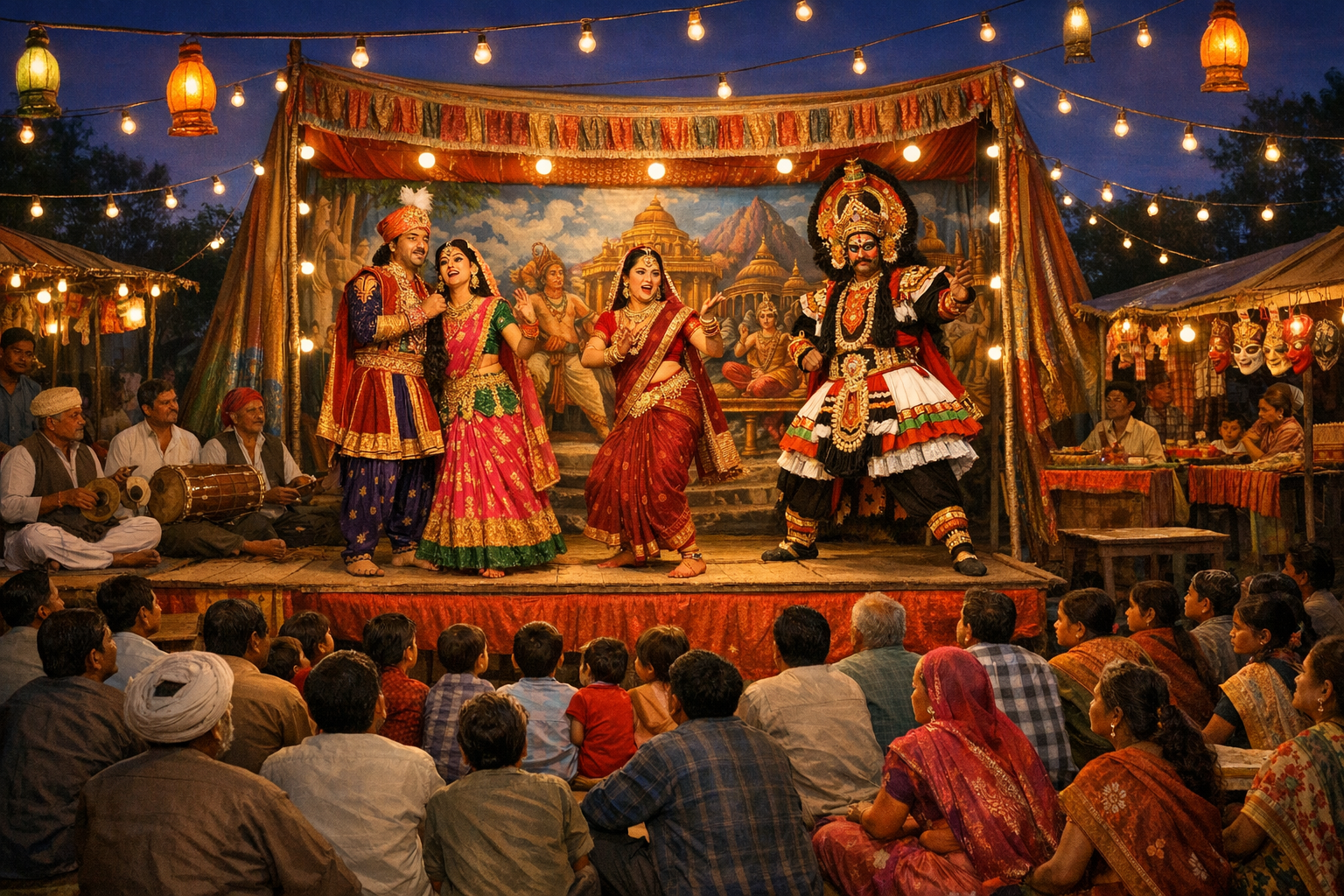
Folk drama in India forms a unique branch of art. Its origin lies in ancient times. These dramas, known by many names such as Nautanki, Tamasha, Lavani performances, Yakshagana and Jatra, go back to early periods of Indian civilisation. Characters such as fairies, jinns and a large range of comic or silent figures often entered the action. They made the traditional Indian story more attractive. People valued these stories in large part because performers could stage them again and again, each time with small changes. Young people and those newly introduced to a region learned much about life from such shows. Storytelling in this form could take place indoors or outdoors. Indoor shows depended mainly on recitation and acting. Outdoor performances often displayed a more adventurous and energetic character.
Folk theatre has travelled a long path and now covers many kinds of performance across India. The term includes Nautanki, Tamasha, Yakshagana and many other regional types. These forms present detailed portrayals of stories. Yakshagana, for instance, draws its strength from the classical ballad. The story unfolds through music and acting. Indian musical instruments and special vocal styles add richness to the performance. Themes often touch upon mythology, religion, love stories and poetic verse. This wide field of folk theatre includes a range of story levels, from epic sagas to social commentaries and domestic dramas.
Oral Literature
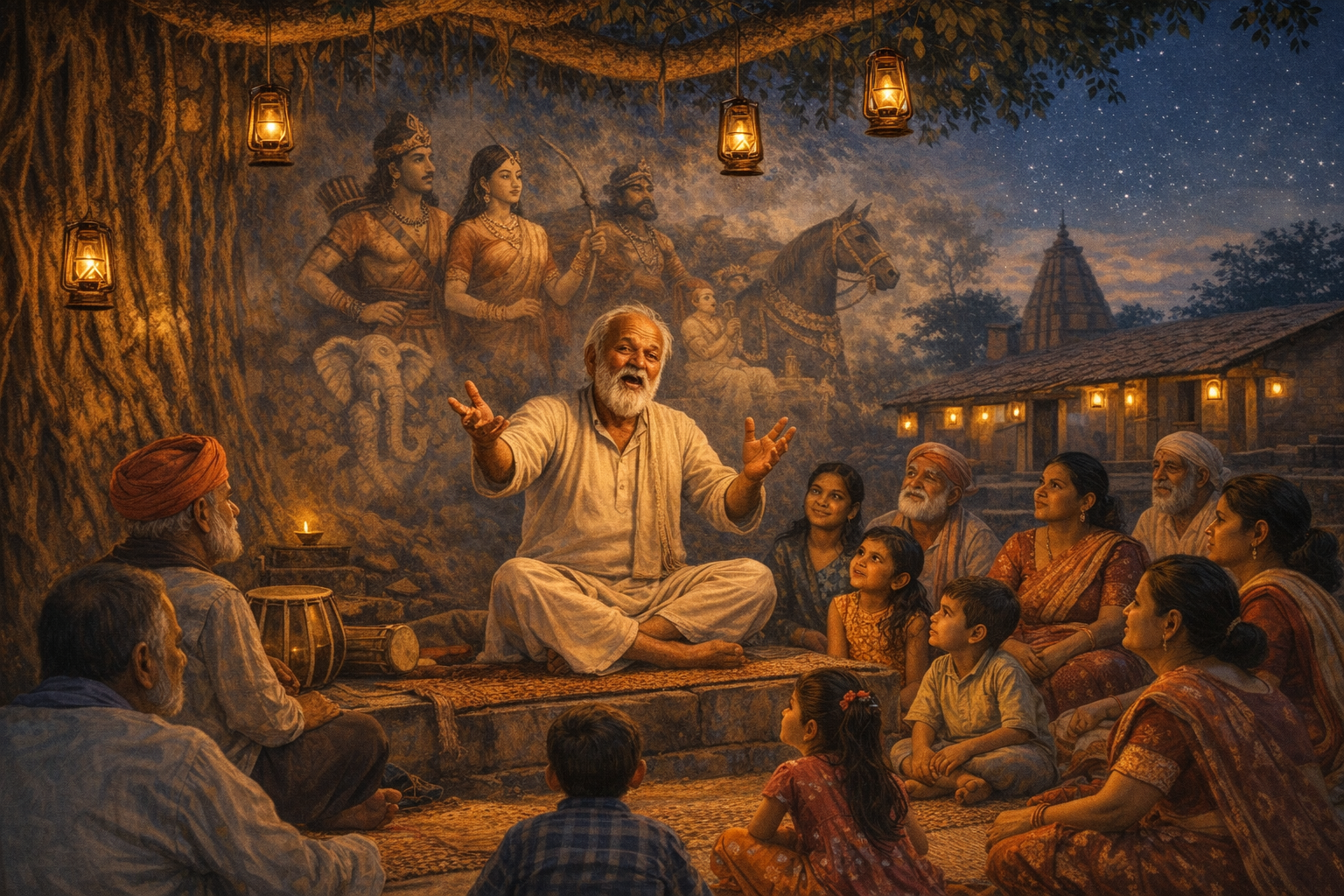
The oral literature of India has made great contributions to world literature. Many observers remark that the Indian public behaves like a living library of world literature. Several factors lie behind the endurance of this oral tradition. It belongs among the oldest forms of literature in history, with parts that date back at least to the seventh century before the common era. It is mostly regional and rooted in South Asia. It consists of rich collections of myths, legends, epics and folk stories. It contains innumerable tales and fables. Some have an historical connection. Others move in mythical time. Oral literature describes customs, faiths and daily habits of people in different parts of India. It speaks about arts, crafts, architecture, ways of living and many other aspects of existence.
This vast literature derives from many streams. The Vedas, the Ramayana and the Mahabharata stand among the earliest sources. The works of Kalidasa and other Sanskrit authors added major strands. Writers in regional languages also joined this effort across centuries. The tradition of oral literature in India thus stretches from early epics to revival movements in the nineteenth century. There appears to be no limit to the depth of Indian orature. India has produced many literary minds who celebrated life and reached an understanding of this land through word and performance.
Indian oral literature has long enjoyed recognition for its rich contribution to intellectual, social, linguistic and historical fields. Its contribution to the growth of human knowledge and culture remains considerable. The present-day India continues to carry cultural and intellectual influence because the long tradition of oral literature has not broken. Another important feature of Indian orature is its scattered yet intact character. The tradition spreads across the length and breadth of the country, yet much has survived in living memory. The long history of this branch of literature still enriches the experience of people living in villages and cities alike.
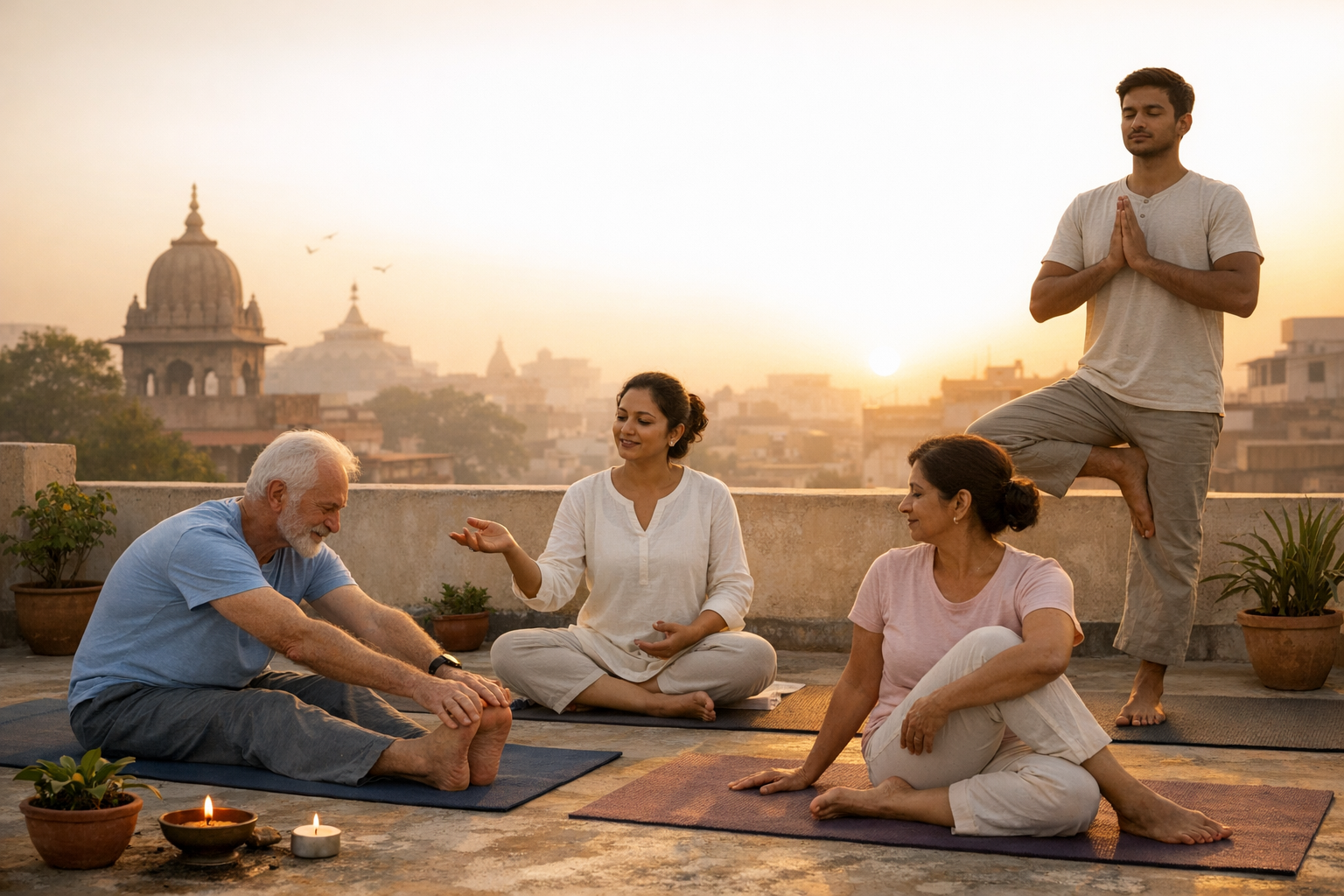
Yoga
Many people around the world ponder whether yoga functions as a healing practice. For those who approach yoga as exercise, it brings clear benefits to the body. The practice helps circulation, flexibility and weight control. Yoga has a calming effect on the mind. It improves mood and clears confusion. One of the appealing features of yoga lies in its relatively low-impact nature. A person can perform many asanas gently and fit them into a daily routine at home.
The Yoga Sutras may be regarded as a central work that discusses the physical, mental and spiritual condition of a human being. The yamas contain guidelines that govern the actions of one who follows yoga. The niyamas contain instructions such as an early rising habit and a fresh mind at dawn. The aspirant receives counsel against harmful thoughts. The discipline covers conduct, concentration and compassion.
The purpose of yoga is to build a balance between mind and body. While the body exercises, the mind too acquires strength and steadiness. People in many towns and cities attend yoga classes in which they stretch and breathe under guidance. Such practice need not add much weight or require heavy equipment. Many doctors today accept yoga as a helpful practice. They note a healing process that unfolds when someone follows yoga with sincerity over a long period.
Yoga serves as a powerful method to improve mind and body as well as flexibility and coordination. A person who thinks of yoga only as physical workout may miss its deeper rewards. Yoga involves attention to mental state, levels of concentration and the response of the body to slow and deliberate movement. It is a form of exercise that grants a measure of balance among mind, body and spirit.
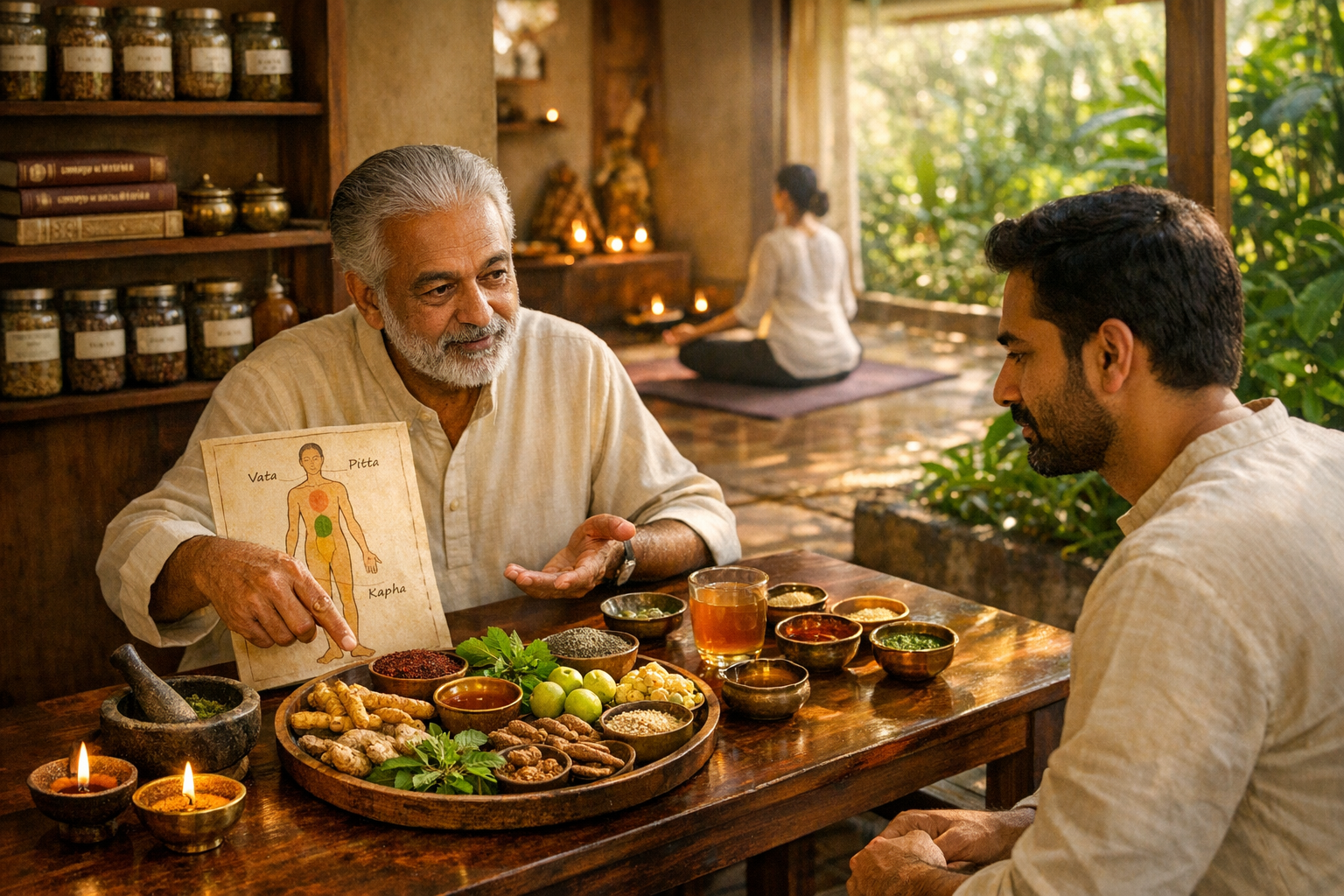
Ayurveda the Holistic Medical System
Ayurveda and spiritual healing seldom come together in common speech, yet they stand very close in principle. When a person considers Ayurveda, that person enters a broad approach to medicine. The system turns towards the whole person and advocates measures that prevent illness. It does not remain satisfied with the treatment of one symptom. Spirituality, in turn, points towards enlightenment and an overall sense of well-being and health.
Those who seek the best in Ayurveda and spiritual healing often look for a practitioner who follows a holistic outlook. Ideally, such a healer holds a degree from a recognised institute of Ayurveda and perhaps a master level qualification in health science with specialisation in nutrition. A trustworthy Ayurvedic doctor can show a patient that there are no grave deficiencies or imbalances in diet or can name those which exist. Proper diet and supplementation then maintain health at an optimum level. A sincere practitioner of Ayurveda does not treat the system as a home remedy or a loose set of dietary rules. The best result comes when a person adopts a big change in lifestyle. This change addresses the roots of an illness and works towards removing the imbalance that gave rise to it. Ayurveda and nutrition stand side by side in such a process.
Another shared element in Ayurveda and other holistic healing methods is their long history. Many of these practices have existed for thousands of years. They now gain popularity in Western countries through new age and alternative medicine. There are several forms of Ayurvedic-based healing active in India and abroad. One may name Hatha Yoga, Kundalini Yoga, Ashtanga Yoga and related schools. These disciplines turn attention towards the inner state of the person through exercise, meditation and deep breathing. This forms the starting point of Ayurveda. A common belief lies at the centre. The human body has the capacity to heal itself when conditions fall into balance. This belief sets Ayurveda and similar systems of ancient medicine apart from more mechanical approaches.
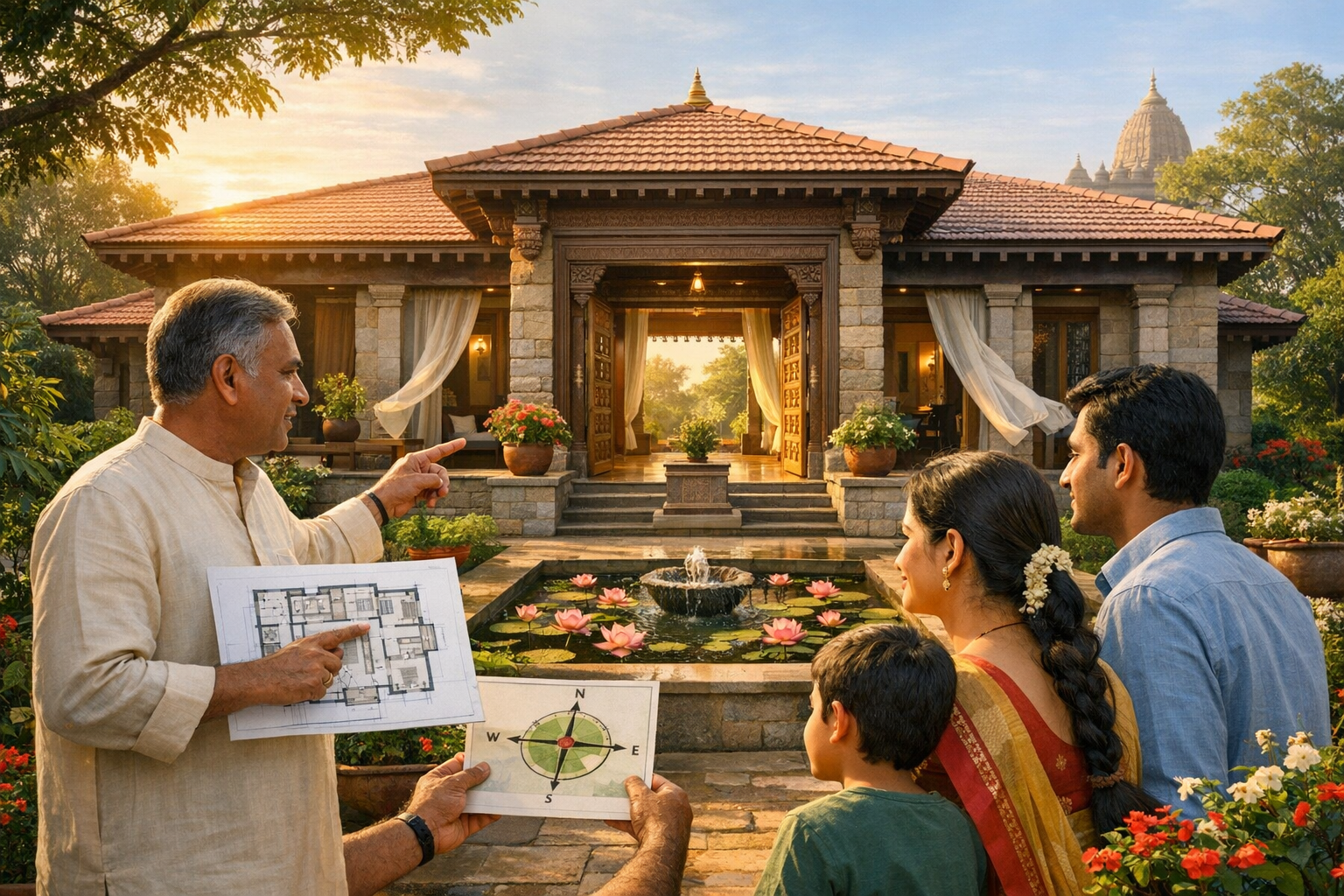
Vastu Style of Architecture
The Vastu system of architecture belongs to an ancient approach to the design and construction of Indian buildings. The term Vastu comes from Sanskrit and often carries the sense of science of architecture in English. Vastu, however, does not refer only to building design. The concept links elements of nature, spiritual insight and practical science within the structure of a house or temple. Modern science may appear to dominate architectural practice in many Indian cities today, yet large numbers of people in India continue to hold traditional architectural teachings in high regard.
Traditional Hindu teachings rest on the thought that all living things require a proper flow of energy. This energy cannot be seen, yet people experience it as a force within living beings. The aim of Vastu is to direct and balance the energies in a building so that those who live there enjoy a long and healthy life. The building itself also gains an extended life span.
Those who follow Vastu teachings study the positions of the sun, wind, rain, trees, rocks and moon. The architect who learns these relationships can make efficient use of natural resources while designing buildings. Proper use of such resources cuts energy costs and meets needs without waste. When architects and residents follow Vastu with sincerity, buildings gain functionality and attractiveness. At the same time, they reduce harm to the natural environment. People who stay in such spaces save money on energy and breathe cleaner air. Vastu occupies an important place in Indian architectural style. It shapes almost all ancient temples of India and continues to influence modern construction.
Conclusion: Everlasting Cultural Heritage of India
India counts among countries with ancient and many-sided cultures. People in India inherit a rich cultural legacy that passes from generation to generation. This legacy does not concern written texts alone. It includes customs, dance, music, rituals and shared social practices. The history and heritage of India have drawn amazed attention from visitors across the globe. They travel through different regions and encounter countless faces of Indian culture.
One central feature of this culture lies in the unity that emerges among different states. Every state in India carries more than one religious tradition or spiritual path. Hinduism, Islam, Christianity, Sikhism, Buddhism and Jainism, among others, all have their ceremonies and modes of worship. Each religious tradition introduces its own practice and ritual pattern into the festival calendar. People from different backgrounds meet during such events and share food, music and stories.
Many elders repeat a thought that runs through public life in India. Strength grows from unity. The building of a culture that does not bend under pressure demands patient work from each generation. India continues to present itself as a cultural power that touches other parts of the world through art, faith and thought. The need to preserve this heritage and guard it from forces of shallow modernity has become urgent. Languages, oral traditions and many crafts stand under stress from rapid urbanisation and uniform media.
For this reason, the country stands in need of a clear and comprehensive public policy on intangible cultural heritage. Such a policy must not rest only on lists drawn up in distant offices. It should grow out of patient discussions with local communities in different regions. These communities keep traditional knowledge alive. Their stake in cultural projects is extremely valuable. Government agencies at the centre and in the states have begun to take steps in this direction. The steps must encourage local people and draw youth into active roles. Cultural projects can include training centres, apprenticeship schemes, archives and festivals that appeal to young minds rather than bore them. When the work becomes enjoyable and meaningful, local participation rises.
The future generations of India have the right to enjoy the fruits of past labour. They will need songs, stories, styles of dress, festivals and rituals that tell them who they are. Thoughtful policy and steady local involvement can protect the heritage of India from slow disappearance. If communities, scholars and officials act together with such a purpose, then the intangible cultural heritage of India can remain an everlasting source of strength and inspiration.
***
Note: Pictures in this essay have been drawn using a paid AI tool.
31-Oct-2026
More by : Prof. Rajeshwar Mittapalli
