Oct 31, 2026
Oct 31, 2026
...a handbook for shapers of tomorrow
 Introduction
Placed before you are a collection of essays written in simple English, primarily addressing adolescents in grades 9 to 12, though generally useful to all others.
The writer believes that students entering into an awareness of the highly competitive conditions of today's society and world need guidance and counseling beyond the academic knowledge currently being ingrained into them. Because of the constant pressure to achieve the best results, school administrations and teachers may lack the time to delve deeply into these crucial life topics. Giving this handbook to each student to read during their vacation—perhaps with an incentive offered at the end of the academic year—will surely address this issue.
This handbook can be published by any consenting school, and how to acknowledge the efforts of the writer will be left entirely to the publisher. A mandatory mention in the book must be its core philosophy: The main purpose is to aid and serve, and not to serve oneself.
Keeping this introduction short, the topics covered in these essays are:
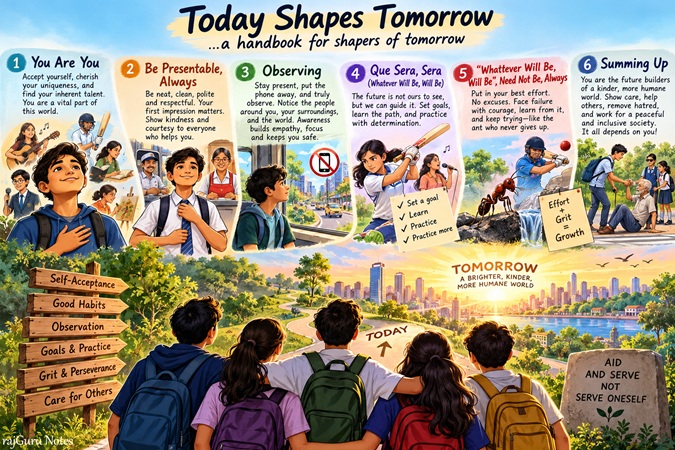
Chapter 1: You Are You
Strange as this title may seem, dear one, yes, you are an individual with your own unique identity, regardless of your physical attributes and mental faculties. Tall or short, fair or dark-complexioned, strongly built or frail, known to be highly intelligent or an average student—whatever and however it may be, the very first necessity for a non-egoistic, grudge-free existence and for building a successful self is Acceptance.
You must accept yourself with all your inherent attributes, characteristics, and qualities. Once you accept yourself exactly as you are, there will be inherent peace within you, and no rancor toward the outside world. After all, without others running behind them, no one can come first in a race, isn't that true? Remember, this world is made up of commoners, not idols. It is the commoners who sustain these idols; be pleased with that fact. And dear one, this humility is your specialty. Be proud of it. An idol could be a prick at times, but you never are, isn't that so?
To expand further, every single individual has some talent or another. One may sing well, another might be an excellent drummer, one could be an impressive writer, another a great orator, and yet another a well-known sports person. A Vaibhav Suryavanshi is a Vaibhav Suryavanshi, not a Jasprit Bumrah. A Sachin Tendulkar is a Tendulkar, not a Rafael Nadal. It is likewise with each one of us. So, everyone is unique, and you are you. All it takes to better oneself is to identify your inherent talent and take proactive steps to achieve excellence in that field.
If I cannot accept what I am and what I have—if I fail to identify my strengths and weaknesses—I will become jealous of others. That bitterness will stop me from improving, as I will always be focusing on others instead of bettering myself.
How to go about doing this is the second step, which will be explained in the essays to follow. Always remember, without each and every one of us, this world would be a barren, unlovely place.
Chapter 2: Be Presentable, Always
It takes just a little consciousness, care, and effort to be neat and clean and to make a good impression. Rich or poor, it does not matter. Remember the saying, "The first impression is the best impression." This is both true and realistic. We must bear in mind that even before we utter a single word, the very first look a person gives us forms an impression. The words we speak afterward, and the manner in which we say them, will either strengthen that good impression or negate it entirely, bit by bit.
You may have only one pair of school uniforms. With proper care, it does not have to get soiled or crumpled. If possible, wash and dry it overnight. Fold it properly, smoothing out the creases. Lo and behold, you will appear just as neat, clean, and presentable as anyone else in the classroom. In life, every single action—good or bad—requires effort. Even chewing sweetmeat requires effort, isn't that true, my friend?
Etiquette, politeness, and good manners are the essential ornaments one should wear alongside being neat and clean to present the best version of oneself. A slight, respectful bow as you present yourself, speaking slowly and clearly when answering a question, and remaining humble and honest form the framework in which your personality should be displayed. Being courteous to everyone who helps and serves us is the extra polish this frame needs.
Showing courtesy to the school bus driver, the clerk at the counter, or the person serving food in the canteen shows that we care about humanity, irrespective of a person's station in life. Why not offer an endearing little smile, even when we are tense, bothered, or in pain? Every person we win over with kindness becomes an invaluable, everlasting asset to us.
We all wish to be cared for by our parents, teachers, and others, without a doubt. Is it not incumbent upon us, then, to be equally—if not more—caring toward others? It is always better and more heartening for all of us to make this world a little livelier and more enjoyable
Chapter 3: Observing
Dear young ones, what I am going to say now may offend you a bit, but believe me, this habit helps immensely.
As soon as we students—and I am including myself here, as I too am a student of life—get into a school van or any public transport, our immediate instinct is to open our smartphones to check WhatsApp, Instagram, or some other social media feed.
But let me ask you a simple question: Have you ever truly watched your mother’s face when she comes out of the hot kitchen? Have you looked at your father’s face when he returns home from a grueling day at work? Or your teacher’s face after a full day of managing a classroom? Be honest with yourself. If you look closely at them, you will automatically understand what observation really is, and why it matters so much.
Consider this scientific fact: A baby of six months or older observes everything—faces, expressions, and surroundings—twenty times more intensely than an adult, recording all that data in their developing brain. Just by the touch of a hand, a baby can sense their mother's mood. An angry stare can make a baby cry or look utterly puzzled. That is exactly how a child in a cradle learns about their world. Try to test this theory; I am ready to admit I am wrong if you can prove otherwise.
Coming back to our daily routine, your transit route to school changes slowly but surely over time. New buildings rise; new shops and businesses open. If you look out the window and notice them, you will learn your neighborhood thoroughly. If your school vehicle ever breaks down unexpectedly, you won't get frantic or lost; you will easily navigate your way to your destination because you know exactly where you are.
If you practice observing daily, you will easily sense when your teacher is feeling under the weather or when they are in a particularly joyous mood. This heightened awareness trains your brain to focus deeply on the task at hand, anchoring your attention so your mind doesn't waver.
An added advantage is that when people realize you are observant, they instantly become more mindful of their own behavior around you. Most importantly, keen observation helps you spot impending trouble or physical danger early, giving you the critical moments needed to protect yourself or save others from harm.
I challenge you: do my bidding for just one week. Put the phone away, observe everything around you while you are awake, and watch how your world changes.
Chapter 4: Que Sera, Sera (Whatever Will Be, Will Be)
Dear young friends, let me share a beautiful and famous song with you. It goes like this:
Verse 1:
When I was just a little girl
I asked my mother, "What will I be?
Will I be pretty? Will I be rich?"
Here's what she said to me:
Chorus:
"Que Sera, Sera
Whatever will be, will be
The future's not ours to see
Que Sera, Sera
What will be, will be"
Verse 2:
When I grew up and fell in love
I asked my sweetheart, "What lies ahead?
Will we have rainbows day after day?"
Here's what my sweetheart said:
Chorus:
"Que Sera, Sera
Whatever will be, will be
The future's not ours to see
Que Sera, Sera
What will be, will be"
Verse 3:
Now I have children of my own
They ask their mother, "What will I be?
Will I be handsome? Will I be rich?"
I tell them tenderly:
Chorus:
"Que Sera, Sera
Whatever will be, will be
The future's not ours to see
Que Sera, Sera
What will be, will be"
We all have burning questions about our future, don't we, dear ones? Yes, not only you, but even elders like me. Some of these questions are answerable, while others never will be.
Whatever will be, will be—that is true. But for the future to happen in the best way possible, we must lend it a hand. We must guide it in the direction we want it to go. After all, it is your individual life, isn't it?
If you want to go to a cinema, a fair, or an exhibition, a certain amount of effort must be put in. It will not do for you to simply sit back and say, "Whatever will be, will be." You have to ask your parents, convince them to take you, get ready, and actually travel to that place.
So, how do we push the future onto a path that is favorable to us?
If I want to be a highly successful and adored cricket player, I have to go to the ground and play. If I just sit at home watching a match on television, even my own sister won't accept me as a cricketer! If I am hungry, I have to use my own hands to feed myself from the plate. Otherwise, we all know exactly "what will be, will be" for me—I will remain hungry.
Therefore, what is needed first and foremost is a liking, a desire, and an unwavering, iron-clad determination. Let me share a real-world fact so you better understand what I am hinting at. To reach where he is, the young prodigy Vaibhav Suryavanshi practiced for six hours daily. Let me repeat that: six hours every single day, just hitting the ball with his bat. That is what true determination and drive look like.
Hence, the formula is:
1. Aiming for a set goal.
2. Learning the exact path to reach it.
3. Practice, practice, and more practice.
Look at another legend: the great Asha Bhosle. Even after reaching her 90th year, having already sung professionally for about 75 years, she still practiced her vocals for three hours a day. You might ask, why did a legend need to do that? Because true mastery requires never-ending practice.
Even after putting in all this effort, things might not always go your way. Absolute success is never guaranteed, and "Que Sera, Sera" might still happen. But by giving it your everything, you will live a life of immense satisfaction, free of regrets.
Chapter 5: "Whatever Will Be, Will Be", Need Not Be, Always
Dear attentive children, I am not contradicting myself here.
Visualize this: you have a bat in your hand. You watch the ball carefully from the exact moment it leaves the bowler’s hand, and you hit it with all your might. Whether it goes for a six or a four, you don't know yet either. That is where "whatever will be, will be" truly applies.
But if you completely miss the ball, we all know what happens. Likewise, if you don't even hold a bat, make absolutely no effort to swing, and then sit back saying, "Whatever will be, will be," you are simply comforting yourself with an excuse. Yes, my friends, that is just offering an excuse for a total lack of effort.
Simply put, during these crucial years of learning, preparing, and building your capabilities, you must put all your brawn and brain into your goals. Concentrate hard, listen carefully to your teachers, comprehend your lessons fully, and then pour your energy into relentless practice.
To refresh your knowledge, learning has no age limit. Think of the inspiring stories of 80 or 90 years old people who finally finished their school education or proudly acquired their graduation degrees later in life.
Let's do a small experiment. Place a thin line of water in the path of a moving ant. Watch how relentlessly it tries to overcome that barrier. You might get exhausted just watching it, but the ant will not stop until it finds a way around or over it.
Even after putting your best effort to the 'T', you might still fall short of your ultimate goal. Think of tennis legends Roger Federer and Rafael Nadal. Recollect how hard they fought to achieve the ultimate record for Grand Slam wins. Yet, in the end, it was Novak Djokovic who surpassed them. In a few years, another player will come along and break his record, too. Think of how passionately the Ireland cricket team fights, putting in immense effort to secure a one-day international series win against a powerhouse like India.
Effort is the prerequisite. At the ultimate step, you may win or you may lose. If you win, be gracious. Appreciate the hard work put in by your rival. Always remember: there is no first-place winner without someone else coming in second, right?
And if you fail, you must first accept that failure. Analyze it. Perhaps it was due to insufficient effort, a momentary lack of concentration, a dip in confidence, or a small technical error. Getting disheartened and quitting is not for us—we are the determined lot, built to achieve success and reach our goals. Your day, my day, and our day will always come, as long as we keep trying.
Remember the ant.
Chapter 6: Summing Up
In the preceding chapters, we have discussed the essential ingredients required to lay a firm foundation for the grand edifice we intend to build of our lives. No one desires to be a failure—least of all any of you, isn't that true? We shall do our absolute best, and only then let the final result be: "Whatever will be, will be."
Not intending to waste your precious time, I will not recount everything we have already covered. Instead, I want to leave you with a few vital thoughts to carry with you.
The Future Builders:
Dear young ones, please realize that this entire world will depend upon you some twenty to twenty-five years from now. Long ago, someone invented the wheel, and from that single spark, humanity moved forward to create the world we see today.
Today, many grown-ups hold the opinion that the young generation wants nothing but fast results, that adolescents do not care much about their surroundings or others, and that you wouldn't even be interested in reading a handbook like this. Even if that is currently true, I will not consider the time and effort spent writing this to be a wasted exercise. If not today, then someday you will peruse these words, understand their value, and hand this book down to your own children. I know that once you reach the age where you must actively work to build your own life, you will evolve into deeply responsible inhabitants of this world.
To be completely frank, it is my opinion that my generation, the generations before mine, and your parents' generation have grossly failed to hand over to you a world that is peaceful. We have failed to give you a world that interacts in a spirit of healthy give-and-take—a world where one's individual faith does not make them intolerant of another's, and a world where hunger no longer exists.
Honestly, is mine just a pipe dream? If you agree with my vision, then I challenge you to act and help build that better world.
Truly, it is all up to you, dear ones.
If you understand what I am trying to say, let us first prioritize genuine human feelings. Not much is asked of you. Just show a little care for the people around you: help a visually impaired person cross the road, lend a helping hand to someone who has tripped and is struggling to get up, help a classmate understand a difficult lesson, and above all, remove hatred, bitterness, and intolerance from your hearts. Will you do this for me, please?
I believe you will.
I thank you in advance. God bless each and every one of you.
Image courtesy rajGuru Notes
31-Oct-2026
More by : Ramachandra Rao Nanduri
Top | Individuality | Home
