El Nino, Emptying Granaries and Rising Prices
When the monsoon falters, the price of food becomes the price of economic stability.
“Everything else can wait, but not agriculture.”
— Jawaharlal Nehru, India’s first Prime Minister
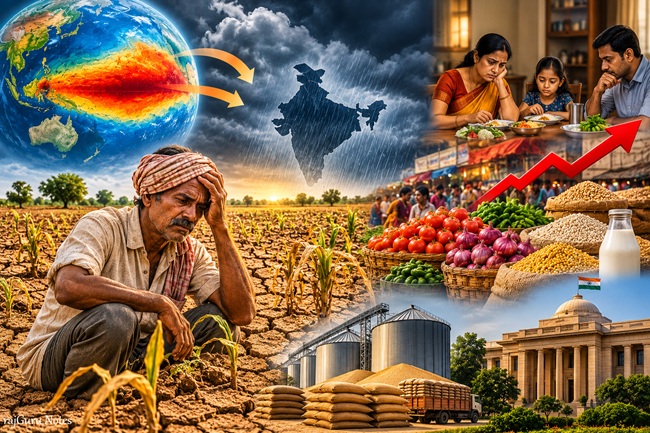
India’s greatest economic anxieties sometimes begin far beyond its financial markets—in the warming waters of the Pacific Ocean. El Nino, a climatic phenomenon caused by unusually warm sea-surface temperatures in the central and eastern equatorial Pacific, can disrupt global weather patterns and weaken the Indian monsoon. Its consequences travel from parched fields to crowded markets, and from farmers’ shrinking incomes to household budgets already strained by rising living costs.
Key Takeaways
- The monsoon has underdelivered: the 2026 southwest monsoon ended roughly 12.6 per cent below normal, as reported by India Meteorological Department (IMD) data.
- Food inflation is the main risk, led by vegetables, pulses, edible oils and, possibly, milk.
- Rural India could be hit twice: once through lower farm incomes and again through costlier food.
- India is not defenseless: central grain stocks are well above buffer norms, and irrigation, public distribution and welfare schemes offer real cushions.
- Timing is everything: early, targeted action costs far less than a reaction after prices have already surged.
Where Things Stand
- A weak season overall. The southwest monsoon closed with rainfall about 12.6 per cent below normal, and the intensifying El Nino has sharpened worries over farm output, food prices and rural demand.
- Crops at a vulnerable stage. The Finance Ministry’s Monthly Economic Review for August 2026 warned that weather stress “could pose downside risks to crop yields during the Late-August flowering and grain-formation stages.”
- A poor start made it worse. June 2026 was among the driest Junes on record, with rainfall reported at nearly 40 per cent below the long-period average, which delayed kharif sowing in many areas.
- Distribution matters as much as the total. A national average can hide sharp deficits in particular states and districts, and badly timed dry spells can damage crops even in a “near-normal” year.
- El Nino is not over yet. Such events usually peak around the northern winter, so the effects on soil moisture, reservoirs and the coming rabi season need close watching.
- A crisis is not automatic. The impact will vary across regions and crops; El Nino does not by itself translate into a nationwide food emergency.
From Rainfall Deficit to Inflationary Pressure
- Lower yields. Despite better irrigation, technology and crop management, agriculture still leans heavily on the monsoon. Pulses, oilseeds, cotton and other rain-fed crops are the most exposed.
- Costlier irrigation. Water scarcity forces farmers to pump more groundwater, raising diesel and electricity costs.
- Fodder stress and milk prices. Fodder shortages push up livestock expenses and can eventually lift dairy prices.
- Vegetables move first. Perishables such as tomatoes and onions react fastest to weather shocks, and past El Nino episodes have added to headline inflation mainly through vegetable prices.
- Edible oils are a weak spot. India imports more than half of the edible oil it consumes, so a poor domestic oilseed crop combined with costlier global supplies can feed quickly into kitchen budgets.
- Food weighs heavily on the CPI. Because food makes up a large share of the consumer price index, even a moderate food shock can move overall inflation.
- Households lose purchasing power. Families that spend a big share of income on essentials feel rising prices first and hardest.
The Finance Ministry has made the same point. Its August 2026 Monthly Economic Review cautioned that elevated food inflation, “by absorbing a larger share of household disposable income,” could leave families with less to spend on everything else.
The Ripple Effects Beyond the Farm
- Weaker rural demand. Lower farm incomes mean fewer purchases of two-wheelers, tractors, consumer goods and services, hurting businesses well beyond agriculture.
- Rabi season risk. Poor soil moisture and low reservoir levels can cause damage to the winter crops, including wheat and pulses.
- Power and water stress. Weak rainfall can reduce hydropower generation while raising electricity demand for irrigation pumps, and it strains drinking-water supplies in towns and villages alike.
- The RBI is watching closely. Governor Sanjay Malhotra has flagged a deficient and irregular monsoon under El Nino conditions as a key risk to farm activity and rural consumption, while pointing to crop diversification, climate-resilient crops and water conservation as ways to soften the blow.
- A harder job for monetary policy. Central banks usually look through short-lived supply shocks, but persistent food inflation can raise inflation expectations and delay interest-rate relief for borrowers.
- Pressure on public finances. Relief packages, higher subsidies and crop-insurance payouts may stretch government budgets.
- Global spillovers. El Nino also affects other producing regions, which can tighten world supplies of rice, sugar, wheat and vegetable oils and make imports more expensive just when India may need them.
India’s Cushions: Strengths to Use Wisely
- Ample grain stocks. Central pool stocks of wheat and rice stood at about 870 lakh tons on 1 September 2026, roughly 2.8 times the buffer norm for 1 October. The issue is not an empty granary but whether stocks are released in time and in the right places.
- Market tools are ready. Surplus wheat and rice can be sold through the Open Market Sale Scheme to cool cereal prices.
- A wide safety net. The public distribution system and free food grain scheme protect the poorest households from the worst of cereal inflation.
- Official awareness. The Finance Ministry has already flagged weather-related risks and El Nino as concerns for the food-inflation outlook.
- Real limits remain. Grain stocks cannot fully protect against shortages in pulses, edible oils, vegetables or milk, which is where the policy focus must sharpen.
Prevention Is Cheaper Than Panic: What Government Should Do
- Monitor continuously. The Centre and states should track rainfall, soil moisture, reservoir storage, crop sowing and wholesale prices in real time.
- Put district contingency plans into action. Forecasts must turn into practical advice on short-duration varieties, drought-resistant seeds, efficient irrigation and alternative crops where sowing becomes unviable.
- Release buffer stocks judiciously. Market interventions should be timely, transparent and targeted at regions where prices are rising fastest.
- Plan imports early. Arrangements for pulses and edible oils should be made before prices surge, not after.
- Strengthen financial protection. Crop insurance claims should be settled quickly, and farm credit should be affordable, with loan restructuring in the worst-hit districts.
- Secure water and fodder. Drinking water security, fodder banks and cattle camps can prevent distress sales of livestock.
- Create rural work. Expanding public works under rural employment schemes can support incomes while building water-conservation assets.
- Act against hoarding, without overreacting. Better market intelligence, checks on suspicious stockpiling and credible public information on availability are essential, but panic-driven export bans or stock limits can discourage farmers and distort supply chains.
- Communicate clearly. Advisories should be timely, consistent and available in regional languages.
- Invest for the long term. Rainwater harvesting, watershed development, micro-irrigation, better storage and climate-resilient agricultural research will pay off long after this El Nino passes.
What Farmers Can Do
- Follow trusted advisories. Rely on IMD and agricultural-extension guidance rather than rumors or unverified predictions.
- Choose crops wisely. Short-duration, drought-tolerant varieties and less water-intensive crops reduce risk.
- Save every drop. Mulching, drip or sprinkler irrigation and farm ponds help stretch scarce water.
- Insure and diversify. Enroll in crop insurance before deadlines, and spread risk through livestock, poultry or allied activities where possible.
What Households Can Do
- Plan purchases. Buy essentials in sensible quantities; panic buying deepens shortages and rewards opportunistic traders.
- Cut food waste. Every kilogram saved eases supply pressure.
- Switch smartly. Compare prices and substitute reasonably priced seasonal foods without compromising nutrition.
- Conserve water. Responsible use at home helps towns and villages through a dry year.
- Help the vulnerable. Community organizations can identify families who need food assistance and connect them to public schemes.
Economic Resilience Is the Real Test
El Nino is a climatic event; an uncontrolled price spiral is not inevitable. India possesses important safeguards, including public food stocks, irrigation infrastructure, agricultural research and established welfare programs. The challenge is to deploy these resources before shortages become widespread.
“If agriculture goes wrong, nothing else will have a chance to go right in the country.”
— Dr M.S. Swaminathan, father of India’s Green Revolution
Ultimately, economic resilience cannot be measured solely by GDP growth or stock-market performance. It must also be measured by whether a farmer can survive a failed harvest, whether a worker can afford daily necessities and whether nutritious food remains accessible to the poorest citizen.
When the monsoon weakens, economic wisdom must strengthen. Preparedness, credible information and timely intervention can prevent a weather shock from becoming a livelihood crisis. The most effective response to El Nino is not alarmism, but informed vigilance—and the political and economic will to protect the nation’s food security before rising prices become an unbearable burden.
Image courtesy rajGuru Notes
