Nov 07, 2026
Nov 07, 2026
An early (6th Century) ascetic, the 24th Nayanar and Tamil poet, this is the fascinating story of peyar meaning "the ghoul-like one". She earned this title after she asked her Lord Shiva to transform her from a magnificent beauty into a skeletal form so she could escape worldly ties and devote herself entirely to him.
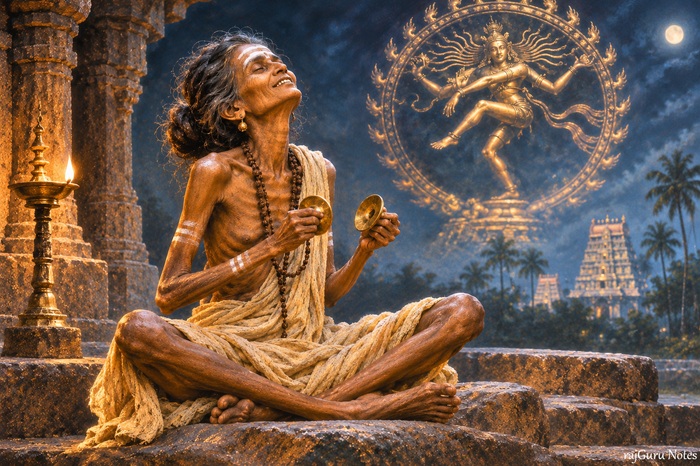
She was among the only three female bhakti poets of the 63 Nayanars, devotees of Shiva.
Karaikal was a famously flourishing port on the west coast of Tamilnadu. A girl child was born there to a wealthy merchant named Dhanadattan and his wife. They called her Punithavathi at birth. Her father, a pious man, introduced her to spiritualism from an early age. A true Shaivite, it is believed that from the time she began to walk, she was intensely drawn to Lord Shiva. Once she learned to talk she only spoke of Shiva and his enchanting cosmic dance.
The Mango Festival
She grew into a stunning young maiden and was married to Paramadattan, another well-off merchant from Nagapattinam. Folklore has it that once her husband sent home two mangoes he had been gifted. She gave away one to a starving Shiva devotee who came to her door. Later, at lunch, she served her husband the remaining mango. It was delicious. Paramadattan wanted the second one too. Contrite for having given away the second one and not knowing what to do, she prayed before a lingam for divine help. Miraculously a mango appeared in her hands! Her husband found it exquisitely coloured and scrumptious. He doubted that it really was one of the two he had sent home. She told him the truth but he of little faith, was not ready to believe her. He wanted her to turn up another. She beseeched the lingam. One more mango manifested in her hands but to their surprise it disappeared as soon as she handed it over to her husband.
This miracle is annually memorialised as the Mangani or Mango Festival during the Tamil month of Aani (June-July) at the Karaikal Ammaiyar Temple dedicated to her. At the festivities, Lord Shiva is taken around the town in a chariot and devotees throw mangoes from the roof-tops, eventually eating them as a blessing!
The mango incident changed her life forever. Paramadattan realised that she wasn’t any ordinary householder and slipped away from her under the pretext of a business tour abroad. He had actually moved to another town, remarried and also had a daughter from this second marriage. He had named her Punithavathi in honour of his first wife. Unaware of her fate, she continued as a dutiful wife, serving the mendicants and Shiva worshippers who came to her door, even while she waited faithfully for her husband to return.
After very long, when Amaiyar’s parents learned that he was in another town with a second family, they took her there. Her husband, with his family, fell at her feet in reverence as he now looked upon her as a divine entity. He couldn’t see her any differently. At this turn of events, she was shocked and prayed, *“With this decision of my husband, let Thy grace give me the form of a skeletal form (pei) that praises you always thereby taking away the beauty obtained by this flesh’’.
Once she made a pilgrimage to Mount Kailash. When she reached the mountain, to her dismay she saw a lingam appear wherever she stepped. It was Lord Shiva’s maya playing itself out for his devotee. She understood what was afoot and unwilling to desecrate the holy ground, she is believed to have completed the rest of the journey upside down, walking on her hands to reach Shiva’s abode. A delighted Shiva welcomed her affectionately as Ammaiyar, Mother. From then on she has been known as Karaikal Ammaiyar. He granted her wish of eternal devotion and moksha. Then he bade her go to Tiruvalangadu, a temple near Chennai to worship him in his Natarajan pose and sing his praises. There, at his holy feet she composed the Tiruvalangadu Mootha Tirupadhigam.
She is also famous as a foundational figure in early Tamil literature having pioneered the Anaati or Andhadhi style. ‘Ant’ or ‘Andha’ means the end and ‘Ati’ or ‘Adhi’ means the beginning. It is a classic form of Tamil Poetry where the last word of each verse becomes the first word of the next verse, forming an unbroken continuous musical chain of devotional hymns.
Karaikal Ammaiyar’s iconic opening verse "Kongai Thirangi" from the Tiruvaalangaattu Mootha Thirupathigam vividly describes a terrifying female ghoul residing in a desolate cremation ground where Lord Shiva performs His cosmic dance of bliss. The verse contrasts the grotesque imagery of the demoness's withered, vein-bulging form with the divine grace of the dancing Lord whose matted locks sweep the eight directions.
Breasts shrunk, nerves go lax,
eyes sunken, gums teethless,
stomach dent, hair tawny,
carnassials stick out,
ankles twitch of a baby ghost
that yells in arid forest!
Locks brooming eight airs in AlangkAtu,
Dances our Father His five Acts!
Sits on cactus fork, puts out a fire-log,
cools the coal to line her eyes
frightens all, guffaws loud,
keens the charred coils in the charnel ghat,
chokes all flames in a fit of fury,
throws ashen sand heap over
and pirouettes a girlish ghost in AlangkAtu
where our Father abides ever!
Read more at Shaivam.Org
Key Works of Karaikal Ammaiyar
*shaivam.org
Sourced from the internet
07-Nov-2026
More by : Shernaz Wadia
Top | Spirituality | Home
