Oct 31, 2026
Oct 31, 2026
The Next Financial Fault Line?
There is a lot of talk about Data Centers and the huge investments that come with it. A data center is the core of the AI ecosystem. It is a facility that houses the infrastructure needed to train, deploy and deliver AI applications and services. Obviously, it is equipped with state-of-the-art compute, network and storage architecture together with energy and cooling systems.
 Apart from being the nerve center of cutting-edge technology that is defining our future, data centers have attracted attention for multiple reasons.
According to PWC’s Global Data Centre Outlook, global data center spending is projected to reach approximately $800 billion to $1 trillion in 2026, driven heavily by artificial intelligence (AI) infrastructure demand and cloud scaling. By 2050 capex is projected to cross US $ 31.6 trillion
The US is expected to attract 48% of the investments – approximately $15.1 trillion. Cumulative investments on capex worth US $8.2 trillion are expected in the Asia Pacific region with China and India in the lead. UK, Germany and France lead the European investments in data centers.
As would be expected, as of September 2026, per Statista, the USA leads the world with ~ 4800 data centers followed by UK (568), Germany (533), France (393), China (376) and India (305).
These investments have paid the US handsome dividends and rocketed it years ahead in the global AI game. The US will maintain chokehold on AI ecosystem for some years by when other countries will catch up.
By dominating the ownership of assets in the AI ecosystem, the US has enviable lead in determining and controlling the development of AI. Further, it provides the US administration with the opportunity and space to review, enforce and dictate how, when and where American AI companies can deploy their AI models.
For example, the world recently was witness to the unilateral worldwide disabling of Anthropic’s Claude Fable-5 and Mythos-5 LLMs. The US action was then seen as the weaponization of LLMs and sent shockwaves all over the world as it exposed the vulnerability of critical systems already using them. Arguably this single action spurred EU and other nations to build indigenous models to wean themselves away from American AI.
The other important dividend for the US is the first use deployment of AI as a geopolitical asset to retain global dominance. This is an important toolkit on hand at a time when its global influence, particularly hard and soft power is perceived to be diminishing in the wake of trade tensions, fractured alliances as well as punishing economic costs consequent to the Iran war.
But the picture is not all rosy for several reasons. At best, the advantages may be transitory and may only yield diminishing results. The reason is that all other players of significance in the AI game are working overtime to not lose any strategic advantage whatsoever.
In parallel to the gains, it has also upped the stakes for the US. Wall Street is understandably worried about the concentrated stack of ultra sized investments in data centers and other AI assets. Any misstep by the hyperscalers could trigger unintended tsunami(s) in the global financial markets including the US.
[ Hyperscalers operate data centers that are huge, with at least 5,000 servers and occupy at least 10,000 square feet of physical space. These data centers provide extreme scalability capabilities and are engineered for large-scale workloads (such as generative AI). (IBM)]
Two major players in AI are in serious financial trouble, albeit for different reasons. But the case of Core Weave and NextDC has sent shock waves in the market.
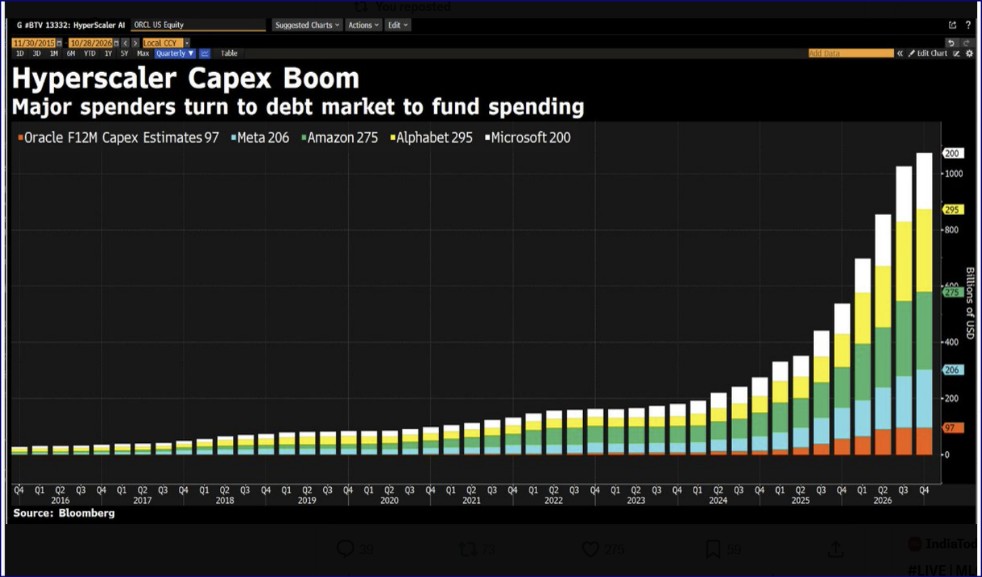
Bloomberg has reported (October 28th, 2026) that concerns about Big Tech's capex plans are ballooning. It points out that Wall Street is getting nervous as it bankrolls the vast network of data centers and chips behind the AI boom.
Another report (Washington Post, October 27, 2026) suggests that there is not enough money in the world to pay for the AI boom. It reports that the “AI boom is so expensive that even Silicon Valley giants are bleeding cash, and companies are now racing one another to collect or borrow other people’s money for the estimated $10 trillion of AI-related spending in coming years”.
This puts the big AI hyperscalers in unchartered territory at the expense of all investors. Just seven companies or the magnificent 7 (Apple, Microsoft, Nvidia, Amazon, Alphabet/Google, Meta, Tesla) account for about 34.7% to 35.5% of the total weight in the S&P 500.
Since the S&P 500 is weighted by market capitalization rather than equally by company count, outsized performance or massive valuations from “Mag-7” mean they drive a disproportionate share of the index's overall gains or losses.
Market experts point out that the AI build-out has created dense interconnections (circular financing, large lease and purchase commitments, private-credit exposure, and reliance on a few key players). Stress at one node—whether a leveraged pure-play, a hyperscaler facing higher borrowing costs, or a major AI lab—can transmit more readily through the system than in a more diversified market.
In layman’s terms, the S&P 500 is no longer reflecting the broad market exposure investors expect. This is a rude wake up call.
Circular financing in the context of AI hyperscalers and frontier model labs, refers to a closed-loop economic ecosystem. In this structure, suppliers, chipmakers, and cloud hyperscalers provide multi-billion-dollar capital injections or equity guarantees to AI startups. In turn, those startups immediately funnel that cash right back to the investors to purchase high-end GPUs, infrastructure, and cloud computing services.
Connecting the dots it is easy to realize that red flags abound and that the credit markets have maxed out. And secondly, the flagship S&P 500 is no longer representative of the wider corporate America. This has blindsided investors and financial markets around the globe.
The intent of this piece is also not to offer any alarmist point of view or naively predict an imminent market collapse but rather present an analytical perspective with data so readers can make their own informed conclusions. As the adage goes, forewarned is forearmed.
30-Oct-2026
More by : Naagesh Padmanaban
