Nov 07, 2026
Nov 07, 2026
by B.S. Ramulu
From Self-Transformation to Mass Influence
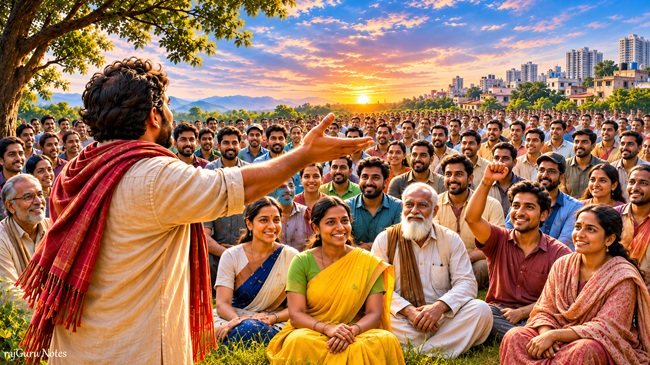
The discourse on leadership is vast, yet it frequently converges on a singular truth: true leadership is not defined by corporate titles, political chairs, or institutional authority, but by the profound capacity for social influence and ethical resonance. As the foundational baseline of modern leadership studies establishes, leadership is fundamentally about the relationship between the guide and the collective.
To contextualize this within global frameworks, we must look at the highest definitions that govern contemporary organizational and philosophical thought. Peter Drucker, the pioneer of modern management, succinctly notes: “The only definition of a leader is someone who has followers. To influence followers more than you are influenced by them is leadership.” Expanding upon this fluid dynamics of influence, leadership expert “John C. Maxwell” asserts: “Leadership is influence—nothing more, nothing less. It is the ability to obtain followers and move them toward a common goal.” This movement toward a goal requires a catalytic vision, a trait captured by Warren Bennis, who defined leadership as “the capacity to translate vision into reality.”
However, when we look beyond structured boardrooms and formal hierarchies, we discover a powerful tier of leadership that operates entirely within unorganized frameworks: the Mass Leader.
The Anatomy of Mass Leadership and Moral Authority
A Mass Leader is an informal changemaker—be they an artist, a journalist, a cinema actor, or a grassroots activist—who exerts monumental influence over millions without holding any official portfolio or executive power. In classical sociological theory, Max Weber conceptualized this as Charismatic Authority, where a collective willingly follows a leader not out of legal obligation or systemic fear, but out of absolute reverence for the leader’s exceptional character, intellect, or artistic resonance.
This form of leadership is deeply intertwined with Moral Authority (Neythika Shakthi). While Positional Power is fleeting and tied strictly to an office or legal tenure, Moral Power is rooted in the inner conscience, unwavering ethics, and altruistic actions of the individual. When a journalist exposes institutional corruption at the risk of their own life, or an artist encapsulates the pain of the subaltern through a song, they are exercising moral authority. History’s most transformative mass leaders—Mahatma Gandhi, Martin Luthur King Jr., and Nelson Mandela—wielded no military battalions or statutory decrees; their absolute weapon was the moral force of their convictions. Genuine leadership, therefore, is never granted by a title; it is earned through ethical alignment with human values.
Understanding What Leadership is Not: The Path of Self-Transformation
To fully grasp the architecture of authentic leadership, one must explicitly examine its inverse. As leaders, activists, and social organizers, individuals often commit grave errors, sometimes consciously, but frequently out of unexamined habits—and mistakenly interpret these structural flaws as traits of strength. A common frailty is the egocentric desire to appear vastly superior to the collective, projecting a larger-than-life persona while condescendingly telling team members that they “know nothing” merely to assert dominance.
When an organization or movement fails to hit its milestones, an unevolved leader lashes out in anger, completely ignoring the objective field realities and practical constraints faced by the frontline workers. These blunders are fueled by raw ego, hyper-individualism, or a profound collapse of empathetic communication. True leadership requires continuous self-refinement and personal transformation.
The Art of Democratic Dialogue
The linguistic framework of a leader reveals their psychological evolution. A leader must never shut down differing opinions with a blunt, abrasive, or dictatorial “No.” Authoritarian patterns historically relied on fear—the feudal mindset where an overlord rules through absolute volatility, punishing severely in fits of rage or smothering destructively in patronizing affection. If a modern leader's vocabulary begins with an outright rejection of another's viewpoint, they are still carrying the regressive psychological remnants of a feudal lord or monarch.
In a democratic paradigm, communication must be deeply diplomatic and inclusive. Even when completely disagreeing with a perspective, an evolved leader uses phrases like: “That is your perspective, but I look at it differently,” or “You have a valid point there; however, let us examine this alternative.” By validating the other person's right to express themselves, you disarm their psychological defensiveness, foster collaboration, and guide the collective vision constructively without bruising individual dignity.
Altruism vs. Egocentrism: The Ultimate Litmus Test
No external entity or external auditor can judge whether a leader’s actions stem from genuine empathy or naked selfishness—only one's own conscience can determine that. An authentic leader constantly introspects whether their public actions are driven by universal welfare (Altruism) or personal glorification (Egocentrism).
An egocentric individual operates strictly within the narrow prism of “me and myself,” experiencing intense envy when a peer thrives and a twisted sense of pleasure (schadenfreude) when others suffer. In stark contrast, an altruistic leader finds absolute fulfillment in the progress of the collective. This selfless mindset is captured beautifully by the classical imagery of a mother who remains hungry just to ensure her children are fully fed. Throughout history, countless activists have sacrificed their personal lives, choosing to remain unmarried or foregoing material comforts, discovering their ultimate joy in the structural upliftment of their communities. As the social thinker Dattopant Thengadi beautifully observed: “They find absolute joy in the very act of sacrifice.”
The Power of Grassroots Connection
A foundational pillar of grassroots organizational strategy is the deliberate cultivation of personal bonds, a primary example being the meticulous practice of remembering people’s names. Forgetting an activist's name is often registered by the individual as a severe blow to their dignity, a sign that they are viewed merely as an anonymous cog in a machine.
A great mass leader goes a step further, remembering the names, professions, and situations of an activist’s spouse, children, and family members. There is a powerful historical blueprint of an impactful leader who maintained a structured personal telephone directory; beneath each contact, he recorded the names and ages of their family members. Whenever he made a phone call, he would accurately inquire about the well-being of their household. This systematic empathy ensures that when a leader takes a public stage, they address every coordinator by name, offering authentic validation before delivering their core address.
The Core Prohibitions of Leadership
To maintain institutional integrity, certain behaviors must be categorically recognized as the absolute antithesis of leadership:
Institutional Exploitation and the Trap of Exclusion
True leadership must actively distance itself from patterns of systemic exploitation. To analyze this through a geopolitical lens, one can look at how the United States government structurally utilizes foreign labor to fuel its massive economic machinery while simultaneously erecting violent barriers to deny them legal status or basic human rights. Impoverished laborers from Mexico cross dangerous borders to execute the most grueling, labor-intensive manual tasks—from massive construction projects to road laying. Because their cheap labor is a systemic necessity, the machinery utilizes them yet subjects them to border hazards and systemic marginalization.
Unfortunately, the internal architecture of certain political parties and social organizations mirrors this exact exploitative model. Grassroots activists join a movement, working tirelessly like those migrant laborers, only to be cast aside once the organization scales up.
This mirrors the historical colonization of America, where the indigenous Red Indians who belonged to the soil were systematically pushed out and marginalized by European settlers who took over the land and its resources. In a similar vein, opportunistic latecomers often step into an established movement to enjoy the fruits of institutional power, driving out the original dedicated builders who built the foundation from scratch. When an organization or a nation falls into this habit of exploiting its core builders, its genuine progress comes to a grinding halt.
The Strategy of Strategic Patience
When navigating deeply entrenched or exploitative systems, a leader must combine moral courage with strategic patience. Consider the revolutionary icon Che Guevara, who broke into socialist movements as an outsider and systematically rose through the ranks via sheer hard work and ideological clarity to impact the global stage.
Similarly, the former Chief Election Commission of India, T.N. Seshan, fundamentally transformed the democratic electoral process by striking terror into the hearts of corrupt politicians. However, before wielding that monumental power, he spent decades working patiently within the bureaucratic hierarchy as an IAS officer—serving diligently as a Sub-Collector, Joint Collector, and District Collector. Had he rebelled impulsively against the administrative apparatus early in his career, the system would have crushed and suppressed him. By maintaining strategic discipline and climbing the hierarchy step-by-step, he achieved the highest institutional platform and subsequently demonstrated his extraordinary capacity to reform the entire nation.
The Principle of Radical Inclusivity: The Pushpaka Vimana Mindset
True leadership is completely incompatible with patriarchy, caste supremacy, financial elitism, or muscle power. Authentic leadership centers on actively resisting these systemic inequalities and sculpting personalities that challenge such oppressive frameworks. It must operate on absolute inclusivity.
To share a metaphorical reflection from grassroots administration: when commuting weekly on a scooter along the highway between Jagtial and Sircilla, countless local commuters would wave down the vehicle asking for a lift. By consistently offering a ride to whoever asked, a fascinating natural balance emerged—the pillion seat was always utilized by someone in need, yet never did two people demand it simultaneously.
This routine reveals a profound socio-philosophical truth: if you deliberately keep the “pillion seat” of your life and your goals vacant for others, society will naturally step in to join your journey. This open, accommodating spirit mirrors the mythical Pushpaka Vimana—the celestial vehicle that miraculously expanded to accommodate every single passenger, symbolizing a leadership model that is infinitely inclusive and never runs out of space for the people.
The Evolution from Leader to Mentor (Guru)
A conventional leader often seeks conformity—surrounding themselves with followers and activists who act as echo chambers, sharing the exact same opinions and obeying commands without question. In stark contrast, a true mentor (Guru) takes immense pride in watching their disciples develop independent thinking, excel in diverse fields, and ultimately surpass the mentor's own achievements.
When a leader elevates their role to that of a mentor, their impact becomes permanent. While Mahatma Gandhi operated as a political leader within the Congress party, he transcended formal executive positions to become a moral mentor to the entire subcontinent, thereby earning the timeless reverence of “Father of the Nation.”
While modern corporate frameworks—such as banking and large industries—mandate uniform behavior and rigid service standards for their staff, social movements must strike a balance. While organizational training for youth, women, and labor unions requires structural alignment, it must never crush individual uniqueness. True leaders do not create clones; they create an environment where individual personalities can blossom uniquely and achieve authentic success.
Re-defining Sacrifice and Self-Preservation
While sacrifice is an essential component of leadership, blind self-sacrifice without strategic self-preservation is a profound error. The legendary character Karna from Indian mythology is celebrated for his unparalleled charity, yet his blind insistence on giving away his divine armor (Kavacha) and earrings (Kundala) to an adversary left him vulnerable and directly led to his downfall. Similarly, King Bali agreeing to give three paces of land, thereby blindly honoring a vow while walking straight into Vamana’s strategic deception, should not be glorified as ultimate greatness. A mature leader must possess the critical awareness to question: “How can I surrender my core strengths and resources to an entity that seeks the destruction of my mission?”
As the classical poet Kalidasa wisely aphorized: “Shariram adyam khalu dharma sadhanam” (The physical body is the primary instrument through which righteous duty must be performed). A leader must preserve their health, intellect, and core resources, because if the primary instrument is destroyed, the larger social mission is permanently compromised.
This requires dismantling the historical inferiority complex that often masquerades as “devotion” or “gratitude.” The traditional narrative of Ekalavya severing his right thumb as an extortionate Guru Dakshina to Dronacharya—who had never spent a single moment actively teaching him—reflects a deeply embedded identity crisis and an unhealthy obsession with seeking validation from dominant structures. Ekalavya mastered archery through his own intrinsic creativity and self-driven inspiration. An evolved, self-aware modern leader must possess the psychological clarity to reject extortion. True gratitude must never become a psychological burden that harrows out one's potential or sabotages personal growth.
The Mathematics of Mass Mobilization
The ultimate metric of a leader's credibility and inspiration is their capacity for genuine mass mobilization. If an organizer coordinates a meeting by printing a pamphlet featuring 74 prominent names alongside major press advertisements, and yet fails to attract even 10 attendees, it indicates an absolute collapse of public trust and an absence of genuine influence.
To quantify leadership capability through a structured growth matrix: suppose a departing leader transitions out and hands over a consolidated base of 100 core activists to a successor.
A true shepherd knows exactly which sheep has gone astray, what each sheep's inherent nature is, and what its specific strengths and capabilities are. A leader is precisely like that shepherd. Often, the sheep that wander off are the ones possessing the highest capability and potential. Cultivating an independent, self-driven mindset to forge one’s own path is an extraordinary quality. When individuals who have gone astray are reformed and rehabilitated from their errant paths, they grow into far greater leaders than those who merely followed orders blindly.
As Osho Rajneesh profoundly noted, Loknayak Jayaprakash Narayan became the catalyst for such a historic transformation in the life of Phoolan Devi. With strategic support, Phoolan Devi was subsequently elected to the Indian Parliament (Lok Sabha). Reforming those who have gone astray and channeling their raw energy toward the greater good of society is the ultimate hallmark of great leadership.
The Avant-Garde of Modern Leadership: Cultural Resistance and Technological Leapfrogging
In the contemporary global era, authentic mass leadership must transcend structural management to engage in active cultural and ideological resistance. True leadership does not merely operate within existing socio-cultural frameworks; it systematically challenges embedded cultural hegemonies and historic exclusions. This is precisely where the intersection of literature, fine arts, and social movements becomes crucial. By giving voice to the marginalized and producing critical alternative narratives, leaders dismantle the patronizing architectures of dominant elites.
This democratic distribution of dignity and rights can be synthesized through a powerful social justice maxim: “No Buffet System. Table Meals! Everyone should be served their own with dignity.” This ethos demands that leadership must not treat human rights and developmental opportunities as a chaotic, self-service lottery where the powerful corner all resources. Instead, an ethical leadership model ensures a structured, inclusive, and equitable institutional framework where every marginalized community is directly and respectfully served their rightful, proportional share.
Furthermore, the late twentieth and early twenty-first centuries have introduced a radical variable into the mathematics of mass mobilization: technological decentralization. Historically, deeply entrenched institutional giants dominated socioeconomic landscapes through sheer financial muscle and monopoly over traditional infrastructure. However, the advent of digital communication and information technology proved that newer, agile players could completely bypass archaic hierarchies—a phenomenon known as “Leapfrogging.” Traditional monoliths often entered fields like information technology and advanced telecommunications late, only after newer, visionary disruptors had already democratized the ecosystem.
For the rising generation of grassroots leaders and changemakers, modern technology acts as the ultimate equalizer. It shatters the old gatekeeping mechanisms of mainstream media and networks, allowing emerging leaders to rapidly cultivate critical consciousness, execute mass mobilization, and project their moral authority directly onto the global stage.
Conclusion: The Perennial River of Collective Action
Ultimately, leadership finds its highest, most unassailable expression when it is translated into a life goal of humanitarian service. Within this altruistic framework, the divisive barriers of religion, geography, caste, and class completely evaporate. Whether it is expanding sanitation infrastructure nationwide like Bindeshwar Pathak or dedicating one's entire existence to healing the marginalized like Mother Teresa and Baba Amte, service transforms individual personality into an immortal moral guide for the world.
Every great grassroots movement, organization, or political party in human history begins as a tiny, unassuming stream. When Swami Vivekananda famously proclaimed, “Give me a handful of men with muscles of iron and nerves of steel, and I will transform this nation,” he was referencing this exact catalytic power of a dedicated nucleus. When the RSS was founded in Nagpur on Vijayadashami in 1925, it commenced with a mere five to six individuals before branching out into a massive global network spanning multiple socioeconomic sectors. Similarly, when a visionary leader co-founded a grassroots movement with just two other associates, that small nucleus of three individuals went on to mobilize lakhs of students, workers, teachers, writers, and artists, ultimately laying the foundation for a historic mass political movement.
As trickles, brooks, and minor streams converge, they dynamically expand into a magnificent, perennial, and unstoppable river. Genuine leadership operates precisely like this continuous hydrological cycle: it remains rooted in the soil, constantly gathers fresh collective energy, rejects stagnation, and flows perpetually forward to unconditionally give back to the society from which it drew its life force.
Image courtesy rajGuru Notes
07-Nov-2026
More by : B.S. Ramulu
Top | Perspective | Home
