Nov 07, 2026
Nov 07, 2026
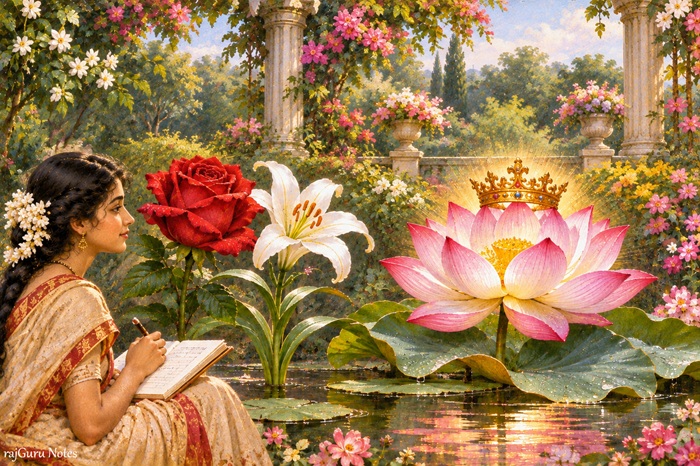
Love came to Flora asking for a flower
That would of flowers be undisputed queen,
The lily and the rose, long, long had been
Rivals for that high honour. Bards of power
Had sung their claims. “The rose can never tower
Like the pale lily with her Juno mien”—
“But is the lily lovelier?” Thus between
Flower-factions rang the strife in Psyche’s bower.
“Give me a flower delicious as the rose
And stately as the lily in her pride”—
“But of what colour?”—“Rose-red,” Love first chose,
Then prayed,—“No, lily-white,—or, both provide”;
And Flora gave the lotus, “rose-red” dyed,
And “lily-white,”—the queenliest flower that blows.
Love comes to Flora asking her to decide upon, to reward the loveliest of the flowers. Which is more and more lovely? Which is lovelier than? Which flower? Love, we mean Cupid, God of Love comes asking Flora, Goddess of Flowers which but a loverly heart can only think in such a way.
The poem is an outcome of a tender girl dreaming of love and beauty. An Indian flower girl is thinking it here, the thought of an Indian Flower Princess. The matter is one of a beauty pageant or contest or maybe it forming a part of flower exhibition.
A Calcuttan Bengali Kayastha girl thinking of her conversion to Christianity, telling of her basking in Greco-Roman myths, not Indian Kamdeva’s arrow striking her. Whatever be it, the context is Indian and the Indian beauty contestant will be crowned in the end.
Whom to award? Whom to give the first prize? How to decide the contestants? Beauty contests turn into close contests, beauty pageants appearing so competitive. And who are the judges, how are the panels drawn from? How are the standards to be followed? We can see the contestants like Miss Lily and Miss Rose. But Toru should not forget Robert Burns’ line, my love is like a red, red rose. An Indian judge she can definitely give superseding points to the lotus as for a mileage over.
Love is the organizer of the pageant perhaps and Flora, Juno and Psyche, all as the judges on the panel, taking stock of Eastern and Western magic and music to pronounce the ever-awaited judgement and the poetess as an anchoress covering it for the media, we mean the small Indo-Anglican audience. Whom to give the Miss Crown title? Who is the Queen of Flowers? How to choose from a riot of colors in close contests and competitions?
We all know the lotus will win finally, so symbolic of Lakshmi, Saraswati, Vinayaka; so dear to Brahma, Vishnu, Maheshvara and to Bhagabati, Rama worshipping Durga with, the lotus symbol so dear to see Buddha seated upon, Lord Mahavira upon. The lotus is a symbol of peace, serenity and happiness. It is a meditational symbol. Our hands when viewed at morn after the sleep in bed lotus-like, to see it, folding, unfolding, rising in unison for a suryanamaskar, to see the crisscrosses of the palm telling of the good things to begin with, admonishing slumber and lethargy.
Flora while judging the contestants praises the red rose and then the white lily, notes their fascination, dream, fancy and imagination hinging upon, the hums and whistles they carry with as musical and sing-song notes, flairs and chasms, but awards the lotus for being tinged with the pink, red color and the serene white color writ large over, so widespread and encompassing, a combination of both the large canvas paint and the side dreamy tint of red hue, silhouettes, shades and shreds. And as for color combination, of being tinged with the pink or ringed with the red or pink hue, the lotus wins the prize, so dreamily hued, fancifully imagined, painted and polished softly, catching our flair for fancy and imagination.
But Toru, the lotus can be held in hands, not like the red rose stuck into the braid of the hair. But this should also be noted that red water lilies are so ravishingly beautiful to see. The bluish lilies too are extraordinary. Violet petunias are also not less than. The theme of the poem is one derived from flower shows or the Indian guys holding such a discussion for so long. In the villages, such a question often engages the guys and folks in discussing to widen and broaden their range of thought and idea. And for long our hamlets and villages have reeled under poverty and illiteracy. Only oral education for a few could not bail out of crisis.
07-Nov-2026
More by : Bijay Kant Dubey
Top | Literary Shelf | Home
