Nov 07, 2026
Nov 07, 2026
by B.S. Ramulu
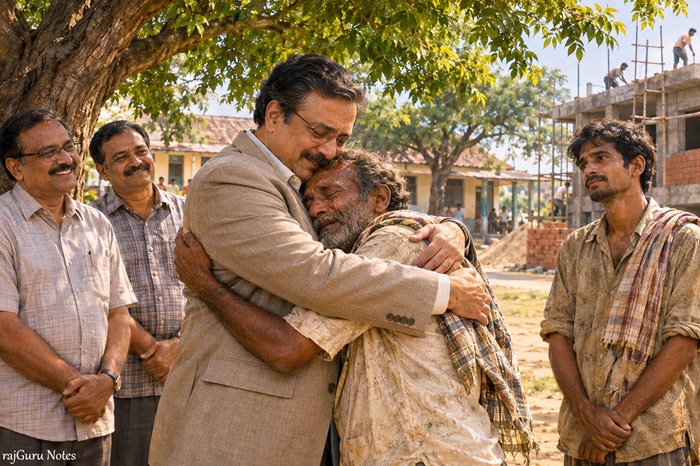
Maisayya felt a deep sense of joy knowing that Rajeswararao, Venkatrao’s youngest son, still remembered his name. However, that simple recognition also unearthed a buried chest of old memories, bringing back glimpses of his past life and long-forgotten days.
Twice, Maisayya stood up from the cot resting under the shade of the neem tree, intending to go and meet him, but both times he hesitated and sat back down. Why should I go and meet him under the hot sun? Maisayya’s mind wrestled with a wave of impatience, anger, and deep sorrow. Is he remembering everyone just to flaunt how grand he has become? To Maisayya, it felt like an exhibition of status. Rajeswararao had left agriculture behind, moved to the city for his education, grew up in the urban landscape, and when the city itself became too small for his ambitions, he flew to America and amassed crores of rupees. On the other hand, Maisayya, unable to abandon his small, marginal farming and unable to grow beyond it, had seen his life shrink over the years, remaining stagnant no matter, how much time passed.
Yet a gentler voice inside his heart countered, What harm is there in just going and saying hello?Rajeswararao had returned to his native village after twenty long years. Who knew when he would ever return again? Even during his brief biennial visits to India, he usually flew back without ever stepping foot into the countryside. Poor man! Maisayya thought, with so many years behind him, would he even have the time to sit and remember all these old connections? What a foolish thought of mine! Rebuking his own cynicism, Maisayya finally set out to meet him.
It had already been twenty days since Rajeswararao arrived from America. He had spent most of his time in the town of Jagtial, having arrived in his native village just two days ago. The previous day, he had made a quick daytime visit to his village, greeting everyone he came across by name. He lovingly exchanged pleasantries with his old friends from the primary school they had attended twenty years ago. He had felt a deep sense of joy visiting the local high school the previous day, personally greeting the teachers and interacting with the students.
A fresh bond had blossomed between Rajeswararao and the school's teachers and students over the past three years. Not only had he provided a substantial donation for the construction of the high school building, but he had also established annual merit-cum-talent awards in his name for the top three students who scored the highest marks in the SSC examinations. During this visit, he took the time to inquire about the past award recipients, asking about their current studies and the well-being of their families. It was during this conversation that Rajeswararao particularly remembered and asked about Mahesh's father, Maisayya. Furthermore, he announced monetary donations for the school's immediate needs and promised to install ceiling fans at the government social welfare hostel. Hearing his immediate consent to these requests, the Headmaster, Anjaneyulu, and the Hostel Warden, Sugunakar, grew to admire Rajeswararao’s magnanimity even more. When others informed Maisayya that Rajeswararao had specifically remembered and asked after him, it filled him with a sudden surge of enthusiasm. Maisayya even felt a quiet wave of pride, knowing that Rajeswararao was now aware that his son had topped the school.
All along the path and during the bus ride, Maisayya’s mind was flooded with thoughts and memories of Rajeswararao. He began reconstructing his perception of Rajeswararao’s new, evolved personality through the lens of fresh understanding. Looking back, Maisayya felt that his past resentment and negative assumptions were perhaps mistakes that had caused unnecessary discord in his mind. Dismissing the old cynicism, he chose to focus entirely on Rajeswararao's goodness. If one corrects past mistakes by doing such noble deeds in the present, who will hold the past against them? Won't everyone remember only the good? Maisayya thought, filled with a newfound sense of optimism.
***
Rajeswararao still held a deep affection for Maisayya, who used to do all kinds of household chores at their home during their childhood. Rajeswararao had even specially bought a pair of dhotis and an upper cloth from Hyderabad as a gift for him.
Seeing Maisayya from a distance, Rajeswararao was momentarily taken aback. Maisayya, who was actually three years younger than him, now looked twenty years older. His skin had darkened intensely from grueling labor, and his body was weathered with premature wrinkles. Shaking off his shock in an instant, Rajeswararao walked a few steps forward, smiled warmly, and firmly took Maisayya's hand in his own. Then, he wrapped him in a tight, affectionate embrace. This unexpected warmth overwhelmed Maisayya; a wave of pure joy washed through his mind and body, bringing tears of happiness to the eyes of those watching them.
Rajeswararao was now a prominent doctor in America. In his childhood, the villagers casually called him 'Chinna Dora' (Little Master). But now, he strongly disliked being addressed by feudal titles like 'Dora'. Hearing everyone respectfully address him as 'Doctor Saab' felt quite novel to Maisayya. Just then, Headmaster Anjaneyulu and Hostel Warden Sugunakar arrived at the scene. True to his promise from the previous day, Rajeswararao wrote out the donation checks and handed them over. He then asked them to sit for a while and continued talking with Maisayya, who kept nodding along respectfully.
The look on Anjaneyulu and Sugunakar's faces seemed to silently urge Maisayya, 'Go ahead, ask him for some favor or help while he is in such a giving mood.' Maisayya had a similar thought lingering in his mind. He decided to wait a little longer before placing his request.
Maisayya’s eldest son had failed his tenth grade and was now looking after the farm labor. His younger son had successfully passed his Intermediate (Class 12) exams. He had also performed his daughter's marriage, and his son-in-law had gone to Saudi Arabia for work.
Clearing his throat nervously, Maisayya finally spoke up. "Sir! Doctor Saab! My eldest boy failed his tenth grade. The younger one passed his Intermediate, but he is just sitting idle at home without any proper direction."
"Why is he sitting idle after passing Intermediate? You can afford to let him study further, right? There are so many hostels available now, and they will provide him with scholarships too," Rajeswararao explained everything in detail, encouraging him.
"But my eldest boy is furious, snapping, 'If I toil in the fields, will he become an engineer?'" Maisayya hesitated to bring this up, but Warden Sugunakar spoke the words for him. Rajeswararao was visibly astonished to hear about such narrow-minded, bitter resentment brewing between biological brothers.
"If the younger brother gets educated, won't it bring prestige to the elder brother as well? Won't he receive at least some support?" Headmaster Anjaneyulu and Sugunakar felt reassured by the underlying tone in Rajeswararao’s words, especially since Mahesh happened to be their favorite student.
"If we can send Mahesh for long-term entrance coaching, he will definitely secure an engineering seat, Sir! There are excellent coaching centers in cities like Vijayawada, Guntur, Ongole, and Nellore. But despite our urging, Doctor Saab, his father is refusing to send him," Anjaneyulu said.
"Doctor Saab, how can I afford all of that?" Maisayya interjected, shaking his head sideways in despair. His reluctance stemmed from a pragmatic fear—if he mortgaged his tiny piece of land, he would lose his only livelihood; and if the boy failed to secure a seat despite the studying, his son would end up stranded with nowhere to go.
The realization that a genius student's future was being choked entirely because he couldn't compete in a money-driven world deeply stirred Rajeswararao’s heart. Mostly, the coaching would cost around thirty thousand rupees. In his currency, that was a mere eight hundred dollars. The amount was negligible to him. Yet those mere eight hundred dollars possessed the power to lift a human life from thousands of years of generational backwardness to the highest peaks of success. Rajeswararao resolved not to let this opportunity slip away. At the same time, he cautioned himself that his financial aid must not wound their self-respect or leave them with a demeaning feeling of inferiority.
"Maisayya! Don't you worry about a thing. I will take care of all those expenses. Your son will definitely become an engineer. Once he graduates, I will arrange for him to come to America. He can repay the money I spend now from his own future earnings. Even then, I will donate that recovered money back in your son's name for the development of our own village," Rajeswararao declared, discussing the detailed breakdown of the expenses with Anjaneyulu. Finally, he added, "While I can provide financial backing, the responsibility of constantly encouraging Mahesh and guiding him to become an engineer rests entirely on you."
Anjaneyulu and Sugunakar, who had been Rajeswararao’s classmates since high school, smiled warmly and nodded in total agreement, saying, "Absolutely!" Maisayya’s heart swelled with pure joy.
As Maisayya walked back home carrying the clothes gifted by Rajeswararao, he felt an exhilarating happiness, as if he were already bringing an engineer son back to his household.
How wonderful it would be if this daytime dream born on the bus journey actually turned into reality, Maisayya thought to himself. However, by the time Maisayya finally arrived to meet him, Rajeswararao was not at his house. The villagers informed him that he had gone out and no one knew which night he would return.
When Maisayya went back the following day, he learned that Rajeswararao had already left for Hyderabad. Maisayya’s soaring hope instantly turned into crushing disappointment, leaving him completely disheartened.
Meanwhile, Teachers Anjaneyulu and Sugunakar had personally taken their own children to Guntur and enrolled them in the long-term entrance coaching. Watching this, Maisayya felt a deep ache in his soul. How wonderful it would have been if my son could become an engineer too! But where would so much money ever come from? Plunged into despair, sitting under the neem tree on his coarse woven cot with closed eyes, brooding over his bleak reality, became Maisayya's agonizing daily routine.
Anjaneyulu and Sugunakar had toured the long-term coaching colleges and hostels in Guntur, initially feeling completely overwhelmed and thrilled by the rigorous discipline and academic environment there. However, the sheer weight of the expenses soon hit them like a heavy, soaking downpour. They felt a deep, unspoken anxiety eating away at them. They realized that even if they had to borrow money and fall into debt, they had no choice but to endure this hardship for a year. However, within just ten days, their children ran away from the coaching center without telling anyone and returned home. The children wept bitterly, crying, "Even if we don't secure a seat, we will study here. Come what may, we won't go back! If you force us to go back, you will only see our dead bodies."
Hearing this, Anjaneyulu and Sugunakar's hearts pounded with fear and shock. In an instant, the admiration they previously held for those entrance coaching centers transformed into pure hatred. They realized these private colleges and coaching institutes were nothing but a pack of thieving scoundrels. They had ruthlessly extracted an advance of twenty thousand rupees and refused to refund even a single paisa. Remembering a past incident where another parent's son had similarly walked out and the college hadn't returned a single penny, the teachers hurled bitter curses at the management, naming each institution. Yet, out of sheer desperation, they spent the next four days beating, scolding, and crying before their children, finally forcing them back into those very colleges.
Meanwhile, with the release of the EAMCET results, Mahesh’s hopes were completely shattered. Dragged into a college course he had no interest in, he failed his first year of degree studies. On the other side, Anjaneyulu and Sugunakar were relentlessly wrestling with numbers and calculations, trying to figure out which engineering college would accept their children based on their ranks. They consoled themselves by looking back: twenty years ago, their classmate Rajeswararao managed to go to America. In those days, just getting that education and securing these jobs was considered a monumental achievement. Rajeswararao, coming from a wealthy background, could afford expensive private tuition, score high marks, and easily secure a seat in the medical course. Even if it was twenty years later, their own children now had the opportunity to grow like Rajeswararao, riding on the back of his financial support. They felt certain that Rajeswararao would definitely help their children settle down in America. Lost in this shared illusion, sipping small pegs of liquor and chewing on mutton curries, Anjaneyulu and Sugunakar traveled through their dream worlds. Rajayya, a junior lecturer, joined their gathering. It was at this exact moment that Maisayya arrived, stumbling his way into the scene. Maisayya, who was always deeply respectful and submissive, looked completely unhinged today, shouting wild accusations.
"If you were actually teaching good education, why didn't my son secure an engineering seat? If you truly have faith in the education you teach, why are you winning seats only for your own sons? Why didn't you teach my son alongside your own children in the same school? You brag so much about being childhood classmates with the landlord Rajeswararao. It's true that you all studied in the same village school back then, and perhaps that's why my son topped the high school. But those days are long gone. Today, at the very least, your sons and my son could not become classmates. All the poor children have been swept away and dumped into government schools, while colleges have become segregated zones. You draw thousands of rupees as government salaries, but you only deliver empty, worthless education to our poor children. Meanwhile, using those very government salaries, you buy elite private education for your own sons. My son is a diamond, Sir!"
Maisayya’s blistering words pierced Anjaneyulu’s heart. Mahesh had indeed topped the school; what more could a poor student possibly do? If government junior and degree colleges functioned properly, wouldn't we have happily educated our own children here as well? Who can we even complain about our own hidden struggles? Indignant yet feeling a stab of guilt as Maisayya insulted them, the teachers chose to maintain a tense silence. Shouting and venting his bottled-up rage, Maisayya finally stormed away into the night.
Trying to shake off the unsettling encounter, Anjaneyulu ordered another small bottle of liquor. Yet Maisayya’s raw words kept ringing violently in his ears. Was there any flaw in what that uneducated farmer had said? Rajeswararao had studied in this very village school. He was their high school classmate. They too had studied in government institutions and secured these teaching jobs. Rajeswararao had gone to America. But why has society fractured so drastically today? Despite their salaries increasing multi-fold compared to the past, if they truly had faith in the schools where they taught, why had they enrolled their own children in private institutions? If untaught, untrained individuals in private schools could deliver superior education, then what was the purpose of all these formal government teacher training programs? If government schools and hostels were managed with the same rigor as private ones, wouldn't a brilliant boy like Mahesh have scored even higher marks and secured his dreams?
"Sugunakar Sir! I have a fundamental doubt," Anjaneyulu asked, his voice heavy with existential dread. "Can anyone studying in these broken government junior colleges ever hope to secure an EAMCET engineering seat in this cut-throat competition?"
"Seats are indeed being secured, but those are entirely due to the constitutional reservations for SC and ST categories. My fundamental doubt is whether anyone from the open competition category studying in a government college is winning a seat at all? What flaw is there in what Maisayya said? Truth is always bitter, and we must listen to it. Only when we address these flaws will society heal, much like the medicinal healing of a neem tree. In the past, the poor could study and progress; they could rise. But today, jobs are completely shrinking. If someone wants to seek self-employment, it requires lakhs of rupees in capital investment. The children of people like us, who moved slightly ahead in the past, are somehow managing to corner a fraction of the rewards in this competition. But today, for the children of those who remain as poor as we once were, climbing the social ladder is nearly impossible."
"They say that under this new framework, thirty crore people will be permanently pushed out of the mainstream of social development. In other words, because of Globalization, Liberalization, and Privatization, even those who manage to get an education will be forced into the unorganized sectors, trapped in new forms of bonded labor without even a minimum living wage. When you think about it deeply, the future of even our own children looks terrifying," Sugunakar added grimly.
Upon hearing this, Rajayya, the junior lecturer, began delivering yet another long lecture on the subject.
"Oh, stop it! You’ve ruined the entire mood. Let's move to a different topic," Anjaneyulu interrupted, trying to deflect the heavy atmosphere.
"The neem tree has been our country's heritage for thousands of years, yet we never recognized its true worth. Now, Americans are trying to claim a patent over it. Now our people are crying out, 'It’s ours!' When our ancestors used it as a crude herbal medicine, nobody gave it any value. But now, it is said that its medical formulations are being registered as patents in America," Sugunakar said, forcefully changing the topic.
As the alcohol took hold deeper, Maisayya’s raw words began to evoke a profound sorrow in Anjaneyulu. *Mahesh is my favorite student. I looked after him as if he were my own son. Look at the terrible things Maisayya said to me! Mahesh, too, is like a neem tree—an aloe vera plant. We completely failed to recognize and nurture his immense potential and capabilities. We failed to recognize his worth. If only there were a Human Resources Department under globalization or privatization that could secure patent rights over his talents, nurture them, and bring them to light! Then Mahesh, too, would have grown just like Rajeswararao, just like our own children," Anjaneyulu said thoughtfully.
Sugunakar nodded along, humming in half-hearted agreement.
"The government is paying all of us our salaries, and it has set up colleges, schools, and hostels for this exact purpose, right? Why push the blame onto someone else?" interjected Rajayya, the junior lecturer.
His words stung the gathering like a scorpion’s bite, and the discussion abruptly ground to a halt.
***
His mouth, which once routinely criticized everyone out of sheer disappointment upon realizing he could no longer grow in life, gradually fell completely silent. Now, even if the world around him collapsed or turned upside down, he remained utterly indifferent, watching everything with a cold, vacant numbness, like a broken man who had internalized a deep, unhealable sickness.
Whenever they saw him, Anjaneyulu and Sugunakar’s hearts twisted with profound sorrow. Their grief intensified whenever they were reminded of how their most brilliant and favorite student had dried up and withered away like a lifeless plant.
Now, Anjaneyulu was constructing a magnificent house using the money his son was sending back from the United States. Mahesh was hired as the construction supervisor (Maistry) for that very building, and his wife labored alongside him as a construction worker. In the past, when Rajeswararao built his house, Mahesh’s father had toiled as a helper; today, for Anjaneyulu’s house, it was the school topper Mahesh who was laboring for the teacher's son.
Mahesh no longer spoke or reacted. If someone assigned him a task, he would merely nod passively. He simply went about his work, executing orders mechanically without a single word.
Meanwhile, the annual merit awards established in the school under Rajeswararao’s name continued to be distributed to the students every year.
Many years later, Rajeswararao returned from the States once again. The government's shifting policies of disinvestment—withdrawing public capital, rapidly privatizing government sectors, and rolling out red-carpet invitations exclusively for Non-Resident Indians (NRIs)—plunged Rajeswararao into deep contemplation. He held intense discussions with his friends and relatives regarding the current socio-economic landscape of the country. He invited his close associates to Hyderabad, hosting a grand banquet for them at a luxury five-star hotel. Anjaneyulu and Sugunakar attended the gathering as well, and Rajeswararao thoughtfully sought their perspective and advice.
"Please do not return to this country by believing the sugar-coated words of the government, Sir!" Anjaneyulu and Sugunakar cautioned him, weighing their words with measured precision. "Apathy, official negligence, political interference, and deep-rooted caste fractures are eating away at this nation like termites, sparing no one. In this land, even pure, refined gold is systematically degraded into worthless mud, Doctor Saab. However, since you belong to the elite, ruling class, these institutional crises might not wound or affect you as deeply as they destroy the rest of us."
Rajeswararao felt an irrepressible longing to see his native village once more, resolving that he must absolutely spend at least two days there during this visit.
Spotting a figure from a distance, Rajeswararao walked quickly forward and called out with pure joy, "Maisayya! Is Mahesh doing well?" He then wrapped the man in a tight, enthusiastic embrace.
"I am Mahesh, Sir. Father passed away a year ago," Mahesh replied softly, tears welling up in his eyes.
"Mahesh! You?! You didn't become an engineer? Why do you look so old and weathered?!" Rajeswararao was visibly struck with disbelief and shock. His eyes filled with tears; he had desperately wanted to act differently from his father, who had inflicted feudal atrocities on the village. He had harbored a proud dream of telling the world that his farm hand’s son had successfully become an engineer.
"Sir! I heard you are constructing a factory near Hitec City. Please hire me as a construction supervisor (Maistry) there. Later, even if you assign me a watchman's job, I will take it. Please help me with this, Sir, so that I can at least educate my children in good city schools," Mahesh pleaded, folding his hands in a respectful namaskar.
Hearing Mahesh—whom he had envisioned placing in a high engineering position—begging for a watchman’s job broke Rajeswararao completely, and tears rolled down his cheeks. He stood utterly baffled, unable to comprehend why the fruits of development and societal progress never reached the marginalized communities and lower castes, no matter how much the systems claimed to have evolved.
Deeply shaken and distressed by this harsh reality, Rajeswararao cut his planned two-day visit short and boarded a train back to Hyderabad that very same day.
Editor's Comment:
This poignant story exposes the tragedy of a society where talent and hard work cannot overcome the barriers of poverty, privilege, and unequal educational opportunities. Through the shattered dreams of Maisayya and his gifted son Mahesh, it questions a system that celebrates merit while denying the disadvantaged the means to nurture it. The neem tree becomes a powerful metaphor for neglected human potential—capable of offering healing and nourishment, yet left unrecognized. Most haunting is the irony of a brilliant student becoming a laborer building the very prosperity that education promised him. Ultimately, the story reminds us that true progress is measured not by the wealth a society creates, but by the human potential it refuses to waste.
Image courtesy rajGuru Notes
07-Nov-2026
More by : B.S. Ramulu
