Nov 07, 2026
Nov 07, 2026
Civilization is a multiplied consciousness.
At first glance, the proposition may appear simplistic. Civilization, after all, encompasses far more than the sum of its inhabitants. It has institutions, laws, traditions, economies, technologies, religions, and systems of governance that have evolved over centuries.
Yet none of these emerged independently of human consciousness.
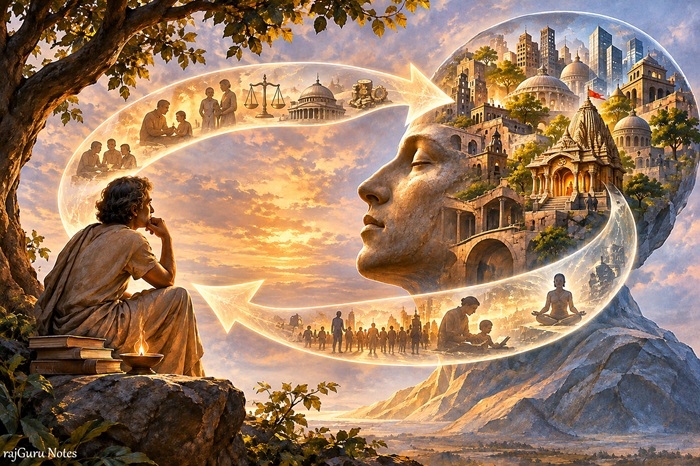
Behind every institution lies an idea. Behind every tradition lies an experience that someone considered worthy of preservation. Behind every law lies a judgment about what ought to be permitted, prohibited, protected, or punished.
What begins within an individual mind can eventually become a collective reality. And therein lies the extraordinary phenomenon of multiplication.
The Arithmetic of Civilization
Multiplication is morally neutral. It does not distinguish between virtue and vice. It merely magnifies whatever enters the equation.
Yet multiplication is equally capable of nourishing civilization.
Thus, the same process that magnifies human weaknesses can amplify human excellence. But this raises a fundamental question. If civilization reflects the consciousness of those who constitute it, can society be permanently transformed without transforming its individuals? And conversely, can individuals transform themselves while remaining unaffected by the society in which they live?
The Mirror That Reflects Both Ways
We ordinarily imagine society as something individuals create.
People establish families, communities, institutions, governments, and civilizations. Their collective actions gradually produce structures that outlive their creators. But once established, those structures begin shaping the individuals who inherit them.
A child does not enter an empty world.
Before the child learns to speak, a language already exists. Before the child develops independent judgments, society has established customs, values, prohibitions, expectations, and definitions of success. The child gradually absorbs these influences, often without recognizing their origins. What earlier generations created becomes the environment within which later generations develop their consciousness.
Thus, the relationship is reciprocal.
Individuals create society. Society creates the conditions within which individuals become themselves. The creator becomes subject to the creation. And the creation becomes an active participant in shaping its creator.
This is not necessarily evidence that society possesses a separate mind in the literal sense. Rather, collective consciousness may be understood as an emergent phenomenon arising through shared beliefs, memories, language, relationships, and institutions. Nevertheless, its influence can be as powerful as that of any individual.
A nation can inherit pride or prejudice. A community can preserve generosity or resentment. An institution can encourage independent thinking or reward unquestioning obedience.
These tendencies survive individual lifetimes because they are transmitted through collective arrangements. The multiplication continues.
Atma–Paramatma: The One and the Many
Indian philosophical traditions have long contemplated the relationship between Atma, the individual Self, and Paramatma, the Supreme Self. Different schools interpret that relationship differently. Some emphasize essential unity, others distinction, and still others forms of inseparable relatedness. For our present inquiry, however, the relationship offers a provocative analogy.
Suppose we consider Atma as individual consciousness and Paramatma, metaphorically, as an encompassing collective.
The individual participates in bringing the collective into existence. Yet the collective becomes a larger reality within which the individual discovers identity, purpose, obligation, and belonging. The individual is neither wholly independent of the collective nor simply dissolved into it. Both participate in an ongoing relationship.
This analogy does not establish that the metaphysical Paramatma is a human creation, nor does it replace the theological meanings of these terms. It merely allows us to contemplate the interplay between the one and the many from another perspective. And this brings us to a still more intriguing question. What happens when human consciousness creates an idea that eventually acquires authority over the consciousness that created it?
The Word and the Gods
The opening of the Gospel according to John introduces the Logos, the Word, as fundamental to existence.
John 1:1 declares: "In the beginning was the Word, and the Word was with God, and the Word was God." In Christian theology, the Word is not merely human speech or a concept invented by humanity. It is divine from the beginning. Yet the biblical language invites philosophical reflection upon the relationship between the Word, meaning, and creation.
Consider a different proposition:
First it was the Word; then it became God.
Taken as a philosophical hypothesis rather than a literal biblical teaching, the statement invites us to examine how human beings name, conceptualize, and invest their experiences with sacred meaning. A word can begin as an attempt to describe something beyond comprehension. Through generations of contemplation, worship, ritual, and transmission, that word may acquire an increasingly elaborate identity. It may become associated with divine attributes, commandments, institutions, and systems of authority.
Eventually, the idea that human beings articulate can begin governing their lives.
This does not settle the question of whether God exists independently of human understanding. That remains a separate metaphysical inquiry. It does, however, reveal how human conceptions of the divine can become powerful forces within civilization.
Interestingly, the ancient Nasadiya Sukta of the Rig Veda (10.129) approaches creation with a remarkable spirit of inquiry. Rather than offering a simple, definitive account of cosmic origins, the hymn questions what existed before creation, how existence emerged, and who, if anyone, possesses ultimate knowledge of that emergence. It even declares that the gods appeared afterward, in relation to the emergence of the cosmos.
The hymn does not necessarily imply that human beings invented the gods. Its concern is cosmic origins, not a sociological theory of religion. Nevertheless, it challenges the assumption that every divine figure familiar to humanity must precede the mystery of existence itself. Its final uncertainty is particularly significant. Perhaps even the highest witness does not know how creation arose.
Here, the ancient seeker does something extraordinary. Instead of declaring that every mystery has been resolved, the seeker preserves the legitimacy of questioning. And perhaps that willingness to question is itself an essential quality of consciousness. Is this not among the enduring strengths of Sanatana Dharma—the freedom to inquire, to question, and to contemplate even the origins of existence?
When Creation Governs Its Creator
The relationship between creator and creation extends far beyond theology.
Consider money.
Human beings devised systems of exchange to facilitate economic relationships. Over time, those systems evolved into currencies, financial institutions, credit arrangements, and global markets. Today, countless individuals organize their lives around the economic structures their predecessors created.
Consider government.
People establish governing institutions to coordinate collective affairs, maintain order, and protect common interests. Yet governments can eventually acquire such authority that individuals begin serving the institutions originally intended to serve them.
Consider technology.
Human ingenuity produces tools to extend human capabilities. These tools then reshape communication, employment, attention, education, and even the ways people perceive themselves.
In each case, a creation returns to influence its creator. But the process is neither automatically beneficial nor inherently destructive.
The outcome depends not only on the intentions of the original creators but also on how succeeding generations maintain, question, and transform what they inherit.
Multiplication is therefore not a single event. It is a continuing process of reciprocal influence.
Can Meditation Repair Society?
If civilization is a multiplied consciousness, it may seem reasonable to conclude that individual spiritual awakening is sufficient to transform the world.
Improve the individual, and society will improve.
There is considerable wisdom in this proposition.
An individual who understands greed may become less exploitative. One who recognizes prejudice may become more inclusive. One who develops compassion may respond more sensitively to suffering. But the proposition becomes inadequate when it ignores the independent persistence of social structures.
Structures possess continuity, incentives, and mechanisms of enforcement that can survive changes in individual attitudes. Consequently, personal transformation, however profound, cannot substitute for social responsibility.
Yet the reverse is equally important.
Institutional reform without corresponding changes in human attitudes may reproduce the very injustices it seeks to eliminate.
Changing the structure without attending to the consciousness operating within it can leave the underlying tendencies intact.
Thus, neither inner awakening nor external reform is sufficient by itself. They must meet. Not as competing alternatives, but as complementary responsibilities. Meditation may illuminate the mind. Action must carry that illumination into relationships, institutions, and everyday conduct.
The inward journey and the outward obligation are not enemies. They are two dimensions of human participation in civilization.
The Responsibility of Multiplication
Perhaps the greatest implication of this inquiry concerns responsibility.
We frequently regard our individual actions as too insignificant to influence civilization.
The questions are understandable. But they overlook the manner in which collective realities emerge. Every widespread tendency begins somewhere, although no complex social development can ordinarily be traced to a single individual.
The process can magnify harm, but it can also multiply goodness.
One person's greed may wound another. A thousand greedy minds may construct an empire upon that wound.
Conversely, one compassionate heart may comfort another. A thousand compassionate hearts, acting together and transforming the structures around them, may change the world.
Yet the responsibility does not end with cultivating desirable qualities within ourselves.
We must also examine what our collective creations have become.
The consciousness of civilization is not something we merely inherit. It is something we continually participate in producing.
The Multiplication of Meaning
The process of multiplication is not confined to institutions, societies, or civilizations. It occurs equally within the world of creative expression.
What began as individual contemplation gradually acquires meanings that its originator may never have anticipated.
The poet does not control every interpretation of the poem. The painter cannot determine everything that a viewer will perceive. Nor is the reader merely a passive recipient of someone else's understanding. Each brings a consciousness shaped by personal experiences, memories, questions, and aspirations.
Thus, creative expression becomes another manifestation of the reciprocal relationship between the individual and the collective.
The poet offers the words.
The painter offers the vision.
The reader completes neither—
but discovers something of his own.
And perhaps therein lies the wonder of creativity. A work does not cease evolving when its creator considers it complete. It continues to acquire significance through the consciousness of those who encounter it.
What began as one person's expression becomes an invitation to countless others.
Meaning itself multiplies.
The Unfinished Equation
We began with a simple proposition:
Civilization is a multiplied consciousness.
But multiplication alone does not explain the whole phenomenon.
The process continues through generations, never entirely escaping its own history, yet never wholly imprisoned by it.
Perhaps the relationship between creator and creation is therefore not a straight line but a circle. Or, more appropriately, a spiral. Each turn carries something inherited while introducing the possibility of something new.
The essential question is not merely what humanity has multiplied. It is what humanity chooses to cultivate, preserve, challenge, and multiply next.
For ultimately—
What we multiply returns to multiply us.
References and Philosophical Context
The comparisons offered in this essay are philosophical explorations, not assertions that these religious traditions share identical metaphysical doctrines.
Image courtesy rajGuru Notes
07-Nov-2026
More by : Rajender Krishan
Top | Perspective | Home
