Nov 07, 2026
Nov 07, 2026
Why Does an Emerging Economic Power Still Remain a Developing Nation?
Despite being the world's fifth-largest economy, possessing an ambitious space programme and emerging as a global information technology hub, India continues to be classified as a developing economy. This apparent contradiction stems largely from its relatively low per capita income, uneven quality of life and persistent human development challenges. Although the country has made remarkable progress in several sectors, significant disparities remain.
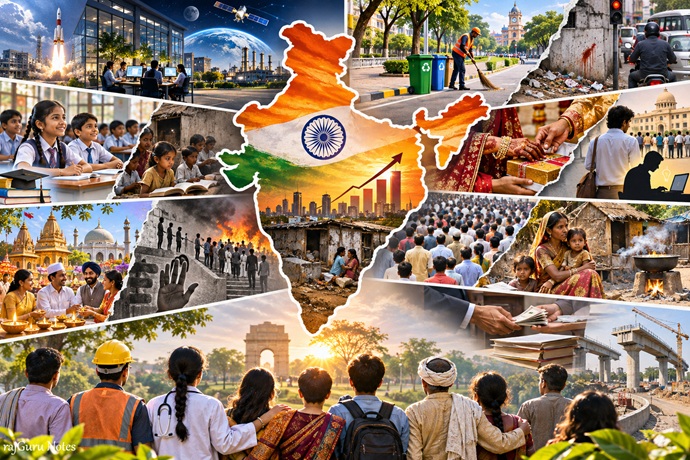
A closer examination of the underlying social, cultural, educational and institutional factors reveals why economic growth has not yet translated into comprehensive development.
1. Lack of Community Spirit and Civic Responsibility
Civic responsibility and community participation are essential indicators of a developed society. Unfortunately, public spaces in many Indian cities continue to suffer from littering, spitting, disregard for traffic regulations and queue-jumping. Such behaviour reflects a lack of collective responsibility towards public property and shared spaces.
However, cities such as Indore demonstrate that meaningful change is possible. Its sustained success in urban cleanliness has been supported by effective municipal administration, waste segregation and active citizen participation. Similarly, although commuters generally follow queue systems and other regulations in public transport facilities such as the Delhi Metro, many people continue to disregard traffic signals on public roads. Unless citizens respect and responsibly use public infrastructure, its intended benefits cannot be fully realised.
2. Low Literacy and Poor Quality of Education
Although India's literacy rates have improved considerably, millions of people still lack basic reading and writing skills. Women and disadvantaged rural communities often face greater educational barriers. For instance, the 2011 Census recorded literacy rates of approximately 94 per cent in Kerala and 62 per cent in Bihar.
Furthermore, access to schooling does not necessarily guarantee quality education. Surveys conducted by the Annual Status of Education Report (ASER) have repeatedly highlighted foundational learning deficiencies, including difficulties among older primary-school children in reading texts intended for younger students. Excessive dependence on rote learning, inadequate teaching resources and insufficient emphasis on critical thinking contribute to this problem.
Without quality education, individuals find it difficult to secure skilled employment, understand their rights and responsibilities, and make informed decisions. Education must therefore move beyond enrolment figures towards meaningful learning outcomes.
3. Cultural Mindsets and Resistance to Change
Indian culture possesses an extraordinary heritage characterised by strong family bonds, hospitality, resilience and respect for tradition. Nevertheless, certain entrenched social practices and attitudes can impede progress. Despite the prohibition of dowry under the Dowry Prohibition Act, 1961, the practice continues in several parts of the country. Early marriage and gender-based inequalities also remain serious concerns.
Another challenge is the widespread preference for secure government employment over entrepreneurship and risk-taking. While government employment offers stability, excessive dependence on a limited number of vacancies can discourage innovation and independent enterprise. The global achievements of Indian-origin leaders such as Sundar Pichai and Satya Nadella demonstrate the enormous potential of Indian talent. India must create an environment in which equally ambitious individuals can innovate, establish enterprises and generate employment within the country.
4. Religion, Caste and Social Divisions
Religion provides millions of Indians with moral guidance, spiritual strength and a sense of belonging. Festivals such as Diwali and Eid also create opportunities for inter-community interaction and social harmony. However, when religious identity becomes intertwined with superstition, caste prejudice or divisive political interests, it can undermine social cohesion.
Caste discrimination persists despite constitutional safeguards and legal prohibitions. Communal violence, including the 2002 Gujarat riots and the 2020 Delhi riots, has resulted in loss of life, economic disruption and erosion of social trust. Such divisions divert public attention and institutional resources from more pressing developmental priorities, including education, healthcare, employment and infrastructure. Social harmony and equality are indispensable foundations of national development.
5. Population Pressure and Persistent Poverty
With a population exceeding 1.4 billion, India faces enormous challenges in ensuring equitable access to resources and opportunities. Although its aggregate economic output is substantial, its per capita income remains considerably lower than that of developed economies.
Millions of households continue to experience inadequate sanitation, unreliable healthcare, poor housing and limited access to clean cooking energy. Poverty, in turn, restricts educational opportunities, reduces productivity and perpetuates intergenerational inequality. Population size alone does not determine a nation's developmental status; the real challenge lies in transforming its demographic strength into a productive and adequately skilled workforce.
6. Corruption and Institutional Inefficiency
Corruption remains one of the most persistent obstacles to India's developmental aspirations. It delays infrastructure projects, discourages ethical entrepreneurship and weakens public confidence in institutions. Bribery in public services, irregularities in procurement, poor construction standards and the diversion of welfare resources undermine the effectiveness of government expenditure.
When citizens believe that wealth, influence and political connections can override established rules, the credibility of public institutions suffers. Transparent administration, accountability, effective law enforcement and digital governance are essential to ensuring that public resources reach their intended beneficiaries.
Conclusion
India's continuing developmental challenges cannot be attributed to any single factor. Colonial exploitation, historical economic inequalities, policy shortcomings, inadequate public investment and institutional weaknesses have all influenced its developmental trajectory. Nevertheless, contemporary progress also depends on changing social attitudes, strengthening civic responsibility and ensuring equal opportunities for every citizen.
The experiences of Indore in urban cleanliness and Kerala in literacy demonstrate that sustained institutional commitment and public participation can produce meaningful transformation. India's cultural and religious heritage should be regarded as a source of social strength rather than an impediment to modernisation. Ultimately, economic growth must be accompanied by educational excellence, social equality, scientific temper, environmental responsibility and accountable governance.
Calling India a developing nation is neither an insult nor a denial of its achievements. Rather, it highlights the unfinished dimensions of its development journey. The country's transformation into a genuinely developed society will depend not merely on the size of its economy, technological achievements or global influence, but also on the quality of life it provides to its people. India's development will be complete only when prosperity becomes inclusive, opportunity becomes equitable and progress becomes a shared responsibility of every citizen.
Image courtesy rajGuru Notes
07-Nov-2026
More by : Gopichand Kureti
