Nov 07, 2026
Nov 07, 2026
Introduction: Why is India a Multilingual Society?
India is one of the most diverse countries in the world and has some amazing multilingual communities living side by side in harmony. This is in spite of the fact that, according to the 2011 Census, there are 121 major languages and 1,369 “mother tongues” in India. The most widely spoken language of India is Hindi, which itself has many dialects. Other widely used languages across the country include Marathi, Gujarati, Telugu, Kannada, Bengali and Tamil. This often makes those unfamiliar with the linguistic diversity of India wonder why, being Indians, they do not speak “Indian” like the Italians speak Italian, the French speak French, the Japanese speak Japanese, the Portuguese speak Portuguese, and so on.
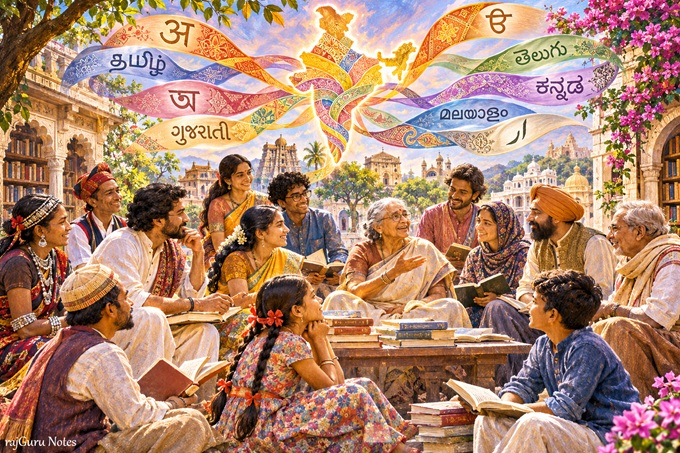
One of the reasons why India is a multilingual society is the presence of different religions and cultures that have spread over the centuries. Hinduism is followed in all parts of the country from north to south, and Islam is also prevalent in many regions. People belonging to different cultural and religious backgrounds communicate freely with one another, and this helps them to come closer, as they do not feel like strangers in a new land. By using one or more common languages in public life, people become more connected with each other.
Another reason why India is a multilingual society is that it has experienced many influences from other parts of the world. Over time, contacts through trade, migration and colonial rule have brought in new languages and scripts and have shaped the ways in which different groups speak and interact.
India’s secular and democratic character has also helped different linguistic and cultural communities to live together. The Constitution gives space to many languages, and this makes it easier for diverse cultures to mix and mingle without any one language or religion being imposed as the only identity.
The education system is also organised in such a way that it can support multilingualism. For many decades, schools in different parts of the country have encouraged children to learn more than one language. People from different regions and backgrounds can thus come together more easily. In order to facilitate this process of multilingualism in India, educational institutions are increasingly set up in a multilingual manner so as to help students learn better and move confidently between their mother tongue, regional languages and wider link languages.
Social Advantages of Multilingualism
The government of India has done a great deal to promote multilingualism. The education system of India, including the syllabus of higher education, is now designed with multilingualism in mind and resources are being dedicated to this purpose. In keeping with the spirit of the National Education Policy (NEP 2020), even the Urdu university (MANUU) promotes interdisciplinary and multilingual traditions by offering certain courses like B.Ed. Physical Sciences in a bilingual (Urdu-English) mode. In some universities, there is already a set of national syllabi that is being modified to support multilingual teaching and learning. So, why multilingualism and not just multiculturalism?
Multilingualism in India is increasingly seen as a cultural and educational asset, and it does not in itself reflect the socio-economic background of a person. The multilingual Indian is a literate person who is proud of his or her education and may be an engineer, a doctor or a professional in any other field, and does not fight shy of speaking and understanding two or more languages at the same time. At times, however, both the education system and society have tended to give greater prestige to a narrow form of monolingual, elite English or to one dominant regional language, which can create the misleading impression that knowing only one high-status language is the ideal. On the contrary, if we look at the social advantages of multilingualism, it can be rightly said that a person with multilingual education is often more successful socially and economically than someone with only a single language. For a person in a multilingual world, society itself is multilingual, and he or she finds it easier to interact and work with people of different age groups, regions and cultures.
If an Indian is an engineer or a doctor, then the job prospects in his or her field will often depend on the ability to communicate fluently in at least one Indian language and in English. It is for this reason that multilingual education helps students to learn more languages like Urdu, Hindi, Gujarati, Marathi, Tamil and others, and thus become more confident and effective human beings. This multilingual education gives a competitive edge to people. It helps them to work with others of different origin and in different places. The social advantages of multilingualism in India are many, and if one looks at its positive outcomes it is evident that a person with multilingual education is often happier, more flexible and more productive than a person with only a single language.
Economic Advantages of Multilingualism
There are several economic advantages of multilingualism for India. The first advantage is that it helps to increase customer loyalty. If their customers are bilingual, commercial establishments can be assured of increased sales and business. Another advantage of multilingualism is that it offers a better business opportunity to companies as they will be able to cater to the needs of both the native people and foreigners. It also makes it easier for Indian companies to expand to other regions and countries, since they can use their knowledge of different languages—especially English—to build new trade links. Multilingualism improves employment opportunities as well, because people who know more than one language are often preferred in jobs related to tourism, hospitality, banking and information technology. Further, it encourages investment from foreign companies who feel more confident doing business in a country where communication barriers are do not pose a hurdle.
Sanskrit and Its Influence on Indian Languages
Sanskrit is one of the oldest and most prolific classical languages of the world. It was used by scholars to compose the Vedas, which include some of the oldest preserved texts in an early form of Sanskrit. Sanskrit is a member of the Indo-European language family, which means that it and languages such as ancient Greek, Latin (the language of the Romans) and the early Indo-Iranian languages all descend from a common ancestral language known as Proto-Indo-European. Sanskrit is therefore regarded as one of the most ancient and important Indo-European languages. In the Indian tradition it is also seen as the language of the gods and of many sacred texts, and it forms the basis for a vast body of religious and literary writing.
Sanskrit is not only a highly structured language to learn; it is also rich and fascinating, and has been used in a wide variety of fields. It has played a major role in philosophy, mythology, astronomy, astrology, music and poetry, as well as in ritual and religious literature. The language is especially important in the field of literature. Some of the great Sanskrit literary works are the Vedas (ancient Indian hymns), and the epics the Ramayana and the Mahabharata. There have been scholars and devotees who have argued that there is a close connection between the language and divine powers, so it was considered by some as a divine language and is now regarded as a sacred language in the Hindu religious tradition. Hindus in many parts of the world use Sanskrit to pray and to read or recite sacred texts, and Hindu priests use it to chant mantras in collective worship.
Because of its special place in Indian culture, Sanskrit has had a profound influence on many other Indian languages. A major modern language that has been deeply shaped by Sanskrit is Hindi, but other Indo-Aryan and even Dravidian languages have taken on much of its vocabulary as well. Hindi has borrowed a very large number of words and expressions from Sanskrit, and many of the formal or literary terms used in Hindi today are directly related to Sanskrit. Similar patterns of borrowing can be seen in several other Indian languages.
In addition to its influence on later languages, Sanskrit has also been a major force in India’s intellectual and cultural history. One of the greatest periods in the history of Sanskrit literature stretches roughly from the third century BCE to the early centuries CE, when Sanskrit developed as a major language of scholarship and high literature. This growth of Sanskrit as a prestigious medium of expression gave rise to many renowned scholars and poets, whose works travelled across regions and even beyond India. Through such contacts, elements of Indian thought expressed in Sanskrit also became known to some Greek and other ancient thinkers, since Sanskrit is related to their languages through the wider Indo-European family.
Hindi as an Official Language
The principal official language of the Union government of India is Hindi in the Devanagari script, with English recognised as an associate official language under the Official Languages Act. In the Hindi language, many words and phrases are shared with or similar to other Indo-Aryan languages, but its vocabulary, pronunciation and grammatical structure also give it a distinct identity. Hindi thus has much in common with several North Indian languages while still remaining a separate language in its own right.
Hindi is the most widely spoken language in India in terms of number of speakers. Large Hindi?speaking populations are spread over many northern and central states, and people from many different social and regional backgrounds speak Hindi as their mother tongue. It is difficult to imagine modern India without Hindi. While exact figures vary, hundreds of millions of Indians use Hindi in some form, and it is one of the official languages of the Union as well as a very important part of Indian culture. There are different regional varieties and dialects, each with its own way of speaking Hindi.
Hindi has made a major contribution to modern Indian cultural life. It has a large influence on popular arts in India, especially cinema and music. This has led to the making of many Hindi films which are highly popular and are widely watched by the masses. Hindi cinema is known for its strong emotional appeal, songs and dramatic storytelling. These films have also become widely known across the world, as people from different cultures watch Hindi movies and listen to Hindi film music and artists.
Hindi is a very rich language and there are various forms and variations in its pronunciation and style. In many states of India, especially in the Hindi?speaking belt, it is taught in schools and often functions as a link language among people from different regions. However, people in some other states of India, especially in parts of the south such as Tamil Nadu, have historically opposed any attempt to impose Hindi as a compulsory language. There were periods in the twentieth century when language policy led to protests and tensions. In recent times, this opposition has remained part of public debate but has also coexisted with growing practical contact with Hindi through media and migration.
The government of India regularly promotes Hindi and takes steps to encourage its use, particularly in non?Hindi speaking states, while Indian citizens also continue to use their own state and regional languages. These efforts, together with the widespread appeal of Hindi films, television and songs across the country, have helped to popularise Hindi and to increase the willingness of many people to learn and use it, alongside their own mother tongues.
The Regional and State Languages
In spite of the fact that India is an open and diverse nation, each region of India possesses its own regional languages, which have become part of the shared cultural heritage of the country. The language of the state where you live may differ from the language used even in your neighbourhood, and this rich variation is one of the most common features of the Indian subcontinent.
As per the Constitution, there is no national language of India. Hindi in the Devanagari script is one of the official languages of the Union, alongside English for many official purposes. In addition, each state has its own official language or languages. For example, Marathi is an indigenous Indian regional language. It is spoken primarily in Maharashtra and also by people in neighbouring regions. Similarly, Kannada is spoken in Karnataka, a state in the south of India. Kannada, Tamil, Telugu and Malayalam belong to the native Dravidian family of languages.
Each of the major regional languages of India is spoken by millions of people, and all of them are important languages to some degree or another. Each has its own unique identity and role in the lives of the people who speak it. There is a long and well?established literary tradition in each of these languages, which continues to grow and develop in modern times.
Special Status of Urdu as a Language
The history of the Urdu language goes back many centuries, with its early forms emerging in North India around the medieval period. Over time, it has been used by different communities and courts, and its rich cultural and geographical context has made it a powerful medium to convey complex ideas, emotions and messages. The historical development of Urdu shows how it has evolved and changed over the centuries and how it has grown into an important language of India and of the wider South Asian region. In many parts of India and in the Indian diaspora, there are communities for whom Urdu is an important language of identity, culture and everyday life.
Urdu developed from an Indo?Aryan base closely related to Hindi, often referred to as Hindustani, and it has absorbed a large number of words and expressions from Persian and Arabic. It has been a significant part of the cultural and linguistic heritage of the subcontinent for a long time. While Hindi, Persian and Arabic are major sources of its vocabulary, Urdu is not simply a mixture of these languages; it is a distinct language with its own grammar, style and literary traditions. It is written primarily in the Perso?Arabic script and has a rich body of poetry, prose and religious writing. Today, Urdu is counted among the major languages of South Asia and has many millions of speakers in India, Pakistan and elsewhere in the world.
At the same time, the position of Urdu in parts of India has faced challenges in recent decades. The reasons for concern about its future are related not only to the number of speakers but also to questions of status and institutional support. In some regions, people who speak Urdu at home may find limited opportunities to use it in higher education, administration or formal employment, where Hindi and English often dominate. For political, cultural, economic and social reasons, Urdu has lost ground in some official and educational domains, even though it remains a recognised language in certain states and continues to be a major language of literature, cinema, music and religious life. Urdu, which once enjoyed very high prestige in courts and elite culture, no longer has the same level of official prominence in many parts of India, but it still retains a special emotional and cultural status among its speakers and admirers.
Are Indian Languages Threatened by English?
Will the Indian languages be wiped out by English? No one knows for certain, especially as long as there are millions of people in India who speak and value their own languages. English has been a dominant language in India for about two centuries, first because of colonial rule and later because of its growing importance as a global language. Many Indians feel the effects of this language situation very strongly, because Indian society uses a wide range of native languages in everyday life, while English often becomes the language of higher education, administration, technology and international communication. Indians speak native languages such as Gujarati, Marathi, Hindi, Kannada, Manipuri and Bengali, and although some of these have large numbers of speakers and rich literary traditions, none of them has the same global reach as English. As a result, many Indians feel that they must learn English in order to communicate with the wider world, and even, in some situations, to move easily across different regions within the country.
Are Indian languages in danger because of English? It is impossible to say, but it is likely that over time some native Indian languages might lose part of their prestige and certain domains of use under the influence of English and of dominant regional languages. It is true that most of the educated population of India is bilingual in English and in one or more native languages, but the native languages do not always enjoy the same prestige as English in fields such as higher education, science or business. Many Indian languages are still doing well in terms of speaker numbers and cultural production, yet it is often predicted that English will continue to overshadow them in official and elite spaces for the foreseeable future. As long as English remains one of the most dominant languages in the world, Indian languages will need to find ways to coexist with it and to assert their own value.
In order to make sure that the languages of India are protected, a number of steps can be taken. First of all, we need to ensure that the languages of India are taught in schools run by different government agencies. We also need to ensure that every child in the country who is enrolled in school has a good basic understanding of at least one Indian language. Second, we need to see that the major languages of India are offered in schools so that children can learn not only English but also their own mother tongue or regional language. Third, we need to make sure that the curriculum and teaching methodologies used in our schools give enough space and respect to Indian languages, so that every child learns the mother tongue very well and can use it confidently. Fourth, we need to see that the laws and policies that are meant to protect and promote Indian languages are effective in practice. Fifth, we need to ensure that the languages of India are supported and patronised by various agencies such as the Government of India, the state governments, regional bodies, educational institutions and language academies. Once such measures are taken seriously, English need not pose a great threat to the Indian languages, and both English and the Indian languages can play their own roles in a truly multilingual society.
English, an Indian Language Now!
English is a tremendously important language in India. One of the main reasons for its significance is that English has become a kind of lingua franca across many parts of the country, especially in higher education, administration and business. Large numbers of people have at least some familiarity with English and can use it to communicate across regions and with people from different linguistic backgrounds. English can also be used to open new business opportunities. Many small and medium?scale businesses prefer to hire people who can use English in order to work on projects, deal with clients and connect with markets both within India and abroad.
The English used in India is often different from that of England, Australia or America. Over time, Indians have developed their own widely used variety of English, sometimes called Indian English. This makes it distinct from other forms of English spoken around the world and reflects local ways of speaking and thinking. At the same time, English in India remains a second language for most people, and there are still many who do not read or write it fluently, especially in rural areas and among less advantaged social groups.
An important reason for the popularity of English in India is its strong presence in education. In many school systems, English is introduced as a subject from the primary or upper?primary level onwards, and in many colleges and universities it is used as a medium of instruction. A large percentage of students develop an affinity towards English, which makes it a very important subject in their lives and creates a sizeable group of young people who can use English as a tool in everyday life. The teaching of English in schools and colleges has increased significantly in recent decades, as parents and students see it as closely linked to quality education and better career prospects.
English also dominates many functional domains in India. It is a primary language in key areas such as business, commerce, industry, higher education, information technology, tourism and certain sections of urban social life. It is more commonly used in cities and towns, and in educated and professional circles, although overall fluent English speakers are still a minority in the total Indian population. Even so, English often remains the language of choice for professional and business purposes, and this gives it a special position alongside the many Indian languages spoken across the country.
Conclusion
Indian languages are among the world’s oldest and most richly layered linguistic traditions. They have been spoken in the subcontinent since ancient times and continue to be used creatively even in this age of computers and digital media. Many Indian languages are still written in traditional scripts, and people can learn to read and write them with the help of grammars, textbooks and dictionaries. These languages not only have a long history; they also shape how people think and feel, influencing their sense of self and their understanding of the world around them.
One reason for the greatness of the Indian languages is the way they are connected to one another. Many of them belong to related language families, which makes it easier for people to recognise similarities, borrow words and communicate across regions. At the same time, each language has its own distinct identity. Indian languages are not a single homogeneous mixture, but rather a rich mosaic of native tongues that have developed side by side over centuries. This means that every part of the country has its own way of speaking, and that modern forms of these languages appear in many different regional and social varieties.
Major Indian languages also possess some of the world’s oldest and most continuous literary traditions, with written histories stretching back many centuries. Sanskrit and Tamil, for example, are so ancient that there is a sense of timelessness about their classical literature. In a way, India is a linguist’s paradise. After India came into contact with the West through trade and colonial expansion, Indian languages also left their mark on several European languages, especially English and Portuguese, and to a lesser extent on others like French and Spanish. The vocabularies of these languages include a number of words that ultimately come from Sanskrit, Hindi, Tamil and other Indian tongues.
The long cultural legacy of India has had a deep impact on the growth and richness of its languages. The country’s cultural diversity makes these languages more interesting and expressive, giving rise to many literary genres, including a vast body of oral literature. The richness of Indian culture, traditions and languages is therefore closely interwoven, so that one cannot be understood fully without the others.
In spite of some negative indicators and worries about the future, Indian languages still have great possibilities ahead of them. One important reason is the very large and, in many cases, growing number of native speakers. In a multilingual context, many people in India speak more than one language in addition to their mother tongue. This everyday multilingualism makes linguistic diversity less of a barrier and allows people to communicate with each other freely and easily, keeping India’s languages alive and dynamic.
Image courtesy rajGuru Notes
07-Nov-2026
More by : Prof. Rajeshwar Mittapalli
