Nov 08, 2026
Nov 08, 2026
... of the Republican Party has Just Begun
Rockefeller Republicanism may replace
MAGA racism, xenophobia and Christian fundamentalism
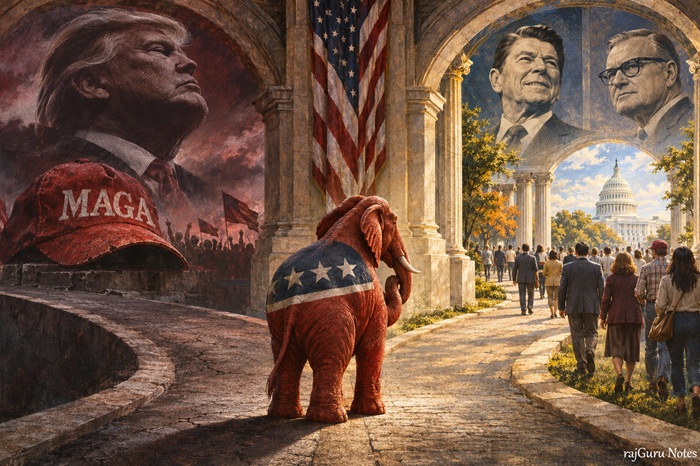
The process of de-Trumpification of the Republican Party (GOP) has just begun. The defeat in the midterm elections may well prove to be a watershed moment in American politics, marking the beginning of the end of Donald Trump's personality cult and the political dominance of the Make America Great Again (MAGA) movement. What appeared until recently to be an invincible political phenomenon is increasingly showing signs of internal fragmentation, ideological exhaustion, and a growing realization among Republican leaders that Donald John Trump may have become an electoral liability rather than an asset. The winning coalition of 2024 that included Hispanics, African Americans, Hindu Americans, Women and working-class Whites has unraveled completely.
The electoral obituary of the MAGA cult may not have been formally written, but the political developments unfolding within the MAGA version of Republican Party suggest that its ideological monopoly is approaching its expiration date. The midterm setback has exposed the vulnerabilities of a political movement that increasingly substituted personal loyalty for ideological consistency, political pragmatism, and responsible governance. The Republican Party now faces a fundamental question: Can it survive as a national political institution by remaining captive to one individual's personality, or must it reclaim its traditional political identity to remain electorally competitive?
The most significant indication of this emerging transformation is the changing attitude of prominent Republican leaders toward Trump and his political legacy. For years, Republican politicians largely avoided publicly challenging Trump, fearing that any criticism could invite his political wrath and alienate the MAGA constituency. However, the post-election environment appears to have altered that calculation. Republican leaders are beginning to recognize that unquestioning loyalty to Trump may carry a greater electoral cost than distancing themselves from him. Glorification of the supreme leader and his vanity projects will be questioned ruthlessly instead of being winked over.
Vice President JD Vance's emerging political posture is particularly significant in this context. His oblique criticism of Trump’s Iran war, identifying it as a major source of the administration's political difficulties, suggests an attempt to create some distance between himself and Trump's increasingly controversial foreign policy decisions. Although Vance has not necessarily broken with Trump, his political positioning may indicate that he is beginning to prepare for a future in which his political fortunes cannot remain permanently tied to those of the President. For a potential 2028 presidential contender, this distinction is particularly important. Vance must balance his association with the MAGA movement, which helped elevate him politically, against the possibility that the movement itself may become an electoral liability.
Even more revealing is the reported endorsement of Vance's position by Donald Trump Jr. By affirming arguments that point toward the political costs of the Iran war, Trump Jr. appears to be acknowledging an uncomfortable reality: his father's political decisions may have become a liability for the Republican Party. Such positioning is especially consequential because it suggests that even within Trump's immediate political and family circle, there may be growing recognition that the Republican Party needs a post-Trump political strategy. There are multiple reports that the Secretary of State Marco Rubio is considering his future after Republicans lost control of Congress, with a possible 2028 presidential bid against JD Vance looming. The speculation comes amid growing public opposition to Trump’s war in Iran and questions about Rubio's possible ambitions for the 2028 presidential election. Rubio rejected the reports, telling The New York Times that working for Trump until the end of his presidency had "always been my plan."
The comments of former House Speaker Newt Gingrich are another indication of the changing political atmosphere. His assessment that the 2028 Republican presidential nomination race has become wide open reflects the growing uncertainty surrounding Trump's political succession. For much of the MAGA era, the Republican candidate selection appeared to be determined largely by Trump's endorsement or opposition. The emergence of an open contest would represent a fundamental departure from that political arrangement. Florida Governor Ron DeSantis, who previously challenged Trump for the Republican nomination, has an opportunity to re-enter the national political arena. His characterization of the midterm defeat as a near-extinction event for the Republican Party reflects the seriousness of the electoral setback. DeSantis may view the moment as an opportunity to reposition himself as a conservative alternative to Trumpism who can preserve the ideological appeal of the Republican Party without carrying the entire burden of Trump's political controversies.
Former United Nations Ambassador Nikki Haley has adopted a more pragmatic approach. Her characterization of the electoral outcome as a Republican loss rather than a nationwide Democratic tsunami is politically significant. Her argument suggests that the Republican Party should not confuse the absence of an overwhelming Democratic wave with an endorsement of its own political performance. The party must confront the reasons voters turned away from Republican candidates rather than seek comfort in the weaknesses of their political opponents. Haley's approach may resonate with traditional Republicans, suburban voters, independents, and those who believe that the party must return to a more disciplined and inclusive political agenda.
Senator Ted Cruz characterized this electoral decimation as “Watergate level of repudiation”. His observations about the Republican Party's losses in Texas are equally important. Texas has traditionally been regarded as one of the strongest Republican political bastions. Any substantial electoral setback there should be treated as a warning signal rather than an isolated political incident. If Republicans begin losing ground even in traditionally conservative states, the implications for their national electoral prospects could be profound. It would suggest that the problem is not simply the strength of the Democratic opposition but the Republican Party's own political positioning. Former New Jersey Governor Chris Christie declared in an interview that “the Trump era is over” after the GOP’s massive electoral defeat but warned Democrats the results don’t mean voters want socialism. Governor Christie has long pushed for the GOP to move past President Trump, believes the midterm bloodbath was a clear rebuke of how Republicans governed under the MAGA boss, rather than a vote of confidence in Democrats.
Former Republican Congressman Mo Brooks has reportedly gone even further by arguing that no individual closely associated with the Trump White House should become the Republican presidential nominee in 2028. Whether or not this position gains wider acceptance, it represents a significant departure from the earlier political environment, in which association with Trump was considered an essential qualification for Republican leadership. The argument now emerging is that the party may need a candidate capable of demonstrating independence from the Trump administration's controversies and rebuilding its credibility among voters who have become disillusioned with MAGA politics.
The growing demand for accountability within the administration, including calls for the removal of Defense Secretary Pete Hegseth, may be another manifestation of this political transition. Such demands are important not merely because of the fate of an individual cabinet member, but because they reflect an emerging willingness among Republicans to question the administration's leadership, policy decisions, and political judgment. There is going to be talk within the GOP on financial corruption of Trump, his family members and cabinet appointees. The era in which every controversy could be dismissed as an attack by the political opposition may be coming to an end. A party that seeks to regain public confidence must demonstrate that it is capable of internal accountability and not become an instrument of American oligarchy.
The era of blind support to the MAGA cult leader seems to be over. An examination of several prominent persons previously identified as disillusioned Trump supporters reveals a complicated picture. Some relationships have collapsed entirely. Others have survived public feuds. And some critics were never accurately described as unwavering MAGA loyalists. Former Georgia congresswoman Marjorie Taylor Green, once one of Trump’s fiercest congressional defenders, now places responsibility for MAGA cult’s electoral debacle directly on Trump himself. “The MAGA movement’s completely dead and Trump himself is the one that killed it,” she said in a post-election interview. Her blunt declaration is her political assessment and demonstrates how thoroughly their relationship has changed.
Trump, however, does not appear prepared to acknowledge the changing political realities. His instinctive response seems to be doubling down rather than undertaking a serious reassessment of his political strategy. The reported elevation of Stephen Miller to a more prominent position in the White House, potentially as Chief of Staff, would reinforce the perception that Trump intends to consolidate the ideological core of his administration rather than broaden its political appeal. Instead of reaching out to disaffected Republicans, independents, moderate conservatives, and voters alienated by his policies, such a strategy risks further narrowing his political constituency.
Similarly, the reported consideration of UFC President Dana White for a White House press secretary role would symbolize an administration increasingly inclined to treat politics as a spectacle rather than as an exercise in responsible governance and public communication. While Dana White's success in building a global sports and entertainment enterprise is undeniable, the selection of personalities from the entertainment and combat-sports world for critical political communication roles would reinforce the impression that the administration is prioritizing celebrity, loyalty, and spectacle over conventional institutional competence.
Trump's political response increasingly resembles a last-ditch effort to fight the previous battle rather than prepare for the next one. His strategy appears to be a political Hail Mary: mobilize the loyal MAGA constituency, intensify ideological confrontation, and hope that personal charisma and political polarization can overcome the growing dissatisfaction within the electorate. But a political movement cannot indefinitely survive by appealing exclusively to its most committed supporters. National elections require broader coalitions, and the Republican Party cannot afford to alienate the very constituencies necessary for its long-term survival.
The deeper question, therefore, is what ideological direction the Republican Party will take after Trump. The party's future need is not defined by a choice between MAGA crass populism, racism, xenophobia and the Democratic Party's ultra-left progressive agenda. There is considerable political and ideological space for a renewed Republicanism grounded in fiscal conservatism, economic responsibility, national security, individual liberty, social stability, and family values.
One possible direction is a return to the principles associated with Ronald Reagan. Reagan Republicanism emphasized limited government, lower taxation, fiscal discipline, strong national defense, economic opportunity, and confidence in America's global leadership. Although Reagan's political philosophy had its own contradictions and limitations, it offered a broad ideological framework capable of uniting different constituencies within the conservative movement. Its appeal extended beyond a narrow personality-driven political base and provided a recognizable national vision.
A renewed Reaganite approach could restore the importance of fiscal conservatism and responsible economic management. The Republican Party must recognize that tariffs, trade wars, unpredictable sanctions, and economic nationalism cannot substitute for a coherent economic policy. American businesses, farmers, consumers, and international trading partners require predictability and stability. Similarly, immigration policy must distinguish between illegal immigration and legal immigration. A country that seeks to retain its technological leadership, academic excellence, entrepreneurial dynamism, and global competitiveness cannot afford to alienate international students, skilled professionals, researchers, and legitimate immigrant communities.
At the same time, the Republican Party may need to rediscover the traditions of Rockefeller Republicanism, which historically represented a more moderate, pragmatic, and institutionally oriented wing of the party. Associated with figures such as Nelson Rockefeller, this tradition emphasized pragmatic governance, economic development, social moderation, institutional responsibility, and a willingness to work across political divisions.
A revival of Rockefeller Republicanism could offer an alternative to the more exclusionary tendencies of MAGA politics. It would provide an opportunity to move away from the rhetoric of racial polarization, xenophobia, and religious exclusion toward a more inclusive understanding of American conservatism. Religious faith and family responsibility can remain important elements of conservative political thought without being transformed into instruments of political exclusion or Christian fundamentalist nationalism. The American constitutional tradition requires respect for religious freedom, pluralism, and the equality of citizens irrespective of their faith or background.
Indeed, the future Republican Party must understand that America's strength lies not in racial, religious, or cultural homogeneity but in its capacity to integrate diverse communities into a common national project. The country's economic and strategic competitiveness depends on attracting talent, encouraging innovation, maintaining global partnerships, and preserving the constitutional principles that have historically distinguished the American political system.
The transition from MAGA politics to a more traditional and pragmatic Republicanism will not necessarily be smooth or immediate. The MAGA constituency remains a significant political force, and Trump continues to command considerable loyalty among sections of the Republican electorate. Any attempt to marginalize him will therefore generate resistance. Furthermore, the Republican Party cannot simply erase the political grievances that contributed to Trump's rise. Concerns about economic insecurity, globalization, illegal immigration, cultural change, and distrust of established political institutions remain genuine issues requiring serious policy responses.
The challenge is to address these concerns without allowing them to become vehicles for racial resentment, religious intolerance, institutional weakening, or permanent political polarization. A successful post-Trump Republican Party must distinguish between legitimate conservative concerns and the personality-driven excesses of the racist and Xenophobic MAGA movement.
The 2028 presidential nomination will consequently become a defining moment in the history of the Republican Party. JD Vance, Ron DeSantis, Nikki Haley, and other potential contenders may attempt to position themselves as the inheritors of the conservative movement. However, the decisive question will not simply be who receives Trump's endorsement or who can mobilize the MAGA base. It will be who can reconstruct a winning national coalition while restoring confidence in Republican leadership.
The process of de-Trumpification does not necessarily mean the disappearance of conservatism or the rejection of every policy associated with Trump. Rather, it signifies the possible separation of the Republican Party from the political dominance of one individual and the restoration of its institutional independence. A political party cannot remain indefinitely hostage to the ambitions, grievances, personal controversies, and changing impulses of a single mercurial and narcissistic leader.
The Republican Party now stands at a historical crossroads. It can either continue fighting Trump's personal and political battles and risk becoming a diminished personality cult, or it can rediscover the broader ideological traditions that once made it a competitive national party. The return of Reagan Republicanism, combined with the pragmatic and inclusive traditions of Rockefeller Republicanism, could provide the intellectual foundation for such a transformation. Certainly, there is an opportunity for the return of the moderate Republicans who were forced out of the GOP by a process of witch-hunt and name-calling as RINOs. Crude name-calling is certainly not a substitute for intra-party sober, intellectual debate and dialogue.
The MAGA movement may have reshaped the Republican Party, but it does not mercenarily own its future. The midterm defeat may ultimately be remembered not merely as an electoral setback but as the beginning of a political realignment within the GOP. Whether this transformation succeeds remains to be seen. Nevertheless, the signs of internal dissent, political repositioning, and succession maneuvering suggest that the process has begun.
De-Trumpification of the Republican Party is no longer merely a political speculation. It may well become the defining political struggle within the GOP leading up to 2028. The proud party of Abraham Lincoln needs to rediscover its soul after getting rid of the MAGA virus.
Illustration courtesy rajGuru Notes
08-Nov-2026
More by : Dr. A. Adityanjee
