Nov 14, 2026
Nov 14, 2026
by B.S. Ramulu
A Cross-Cultural Critique of Societies and Nations
The evolution of human civilization is inextricably bound to the trajectory of learning, language, and knowledge systems. In the contemporary era, modern education operates as the primary engine driving macro-development and micro-personality traits across the globe.
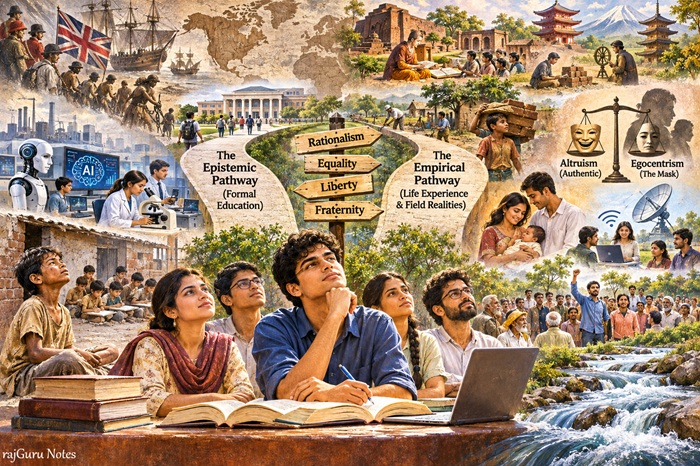
Through relentless cross-disciplinary research, modern education has generated thousands of industrial ecosystems, expanded economic avenues, elevated material living standards, and cultivated entrepreneurs, scientists, social theorists, and cultural innovators.
However, within post-colonial landscapes, the adoption of modern educational frameworks introduces a critical socio-philosophical challenge. A vast majority of contemporary success and strategic management literature is deeply rooted in empirical data and histories specific to Europe, America, and Russia. These structural models reflect unique Eurocentric geographical paradigms and specific social trajectories.
When developing nations blindly import these success metrics alongside Western sciences, fine arts, cinema, and television, they inadvertently absorb alienated personality development frameworks. This creates a severe intellectual scarcity: the systemic lack of alternative frameworks designed from the indigenous standpoints of major Asian nations like China, Japan, and India.
The Colonial Matrix vs. Subjugated Epistemologies
To understand the asymmetry in global success models, one must critically examine economic and colonial history. Until the dawn of the eighteenth century, Asian nations occupied the absolute global zenith of industrial production, scientific innovation, and cultural legacy. Other global entities traversed dangerous maritime routes purely to trade with these prosperous hubs. However, the subsequent centuries witnessed the brutal institutionalization of colonial hegemony. For over 350 years, colonial networks aggressively plundered the material resources of Asian and African societies, occupied vast territories, and generated hyper-capitalist production by subjugating, enslaving, and liquidating indigenous populations, including Black communities and native Red Indians.
The developmental models, cultural values, and cognitive mindsets of colonizing nations were structurally engineered upon this very foundation of territorial expansion, warfare, and absolute commercialization—turning science, arts, technology, and human adventure into profit-driven commodities.
Conversely, the nations subjected to this historical drain experienced a completely different developmental trajectory. The subaltern psyche, indigenous sciences, local values, and domestic educational models were systematically neglected, delegitimized, and humiliated. The stolen capital from these colonized lands accelerated the Western Industrial Revolution, converting occupied resources into instruments to further dominate and govern the subjugated populations. Therefore, any universal framework of personality development today must confront this historical asymmetry to build true intellectual sovereignty.
The Polarization of Exclusion: Attrition and the Inferiority Complex
Within developing societies, modern education faces a severe crisis of structural exclusion. To quantify this through an educational attrition matrix: out of every 1.2 crore children who become biologically ripe to enter primary school annually at the age of five, only a fraction—around fourteen lakhs—successfully reach the tenth-grade milestone. Statistical data demonstrates that out of every hundred students who enter the primary academic pipeline, a meager thirteen manage to sit for the secondary school examinations. By the time this shrinking cohort scales up to post-graduate research, the numbers collapse from lakhs into a few mere thousands.
Consequently, the progressive personality development and economic empowerment catalyzed by modern education fail to reach even ten percent of the population. True social balance can only be realized when the state guarantees free high-quality higher education alongside universal residential infrastructure for all. Because over sixty percent of the populace is systematically excluded from formal academic resources, a vast majority of young boys and girls are pushed prematurely into the workforce as child laborers.
This exclusion fractures society into two distinct pathways of personality development: the Epistemic Pathway, which relies on structured, indirect collective knowledge compiled by academic systems, and the Empirical Pathway, where the subaltern majority carves out their existence, values, and survival skills purely through localized field realities, neighborhood interactions, and direct life experiences.
When these empirical experiments are codified, they transform back into advanced science. Yet the deep chasm between these pathways breeds a generational inferiority complex among the excluded masses. Despite carrying these systemic scars, these marginalized groups continuously strive to break free from this psychological trap, seeking authentic identity, self-worth, and social validation to march forward.
The Socio-Biological Lifecycle: The Dilemma of Delayed Transitions
Human personality development is inherently a lifecycle framework, unfolding through distinct chronological and physiological turning points. In classical human development studies, the initial decade of childhood forms the psychological baseline, anchoring the emotional impressions and lived lessons that govern adult behavior. Evolving beyond these boundaries requires a qualitative shift—a Paradigm Shift—where an individual transforms their conduct to match their expanding social status.
This is perfectly illustrated by the career trajectory of a clerk rising to the position of Managing Director or CEO. The clerk’s personality operates on strict execution and compliance; the executive's personality must operate on strategic autonomy, systemic decision-making, and talent management.
However, the most profound paradigm shift occurs within the natural lifecycle: the transition from dependent childhood to parental leadership. Prior to marriage, individuals function largely within individual-centric boundaries; following marriage and childbirth, they transform into parents, naturally assuming the role of primary leaders and ethical guides for the next generation.
In the contemporary era, the hyper-focus on professional advancement and material accumulation has severely disrupted this natural lifecycle. Driven by intense competition, young men and women are systematically prioritizing institutional career goals over foundational life stages, frequently delaying marriage and family formation until their mid-thirties. This structural delay has resulted in profound, unintended psychological and social consequences.
By the time individuals approach their mid-thirties, their personality traits, personal tastes, and individual habits become deeply rigid and unyielding. Consequently, the natural capacity for biological and psychological adaptability decreases dramatically. When delayed marriages do occur, this lack of adaptability makes it deeply difficult for couples to foster mutual equality, emotional synthesis, and deep coexistence. The immediate result is a global surge in marital conflict, skyrocketing divorce rates, and the critical rise of single-parenting households.
While professional goals and career milestones are infinitely renewable and continue throughout a lifetime, the biological timeline governing human reproduction and primal companionship remains absolute. Postponing these natural rites of passage until the approach of the Menopause Phase—a period that naturally introduces complex physiological and emotional shifts in women—deprives individuals of the organic lifeworld, the shared journey of mutual growth, and the vital, nature-endowed cushion of companionate security. True personality development requires an individual to recognize that professional ambition must never swallow the holistic, biological, and psychological ecosystem of human existence. Evolving together through the formative years of youth is a foundational element of life satisfaction.
Altruism vs. Egocentrism: The Illusion of the Mask
No external entity, objective metrics, or public auditor can genuinely judge whether a leader’s or an individual's actions stem from pure empathy or naked vanity. An authentic framework of personality development must confront the psychological trap of the "Mask" (Persona). In contemporary market-driven societies, personality development is often degraded into a tactical mask, a tool for diplomatic deception, corporate manipulation, or acquiring social credit and financial leverage through fabricated virtues.
This critical boundary between authentic altruism and sophisticated selfishness was deeply explored by the profound social thinker and labor organizer Dattopant Thengadi. He insightfully illuminated that no matter how monumental an individual's public sacrifices appear, the external world can never truly decode the underlying motivation. Whether an act of sacrifice is genuinely altruistic, or merely a sophisticated mask to secure personal fame, egoistical gratification, and systemic authority, is completely impossible for the public to detect. The collective cannot cross that psychological barrier. Ultimately, that absolute truth is known only to the individual's inner heart and their deep conscience.
True transformation, therefore, requires shattering this mask of validation-seeking egocentrism. An authentic personality finds absolute joy in the very act of unmasked sacrifice, mirroring the classical imagery of a mother who remains hungry just to ensure her children are fully fed.
Philosophical Resolution: Rationalism and the Framework of Constitutional Dignity
To dismantle the anxieties generated by both modern societal pressures and regressive traditional inheritances, life must be rigorously filtered through the lens of absolute rationalism. An evolved, progressive personality must embrace a universal approach to knowledge: no school of thought should be treated as untouchable. Even within traditional or conservative frameworks, if a profound truth or structural insight is articulated, a rational mind must possess the intellectual honesty to evaluate and accept it.
This requires filtering out regressive dogmas that exploit human vulnerability through fear. One can draw from the modern insights of yogic thinkers like Baba Ramdev, who emphasizes that every single dimension of space, time, and direction is inherently sacred, and that the concept of the profane is merely a regressive construct designed to enforce compliance. Rationalism demands that as new knowledge and scientific insights emerge, individuals must dynamically update their belief systems to optimize self-confidence.
Furthermore, individual transformation must be synthesized with collective progress. The poet-philosopher Vemana illuminated the architecture of perspective through his bitter gourd analogy: humans willingly accept the bitter gourd because their cognitive framework expects it, yet they reject a bitter ridge gourd because their rigid bias demands absolute sweetness. Shifting one's perspective allows an individual to embrace complex realities with poise.
Ultimately, personality development is never an isolated individual pursuit confined to the advancement of a single household. When restricted to raw self-interest, an individual often ends up consuming the structural opportunities of others, transforming them into an obstacle to universal progress.
Individual consciousness and social existence resemble the two parallel tracks of a railway line—the train of human progress can only advance when it balances perfectly on both tracks simultaneously. Genuine personality development must serve as a democratic instrument to liberate the collective from historical hierarchies of caste, class, and gender. It must be anchored firmly upon the core global touchstones of Liberty, Equality, and Fraternity, ensuring that every human being can fulfill their infinite goals while moving forward with absolute dignity.
The Avant-Garde of Modern Leadership: Cultural Resistance and Technological Leapfrogging
In the contemporary global era, authentic mass leadership must transcend structural management to engage in active cultural and ideological resistance. True leadership does not merely operate within existing socio-cultural frameworks; it systematically challenges embedded cultural hegemonies and historic exclusions. This is precisely where the intersection of literature, fine arts, and social movements becomes crucial. By giving voice to the marginalized and producing critical alternative narratives, leaders dismantle the patronizing architectures of dominant elites.
This democratic distribution of dignity and rights can be synthesized through a powerful social justice maxim: "No Buffet System. Table Meals! Everyone should be served their own with dignity." This ethos demands that leadership must not treat human rights and developmental opportunities as a chaotic, self-service lottery where the powerful corner all resources. Instead, an ethical leadership model ensures a structured, inclusive, and equitable institutional framework where every marginalized community is directly and respectfully served their rightful, proportional share.
Furthermore, the late twentieth and early twenty-first centuries have introduced a radical variable into the mathematics of mass mobilization: technological decentralization. Historically, deeply entrenched institutional giants dominated socioeconomic landscapes through sheer financial muscle and monopoly over traditional infrastructure. However, the advent of digital communication and information technology proved that newer, agile players could completely bypass archaic hierarchies—a phenomenon known as "Leapfrogging." Traditional monoliths often entered fields like information technology and advanced telecommunications late, only after newer, visionary disruptors had already democratized the ecosystem.
For the rising generation of grassroots leaders and changemakers, modern technology acts as the ultimate equalizer. It shatters the old gatekeeping mechanisms of mainstream media and networks, allowing emerging leaders to rapidly cultivate critical consciousness, execute mass mobilization, and project their moral authority directly onto the global stage.
Conclusion: The Perennial River of Collective Action
Ultimately, leadership finds its highest, most unassailable expression when it is translated into a life goal of humanitarian service. Within this altruistic framework, the divisive barriers of religion, geography, caste, and class completely evaporate. Whether it is expanding sanitation infrastructure nationwide like Bindeshwar Pathak or dedicating one's entire existence to healing the marginalized like Mother Teresa and Baba Amte, service transforms individual personality into an immortal moral guide for the world.
Every great grassroots movement, organization, or political party in human history begins as a tiny, unassuming stream. When Swami Vivekananda famously proclaimed, "Give me a handful of men with muscles of iron and nerves of steel, and I will transform this nation," he was referencing this exact catalytic power of a dedicated nucleus. When the RSS was founded in Nagpur on Vijayadashami in 1925, it commenced with a mere five to six individuals before branching out into a massive global network spanning multiple socioeconomic sectors. Similarly, when a visionary leader co-founded a grassroots movement with just two other associates, that small nucleus of three individuals went on to mobilize lakhs of students, workers, teachers, writers, and artists, ultimately laying the foundation for a historic mass political movement.
As trickles, brooks, and minor streams converge, they dynamically expand into a magnificent, perennial, and unstoppable river. Genuine leadership operates precisely like this continuous hydrological cycle: it remains rooted in the soil, constantly gathers fresh collective energy, rejects stagnation, and flows perpetually forward to unconditionally give back to the society from which it drew its life force.
14-Nov-2026
More by : B.S. Ramulu
