Nov 14, 2026
Nov 14, 2026
by Sahithi B
Will They Ask to Meet Our Scientists or Our Influencers?
“We have spent centuries wondering whether aliens exist. Perhaps we should spend a few minutes wondering what they would think of us.”
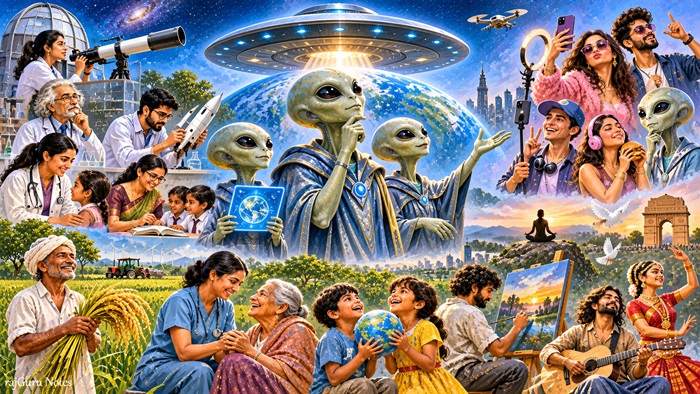
Introduction:
Imagine waking up one morning to discover that an extraterrestrial spacecraft has entered Earth's atmosphere. Governments are holding emergency meetings. Scientists are rushing to their laboratories. News channels are broadcasting breaking news every thirty seconds. People are looking at the sky, wondering whether humanity is about to make the greatest discovery in its history. And somewhere on Earth, someone is already asking:
"Do you think the aliens will have Instagram?" Another person is checking whether the spacecraft has a good camera. A third is preparing a video titled "I Spent 24 Hours With ALIENS! (Gone Intergalactic!)"
Humanity has finally encountered a civilisation from beyond Earth, and our first instinct might be to turn the entire event into content. But imagine that the aliens have travelled thousands of light-years to meet us. They want to understand our science, our history, our achievements, and our place in the universe.
Whom should we introduce first?
Of course, this is an imaginary scenario. We have no confirmed evidence that extraterrestrial beings have visited Earth, and we cannot know how an alien civilisation would react to humanity. Nevertheless, the question creates an entertaining opportunity to examine our priorities.
If another civilisation wanted to understand Earth, would our most visible people represent our greatest achievements—or simply our greatest ability to attract attention? Welcome to the most important diplomatic meeting in human history. Please silence your phones. The aliens are watching.
1. First Contact: The Greatest Day in Human History
For generations, humans have looked towards the stars and wondered whether life exists elsewhere.
Scientists have discovered thousands of planets beyond our solar system, known as exoplanets. Some orbit within regions where temperatures could permit liquid water under suitable atmospheric conditions.
Astronomers also study the chemical ingredients of life, investigate environments where microorganisms might survive, and search for possible signs of life beyond Earth.
However, finding a potentially habitable planet is not the same as finding life. So far, there is no confirmed discovery of extraterrestrial life.
Now imagine that this uncertainty disappears. A spacecraft arrives. Its occupants make contact. Humanity receives undeniable evidence that we are not alone. It would be an extraordinary scientific event. Researchers would want to examine the spacecraft, understand its propulsion system, learn how the visitors communicate, and determine whether their biology differs from ours.
And the internet?
The internet would immediately become a battlefield of theories, jokes, reaction videos, and questionable explanations.
Someone would claim that the aliens were spotted in a village years ago. Someone else would announce that their neighbour had predicted the event. Another person would upload a blurry photograph of a streetlight and call it definitive proof. Before scientists could complete their first analysis, humanity might already have produced approximately four million opinions. Perhaps the first challenge of contact would not be understanding the aliens. It would be agreeing on what actually happened.
"One universe, billions of questions, and somehow everyone already has an opinion."
2. The Scientists: People Who Actually Study the Universe
If extraterrestrial visitors wanted to understand humanity's scientific achievements, scientists would be an obvious starting point. They study the physical laws governing the universe, investigate the origins of stars and galaxies, develop technologies, and search for answers to questions that have fascinated humans for centuries.
Astronomers investigate distant worlds. Physicists explore matter, energy, space, and time. Biologists study the extraordinary diversity of life on Earth. Engineers turn scientific principles into practical technologies. Space exploration itself demonstrates what human curiosity can achieve.
We have launched telescopes capable of observing distant galaxies, sent robotic explorers to other planets, and developed spacecraft that travel beyond Earth's immediate neighbourhood. Missions such as NASA's Voyager programme have carried instruments into interstellar space, while observatories such as the James Webb Space Telescope help researchers investigate the early universe and the atmospheres of distant planets.
These achievements did not happen because someone simply declared that the universe was interesting. They required years of study, experimentation, collaboration, failure, and persistence.
Imagine an alien scientist asking an Earth scientist:
"How did your species discover the age of the universe?"
The human scientist begins explaining observations, mathematical models, and the evidence supporting modern cosmology. The alien listens carefully.
Then comes the next question:
"How did you determine the composition of distant stars?"
Another detailed explanation follows. For the first time, humanity has an opportunity to exchange knowledge with an entirely different civilisation. It could be one of the greatest intellectual moments in history. Unfortunately, someone outside the laboratory might already be asking the scientist to move aside because the spacecraft looks better from another camera angle.
"Scientists study the universe. Influencers study the algorithm. Both are looking for patterns, but the consequences are slightly different."
3. The Influencers: Earth's Unofficial Representatives
Now let us consider the alternative. Imagine that the aliens decide to understand humanity by observing the most visible people on social media. They discover creators who produce educational videos, artists who share their work, musicians who perform for millions, and communicators who explain complex subjects in accessible ways.
Some influencers genuinely help people learn, discover new ideas, support meaningful causes, and connect with communities.
Social media can make knowledge more accessible. A scientist can explain a discovery to a global audience. An artist can share a creation across continents. A young person can learn a new skill without entering a classroom.
That is a remarkable achievement. But the aliens might also encounter an endless stream of product promotions, carefully staged lifestyles, arguments over celebrity gossip, and videos explaining how to become successful in seven days.
Imagine an extraterrestrial researcher studying a video in which a human spends several minutes demonstrating the correct way to open a packet of snacks.
The researcher records the observation:
"Humans have developed advanced digital communication technology. A significant portion of their communication concerns food packaging."
The researcher then watches a video in which someone films themselves walking into a room, leaving the room, and entering again because the first recording was not aesthetically pleasing.
The report continues:
"Humans appear to repeat ordinary actions for observational purposes."
Of course, this is an exaggerated fictional scenario. Social media contains much more than trivial entertainment, and its creators cannot all be placed in the same category. The real question is not whether influencers are useful or useless. It is whether visibility has become confused with importance.
A person can have millions of followers without possessing expertise in every subject. Another person can make an enormous contribution to science, medicine, education, or society without becoming widely known. Popularity measures attention. It does not automatically measure knowledge, character, or achievement.
"Being seen by millions does not necessarily mean having something meaningful to say."
4. The Great Cosmic Interview: Scientists Versus Influencers
Let us imagine a friendly debate between an alien delegation and two groups of humans. On one side stands a team of scientists. On the other stands a group of social media influencers. The aliens begin their investigation.
Alien: "How does your species understand the universe?"
Scientist: "Through observation, experimentation, mathematics, and evidence."
Influencer: "Through a series of carefully edited videos."
The alien pauses.
Alien: "How do you determine whether a claim is true?"
Scientist: "We examine the evidence, test the hypothesis, and consider alternative explanations."
Influencer: "We check the comments."
The scientist closes their eyes for a moment. The alien continues.
Alien: "What is your civilisation's greatest technological achievement?"
Scientist: "That depends on the criteria. We have developed powerful scientific instruments, medical technologies, communication systems, and spacecraft."
Influencer: "A ring light with adjustable brightness."
The alien delegation requests a private meeting.
Again, this is satire, not a judgment of every content creator. Many influencers are intelligent, creative, and highly skilled communicators. In fact, science communicators often bridge the gap between researchers and the public. The point is that scientists and influencers generally perform different roles.
Scientists investigate questions and develop knowledge through specialised methods. Influencers create content and communicate with audiences, often using personal experiences, entertainment, education, or commentary.
When these roles work together, they can be powerful. A scientist may discover something extraordinary, while an effective communicator helps millions of people understand why it matters.
The problem begins when attention becomes more important than accuracy, or when popularity is mistaken for expertise. If aliens visit Earth, perhaps the best delegation would include both the people who discover things and the people who explain them. Provided, of course, that nobody interrupts the meeting to ask the aliens for a collaboration video.
"Knowledge discovers the story. Communication helps the world hear it."
5. What Would Aliens Think of Our Social Media Obsession?
Imagine that an extraterrestrial civilisation has developed a way to observe Earth's public digital communications. It begins analysing our online behaviour. It discovers that humans share photographs of meals, document holidays, celebrate achievements, discuss politics, exchange jokes, and maintain relationships through digital platforms. It also discovers that people sometimes measure popularity using numbers displayed beneath their posts.
Likes. Views. Followers. Shares.
The alien researchers begin asking questions.
These are not problems created exclusively by social media, but digital platforms can amplify them. Humans have always cared about belonging, reputation, and social acceptance. Online platforms can make those concerns more visible by providing constant numerical feedback. A person can share an achievement and receive immediate recognition. That recognition can feel rewarding. But if attention becomes the main measure of personal value, the numbers can begin to control the experience.
A post receives fewer reactions than expected, and disappointment follows. Another person receives more attention, and comparison begins.
The alien researchers may eventually conclude that humans possess sophisticated technology but remain deeply interested in how others perceive them. Perhaps they would find this understandable. After all, social belonging may be an important part of human life. Or perhaps they would simply wonder why an intelligent species invented a global communication network and then used it to argue with strangers about whether a particular food belongs on a pizza.
"We connected the planet, counted the reactions, and somehow made ourselves anxious about both."
6. Would Advanced Aliens Consider Us Intelligent?
This is where the question becomes more philosophical. We often imagine that an advanced alien civilisation would possess extraordinary technology. Perhaps its spacecraft could cross interstellar distances. Perhaps it could communicate using methods we have not discovered. Perhaps it could manipulate energy or matter in ways that currently belong to science fiction. But technological sophistication does not automatically tell us everything about a civilisation's values.
An advanced society might have developed remarkable scientific knowledge, yet we cannot confidently predict its ethics, social structure, or attitudes towards other forms of life.
Those are unknowns. Nevertheless, the imagined encounter gives us an opportunity to reflect on our own civilisation. Human beings have developed vaccines, discovered the structure of DNA, built global communication networks, created extraordinary works of art, and explored space. We have also experienced wars, environmental destruction, inequality, and conflicts that could have been prevented through better cooperation. Our history contains both remarkable achievements and serious failures.
Perhaps intelligence should not be judged solely by the complexity of our technology.
A civilisation's wisdom may also be reflected in how it treats its people, protects its environment, responds to suffering, and handles the power it possesses. These qualities are more difficult to measure than the size of a spacecraft, but they are worth considering.
"Intelligence builds the technology. Wisdom decides what to do with it."
7. What If Aliens Ask Us About Earth?
Imagine the aliens have finished examining our spacecraft, computers, and communication networks. Now they want to know something about our planet.
"What makes Earth special?"
We could tell them about its oceans, forests, mountains, and extraordinary variety of life. We could explain that Earth supports countless species and that human civilisation has developed through the combined contributions of generations of people. We could introduce them to our music, languages, literature, mathematics, scientific discoveries, and artistic traditions. We could show them how people cooperate during disasters, care for family members, teach c hildren, treat patients, and create technologies to solve difficult problems. And we could tell them about the curiosity that led humans to look at the night sky and wonder whether anyone else was out there.
But we might also have to explain the environmental challenges facing our planet.
We might discuss pollution, habitat destruction, biodiversity loss, and climate change. We might explain how human activities have affected ecosystems and how researchers are working to understand and address these problems.
The aliens would not need to compare us with another civilisation to make these questions important.
We already know that Earth is our home and that the choices we make can affect the lives of other people and other species. Perhaps the most meaningful introduction to humanity would not be a list of our most famous personalities. It would be an account of what we have learned, what we have created, what we have damaged, and what we are trying to improve.
After all, a civilisation is more than its celebrities. It is the collective story of the people who live within it.
"If we want to represent Earth, perhaps we should begin by taking care of it."
8. Could the Aliens Become Influencers Too?
Now imagine that the visitors decide to stay on Earth for a few weeks.
Their spacecraft becomes the most photographed object in history. Their language becomes a subject of intense public curiosity. People want to know what they eat, how they travel, and whether they have their own equivalent of entertainment.
A new question emerges: Would the aliens become celebrities? It is entirely possible to imagine such a scenario. A single extraterrestrial could attract enormous attention simply because they were the first confirmed visitor from another world. Companies might want to associate their products with the discovery. News organisations might compete for interviews. Scientists would seek opportunities to communicate with them, while the public would want to learn about their lives.
Then someone might ask:
"Could you please react to our oldest memes?"
The alien agrees.
Within hours, the video reaches millions of views. The extraterrestrial has become a social media sensation without understanding why humans keep showing them photographs of cats. Perhaps they would eventually launch a channel.
"A Day in the Life of an Interstellar Traveller."
The series becomes an international success. But beneath the joke lies a genuine observation: people are often fascinated by what is unusual, unfamiliar, or difficult to explain. An extraterrestrial visitor would represent all three. The attention might help the public engage with science and ask new questions about the universe. It might also distract from the scientific and diplomatic work required to understand the encounter. The challenge would be to turn fascination into learning rather than allowing the spectacle to become the entire story.
"Even an interstellar traveller might need to survive the algorithm."
9. The Real Question: Who Deserves to Represent Humanity?
Our imaginary alien encounter began with a humorous choice between scientists and influencers. But perhaps the question is too narrow. Humanity cannot be represented by one profession, one personality, or one definition of success.
Scientists help us understand the natural world. Engineers develop practical solutions. Doctors protect health. Teachers pass knowledge between generations. Artists help us express ideas and emotions. Farmers produce food. Workers maintain essential services. Caregivers support people who need help. Writers, musicians, filmmakers, and communicators can bring important discoveries to wider audiences. Each contributes differently to the complex system we call civilisation.
Fame is one way people become visible, but visibility does not reveal the full range of human contribution. Many people who make life better for others will never become famous.
A teacher who inspires a student may never trend online. A researcher may spend decades working on a discovery that receives little public attention. A person who quietly helps a neighbour may never receive a single public acknowledgement. Yet these contributions can matter enormously.
Perhaps the best representation of humanity would be a diverse group of people who can demonstrate not only what we know, but also how we learn, create, cooperate, and care for one another. And if the aliens insist on meeting an influencer, we can introduce them to someone who uses their platform to communicate science responsibly. That way, everyone gets a seat at the table.
"A civilisation is not defined only by the people everyone knows, but also by the people whose contributions make life possible."
Conclusion: Dear Aliens, Please Meet Our Best Side
If extraterrestrial visitors ever arrive on Earth, the encounter could transform science, philosophy, politics, and our understanding of humanity's place in the universe. We would have questions that have occupied human minds for centuries.
We cannot predict how such a meeting would unfold. We do not know whether extraterrestrial civilisations exist, whether they could travel to Earth, or what they would consider important about us. But the thought experiment is still useful. It encourages us to examine the difference between fame and knowledge, entertainment and education, technological progress and wisdom.
Social media has created new opportunities for people to share ideas and reach global audiences. Science has expanded our understanding of the universe. Art and culture help us communicate experiences that cannot always be expressed through numbers and equations. These are not competing achievements. At their best, they complement one another. Perhaps the real question is not whether aliens would prefer scientists or influencers. Perhaps it is whether we can create a civilisation in which knowledge is valued, creativity is encouraged, scientific evidence is respected, and public attention is used responsibly.
If aliens visit Earth, let us introduce them to our scientists, our artists, our teachers, our innovators, and the countless people who contribute to society without expecting applause. Let us show them our telescopes and our music, our spacecraft and our stories, our discoveries and our determination to learn. And if someone insists on filming the entire meeting, perhaps we can allow one short video.
Just one.
Because even if the universe turns out to be full of intelligent life, we should probably make sure humanity has something more interesting to offer than its comment section.
Final Thought
"If the universe is full of intelligent life, the greatest question may not be whether someone is watching us. It may be what we would want them to see."
Illustration courtesy rajGuru Notes
14-Nov-2026
More by : Sahithi B
