Nov 14, 2026
Nov 14, 2026
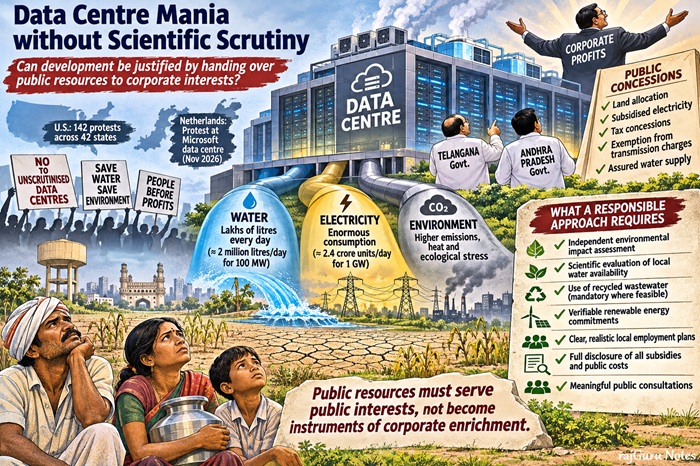
Can development be justified by handing over public resources to corporate interests?
Data centres are indispensable to the digital revolution and the expanding applications of Artificial Intelligence (AI). However, to what extent is it justifiable to jeopardise people's fundamental needs, particularly water, electricity and environmental security, in the name of technological progress? Across the United States and several European countries, the rapid expansion of data centres has triggered growing opposition from citizens, environmental activists and intellectuals. In November 2026, activists even entered the construction site of a Microsoft data centre in Amsterdam, the Netherlands, to register their protest. In the United States, 142 protests across 42 states reflect the mounting public disquiet. Water scarcity, enormous electricity consumption, environmental degradation and the limited benefits accruing to local communities lie at the heart of these objections.
Unfortunately, instead of drawing lessons from these international experiences, Indian governments, particularly those of Telangana and Andhra Pradesh, appear to be competing with one another to attract data centre investments. Announcements of investments worth lakhs of crores, world-class technology hubs and thousands of jobs dominate the political narrative. Yet, the environmental, economic and social costs underlying these ambitious projects receive remarkably little scrutiny. More importantly, the employment potential is often exaggerated. Experience from data centres established abroad suggests that these facilities are highly automated, requiring relatively small permanent workforces. The thousands of jobs projected in investment announcements must therefore be examined with considerable caution.
Data centres are not ordinary commercial establishments. Thousands of servers operate continuously, consuming enormous quantities of electricity. Their heat-intensive operations require sophisticated cooling systems, which can place an extraordinary burden on water resources. Facilities relying on water-based cooling may consume lakhs of litres every day. According to estimates by the International Energy Agency (IEA), a large data centre with a capacity of 100 megawatts may require approximately two million litres of water daily for its direct and indirect needs. A study by the Council on Energy, Environment and Water (CEEW) estimates that India's annual water consumption by data centres had reached approximately 15,000 crore litres by 2025 and could more than double by 2030.
This projected demand is particularly alarming in a country where several cities and rural regions are already grappling with acute water shortages. Hyderabad, for instance, experiences considerable pressure on its drinking water supply during summer. Farmers in many rural areas struggle to secure adequate irrigation, while drinking water scarcity continues to drive distress migration. Against this backdrop, an obvious question arises: where will governments find the water required to sustain these resource-intensive facilities? If groundwater is extracted on a massive scale, what will become of the neighbouring villages and their agricultural livelihoods? The World Resources Institute's (WRI) 2026 assessment reportedly indicates that more than half of India's data centres are located in areas facing water stress. Such findings demand serious attention before further expansion is sanctioned.
The electricity burden is equally disturbing. A data centre with an installed capacity of one gigawatt, operating at full capacity, would consume approximately 2.4 crore units of electricity every day. Ensuring uninterrupted power supply on this scale would necessitate additional generation capacity, transmission infrastructure and backup systems. If coal-fired power remains a major source of this electricity, carbon emissions and air pollution will inevitably rise. While renewable energy is frequently presented as the answer, solar and wind power alone cannot guarantee uninterrupted supply without adequate storage facilities and reliable grid integration. Governments must explain how these challenges will be addressed rather than relying on attractive investment projections.
The employment claims associated with these projects also warrant closer examination. In Andhra Pradesh, two proposed data centres in the Visakhapatnam and Anakapalli regions, with a combined capacity of 1,486 megawatts and investments of Rs.1.44 lakh crore, are projected to generate only 3,130 jobs. In Telangana, a 400-megawatt project involving an investment of Rs.10,000 crore has been projected to create 3,600 jobs. These figures represent government and corporate projections, not guaranteed outcomes. It is essential to distinguish temporary employment during construction from permanent jobs in operations and maintenance. The crucial question is whether local communities will receive meaningful and sustainable employment commensurate with the enormous public resources being committed.
Why, then, are governments competing so aggressively to attract these investments? The desire to project an image of rapid industrialisation, attract global technology corporations and gain an advantage in the inter-state investment race appears to be driving much of this enthusiasm. However, the benefits offered to corporations come at a public cost. Land allocations, subsidised electricity, tax concessions, exemptions from transmission charges and assured water supplies can impose a substantial long-term burden on public finances and essential services. The *Indian Express* has highlighted the concessions, including reductions in electricity tariffs and exemptions from transmission charges, announced for certain projects in Andhra Pradesh. Such incentives raise legitimate questions about who ultimately pays for corporate expansion and who actually benefits from it.
Opposing data centres outright is neither practical nor desirable. They have an important role in technological advancement, digital infrastructure and the emerging AI economy. But inviting them without adequately safeguarding public resources is hardly a responsible development strategy. Every proposed project must undergo a rigorous and independent environmental impact assessment, along with a scientific evaluation of local water availability and long-term electricity requirements. The use of recycled wastewater, rather than scarce freshwater, should be made mandatory wherever technically feasible. Renewable energy commitments must be verifiable, while local employment opportunities should be clearly specified. Governments must also place all subsidies, concessions, public expenditure and projected social benefits in the public domain. Meaningful public consultations should precede decisions that could affect the livelihoods of entire communities.
Ultimately, governments must recognise a fundamental truth: what data centres store may be digital information, but what they consume is the people's water, electricity and land. A development model that places corporate profits above the basic survival needs of ordinary citizens is fundamentally incompatible with democratic accountability and public welfare. Technological progress must improve human life, not undermine the very resources on which it depends. Ensuring drinking water for households, irrigation water for farmers and reliable electricity for ordinary consumers must take precedence. Only after these essential needs are adequately secured should governments consider extending priority and concessions to resource-intensive data centres. Development cannot be measured merely by the scale of corporate investments; it must ultimately be judged by the quality of life it delivers to the people. "Public resources must serve public interests, not become instruments of corporate enrichment".
Illustration courtesy rajGuru Notes
14-Nov-2026
More by : Prof. Dr. K. Ram Kishore
