Nov 14, 2026
Nov 14, 2026
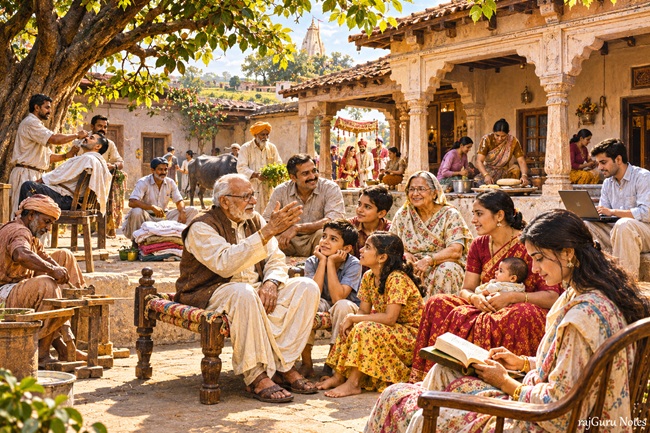
Introduction – Uniqueness of Indian Family
Indian family life often unsettles visitors who search for a single, tidy pattern beneath its many customs and habits. This essay turns away from any one master key. It turns instead to several concrete arenas that together sketch something of that complexity — the village-based Jejmani System, joint households, graded authority within the home, dense kin networks, arranged marriages, wedding rituals, moral codes and the impact of Western institutions and ideas. Taken together, these fields show how families organise work and ritual, distribute power and affection, and respond to wider social and economic change.
The Jejmani System once linked cultivating households and hereditary service groups through fixed obligations. Many villages then resembled little republics with their own economic rhythm and internal hierarchy. Joint families and layered authority inside the home carried this sense of mutual dependence into domestic life. These arrangements strengthened bonds across generations and branches of kin, although they also upheld unequal power. Strong ties of kinship drew related households into wider circles of support and responsibility. Arranged marriages and elaborate weddings created alliances within these circles and allowed families to display status and honour.
Moral codes and everyday ethical norms formed a shared background for judgements about conduct, ambition and misfortune. People drew upon religious teaching, legal rules and popular argument. Western rule and, later, global influences brought in new institutions, fresh desires and new anxieties. Families responded by revisiting questions of hierarchy, gender roles and intimacy. The essay does not search for a single “essence” of the Indian family. It traces patterns of persistence and change across overlapping domains, and it follows arguments among Indians themselves about what family life ought to be.
Jejmani System – Villages as Little Republics
The Jejmani System holds a central place in any discussion of Indian family life because it extended household relations across the entire village. Cultivating families and hereditary service groups formed long term ties that bound work, ritual and daily exchange into one field. Barbers, washermen, carpenters, blacksmiths and similar groups did not work as anonymous sellers of labour in a market. Each group entered enduring relationships with particular households. They received grain after harvest, small pieces of land, occasional sums of money and a share in offerings during festivals. Villagers often used kinship terms such as mama, chachi, bahen or bhai when they spoke to one another. Those forms of address signalled a moral universe in which economic relations rested on idioms of relatedness and mutual obligation.
These arrangements gave village life a particular texture. In many places in northern and central India, and in other regions to some extent, they created a dense web of reciprocity that made villages look like small republics with a degree of economic and administrative autonomy. Households knew in advance who would cut their hair, mend their tools or oversee rites of passage. Service families, in turn, could rely on customary dues at set points in the agricultural and ritual calendar. The Jejmani System brought a measure of predictability to a world marked by climatic uncertainty and limited state presence. It also tied the welfare of each family to shared routines of labour, worship and celebration.
At the same time, jejmani relations rested on strong hierarchy. Rights and duties did not spread evenly across groups. Service castes usually had little scope to change terms or resist harsh demands. Kinship speech could soften interaction, yet it did not wipe away raw inequality. Expectations about purity, pollution and caste rank shaped who served whom and under which conditions. Intimacy and distance existed together. People met every day in fields, courtyards and temples. Their meetings followed inherited rank as much as affection and long habit.
From the twentieth century onwards, land reform, movement of labour across regions, state welfare programmes and the spread of markets weakened the older pattern of fixed hereditary service in many areas. Cash wages, salaried work in government and new routes for mobility loosened some of the tight knots that bound families within jejmani contracts. Even now, traces of jejmani thinking surface in expectations about caste-based duties, ritual responsibilities and the moral vocabulary of obligation and reciprocity. Many villages still imagine themselves as interdependent wholes — settings in which family, work and worship remain interlaced rather than sharply split — and the image of the village as a self-contained “little republic” continues to hold a strong place in memory and public debate.
Joint Family System
The joint family system in India carries this village-centred sense of mutual dependence into the heart of the household. Instead of breaking into small nuclear units, several generations and branches of a lineage often live together or maintain close coordination in matters of residence, livelihood and ritual. Shared kitchens, pooled income and collective responsibility for children and elders create domestic arrangements in which daily routine, economic strategy and moral training lie tightly bound together. Many families draw strength from such households in times of uncertain harvests, unstable markets, illness or old age. These homes also form rich settings in which skills, tales and habits pass from one generation to the next.
The joint family does not form a calm refuge. Authority usually follows lines of age and gender. Senior men, and senior women within their own sphere, often hold strong influence over decisions related to marriage, education and spending. Younger members receive support and advice, yet they may feel hemmed in by calls for obedience and by constant reminder that they must place the collective good above personal preference. Stories in films, fiction and everyday talk often revolve around conflict over property, distribution of domestic labour or the position of daughters-in-law. Those stories expose the close knotting of emotion, status and material resources inside large households.
Economic and social shifts have changed the ground under joint family life. Salaried work, movement to cities within India, migration abroad, crowded housing in expanding urban centres and new kinds of career paths all place pressure on very large co-resident units. In many towns, nuclear families now form the main unit of residence, although they stay linked to a wider circle through visits, telephone calls, online contact and financial transfers. Legal reforms regarding inheritance and women’s rights have reshaped expectations about who owes what to whom inside kin groups. Even with these alterations, the idea of the joint family has not vanished. Many Indians now treat it less as a precise physical pattern and more as a moral commitment to mutual aid and shared honour. That ideal still shapes how people imagine a good home and judge their own choices.
Hierarchical Family Relations
Hierarchy within the Indian family reaches back to precolonial times and connects closely with caste, class and gender. Relations between parents and children, elders and juniors, husbands and wives, brothers and sisters rest on expectations of deference, protection and authority. Children learn these expectations early in life. They learn particular forms of greeting for elders. They seek blessings on key occasions. They accept direction on questions of education, work and marriage. Such routines carry both affection and discipline. The family stands at once as a shelter of intimacy and as a site where wider patterns of social order gain shape.
British rule brought new law, new institutions of education and new kinds of paid work. These developments interacted with older hierarchies instead of sweeping them aside. Schools and colleges opened restricted routes upwards for women and for men from oppressed groups. Courts and codified personal laws created formal settings in which questions about guardianship, inheritance and spousal rights could come under dispute. Christian missions and Western-educated reformers challenged particular forms of patriarchal power, especially in relation to child marriage and harsh restrictions on widows. At the same time, the colonial state relied heavily on male heads of household and caste leaders. This reliance often upheld their authority in daily affairs.
In contemporary India, graded relations inside the family endure, yet they have become more open to contest. Young men and women who leave home for study or work in cities gain distance from constant elder supervision. They encounter new models of partnership and personal freedom. Paid employment for women, legislation against domestic violence and the more visible presence of alternative ways of living give family members fresh grounds for questioning received commands. Many households still value sharply defined lines of respect and decision making. They see such lines as essential to cohesion and to the maintenance of order. Authority within families often emerges through compromise and conversation rather than through rigid obedience or simple revolt. The tension between hierarchy and intimacy has become one of the distinctive themes of Indian family life.
Strong Kinship Bonds
Strong kinship bonds form the connective tissue of the Indian family system. Beyond the immediate household, people belong to dense networks of relations by blood, marriage and ritual tie. These networks stretch across neighbourhoods, villages, regions and in many cases foreign countries. Uncles, aunts, cousins and affines play active roles in the arrangement of marriages, search for jobs, settlement of quarrels and daily management of children or elders. These links lend emotional assurance and practical help at moments of sickness, unemployment or bereavement. They also allow persons to draw on pooled resources of reputation, information and influence.
Such ties demand constant tending. Visits during festivals and life cycle rituals, telephone calls, online messages and gifts of food or money keep bonds alive. Ideas about duty and gratitude anchor these practices. Children hear tales of sacrifice by parents and grandparents. Adults hear repeated insistence that personal success must feed back into the kin group. Stories of exemplary ancestors and much-admired joint families reinforce an ethic that praises loyalty to relatives in times of hardship.
These same networks can weigh heavily. Strong pressure often falls on younger people to marry within certain circles of kin or caste, to pursue certain callings or to protect family honour by restraining personal desire. Disputes over inheritance or perceived insults sometimes split branches of a lineage for long periods. In such cases, resentment moves along the same channels that usually carry support. Migration, urban anonymity and new work patterns have stretched kin across wider spaces. Even so, they have not broken the web. Many families now combine older forms of solidarity with looser, more adaptable ties. Strong kinship bonds still shape life chances and choices, even when people no longer share a single roof.
Arranged Marriages
Arranged marriages in India link these kin networks to the larger moral world of caste, religion and region. Many families treat marriage less as a purely private affair between two persons and more as an alliance between households with long term consequences for property, status and support. In many Hindu groups, marriages have customarily taken place within the same caste and often within a defined sub-group. Among Muslims, Christians, Sikhs and others, similar expectations tie marriage to shared faith, speech forms and locality. Historical records and customary laws show that families across the social spectrum have long taken part in arranging marriages. Elders treat the arrangement of suitable unions as one of their principal duties.
A classical pattern of arranged marriage places parents, close kin or recognised matchmakers at the centre of the search. They identify prospective spouses, exchange information about ancestry, character, education and occupation, and request views from trustworthy intermediaries. Ritual specialists such as priests may match horoscopes or select auspicious dates for the wedding. Ceremonies usually unfold in homes, religious spaces, or function halls rather than civic offices. In Hindu thought, marriage often takes the shape of a religiously sanctioned bond that lays mutual obligations upon husband and wife in this life and, in some interpretations, beyond.
The organisation of arranged marriages has altered over time. Modern education, city-based work and global media have influenced expectations about companionship, conversation and consent. In many urban locations, parents still begin the search for an appropriate spouse. They now often rely on friendship networks, newspaper advertisements or specialised matrimonial websites. Prospective brides and grooms usually meet several times. They talk in person, by telephone or online and then decide whether to proceed. Legal rules that demand the free consent of adult spouses and public campaigns against child marriage and extreme forms of dowry have strengthened the formal position of young people. Enforcement remains uneven, yet it exists as a resource for contest.
A mixed pattern has come into view. Fully arranged marriages still hold strong in many rural districts and in conservative urban pockets. Alongside them, many couples meet during study or employment, form an attachment and later seek parental blessing. Families then treat such unions as “love-cum-arranged” marriages and usually carry out familiar rituals. Across these variants, families continue to worry about continuity of caste and religion, preservation of language and regional ties and a rough matching of educational and economic backgrounds. Arranged marriage continues to act as a key arena in which Indians weigh family authority against personal desire, and inherited structures against changing social worlds.
Wedding Rituals and Ceremonies
Wedding rituals in India cast these negotiations into drama and spectacle. Marriage ceremonies glow with colour and exuberance. They draw in far-flung relatives, neighbours and colleagues across several days and nights. Customs differ sharply by region, religion and community. Yet most weddings blend sacred rite, legal acknowledgement and public display. Each celebration marks a turning point for bride and groom. It also allows families to affirm their standing within broader networks, honour obligations to kin and deities and signal hopes and aspirations through dress, decoration and generous hospitality.
Pre-wedding events such as engagement, mehendi, haldi and sangeet show how ritual duties merge with festivity. Engagement ceremonies give formal recognition to the relationship between two families. The event often includes exchange of clothes, jewellery and sweets. Mehendi and haldi ceremonies focus on blessing and beautification. Relatives and friends apply henna or turmeric to the couple. Music and laughter fill the room. Sangeet events, now popular in many communities, feature singing and dancing. Families sometimes hire choreographers. Young men and women rehearse elaborate performances and then present them with great enthusiasm. These occasions draw younger generations fully into the marriage process. They encourage creativity under the watchful eye of elders.
On the main wedding day, the baraat often forms a striking sight. The groom reaches the venue on a decorated horse or in a car while friends and relatives dance to drums and brass bands. Core rites then seal the union. In many Hindu weddings, the Saat Phere or Saptapadi mark the key moment. The bride and groom circle a sacred fire seven times in the presence of a priest and elders. Sikh, Christian, Muslim and other traditions follow different liturgies and formulas. Each pattern binds the pair before community and, when required, before the state. The vidai or formal departure of the bride from her natal home carries a high emotional charge. It dramatizes both the anguish of separation and the promise of ongoing connection through new ties.
Contemporary weddings also disclose shifts within Indian society. Hotel banquets, faraway venues, professional photographers and event managers have turned many ceremonies into large commercial ventures. Fashion industries, jewellery businesses and entertainment companies all gain from this expansion. Films, television serials and social media spread images of grand weddings. Many families measure their own plans against those images, with some embracing them and others pushing back. Concerns over cost, ostentation and gender injustice have encouraged a number of couples and reform-minded groups to favour simpler ceremonies or to channel some of the expenditure towards charitable work. Weddings remain central stages on which old ritual forms, kinship duties and modern longings meet and change.
Moral Codes and Ethical Norms
Indian family relations rest upon a blend of written law, religious teaching and everyday moral expectation. Children learn from an early age how they ought to behave towards parents, elders, guests and strangers. Stories, rituals and countless small routines of praise and reproach repeat these lessons. Moral codes in this sense do not appear as a single fixed rule book that covers all times and places. They arise from long histories of living together. They form shifting bundles of ideas about duty, respect, honesty and self-control. Families draw upon these ideas when they decide what counts as proper conduct, which forms of ambition they will tolerate and how they should respond when misfortune or conflict intrudes into domestic life.
These codes connect with religious principles, yet they do not match them exactly. Hindu, Muslim, Christian, Sikh and other traditions point to their own scriptures, philosophies and ritual practices. Everyday moral speech blurs these boundaries more than doctrinal statements do. Notions of right and wrong, generosity and meanness, loyalty and betrayal come up in village councils, city neighbourhoods and kin gatherings just as readily as in temples, mosques or churches. Moral norms in such moments guide judgements of character and offer a shared language for praise, blame or defence of behaviour.
The home forms a crucial setting for the transmission of these norms. Joint households and strong kinship ties expose children to a wide circle of caregivers. Each elder draws on slightly different ideas about obedience, independence and responsibility. Many families praise respect for elders, attention to younger members and readiness to place family needs before personal preference. Such virtues sometimes clash with newer ideals that place great weight on individual choice and equality. Stories about illustrious ancestors, admired leaders and mythic heroes circulate along with school lessons, cinema plots and social media messages. Young people grow up amid multiple, and often competing, models of what it means to be a good son, daughter, sibling or spouse.
Tension between moral ideals and lived practice forms a constant topic of complaint and humour. People condemn dishonesty, favouritism and corruption at the level of principle. They also recognise the difficulty of acting upon those principles when scarcity, stubborn bureaucracy or pressure from kin and patrons bears down upon them. Public discussion about dowry, domestic violence, equality between women and men and integrity in office reveals how moral language can shield older arrangements or help those who wish to change them. In present-day India, formal law, arguments about rights and psychological views of the self interact with inherited norms. Families occupy a field of ongoing negotiation in which they must keep rethinking what it means to live a decent and honourable life.
Impact of the West on Indian Family
Western rule and cultural influence reshaped Indian family life. They brought new institutions, new ways of thinking and fresh expectations into an older world of joint households, caste hierarchy and dense ritual duties. Colonial schools, courts, bureaucracies and cities drew people away from ancestral villages and kin-centred settings. New workplaces and social scenes often operated on principles that did not match familiar patterns of age, caste or gender. English-medium education, regular salaried employment and formal legal rules opened alternative routes to status and security alongside inherited claims within the family. Those routes encouraged people to think of themselves not only as members of extended kin groups but also as citizens, professionals and bearers of rights.
Inside the home, Western influence disturbed relations between generations and between men and women in uneven and sometimes contrary ways. Young people who studied in modern schools or colleges met new ideas about personal ambition, romantic attachment and companionate marriage. These notions often clashed with elder expectations of obedience, family-arranged alliances and sharply divided gender roles. Christian missions, social reform movements and Western-educated elites advanced models of the nuclear family, steady monogamy and improved conditions for women. They pressed legislators to change the law in fields such as widow remarriage, inheritance and minimum age at marriage. These efforts did not wipe out joint families or arranged marriage, yet they carved out space for arguments within the home about proper upbringing, rightful authority and fair treatment.
Colonial law and administration also inserted the state more deeply into domestic matters. Codified personal law, formal inheritance rules and guardianship provisions gave legal shape to disputes that older generations often settled through caste councils or elder mediation. Courts stood open, at least in principle, to women or younger men who wished to challenge forced marriages, biased division of property or abusive conduct. Social pressure continued to discourage open conflict, yet legal remedies and a language of rights broadened the range of possible moves for those who felt oppressed.
In daily life, Western influence appeared in smaller habits and aspirations. Urban housing patterns and greater mobility favoured smaller residential units, particularly among salaried middle classes. Large joint households became harder to maintain in cramped flats, even when emotional and ritual ties remained strong across households. Clothing styles, leisure pursuits and goods associated with Western taste — cinema, club culture, later television and digital media — helped to shape new styles of courtship, parenting and domestic privacy. Parents and children had to juggle long-standing ideas about filial duty and family reputation with mounting concern about personal happiness, educational success and career progress.
After Independence, these influences did not simply fade. Many families looked for opportunities in labour markets abroad or in multinational firms within India. Transnational migration and global consumption then wove themselves into older kinship strategies. Remittances and overseas education strengthened some households in material terms. At the same time, they sharpened conflicts over gender roles, elder care and authority across generations. Young migrants compared Indian family expectations with norms they encountered elsewhere and sometimes brought new demands back with them. Western images of romance, nuclear domestic life and child-centred parenting spread through films, advertising and social media. Few households adopted these patterns wholesale. Most drew selectively upon them, combining new forms of intimacy and autonomy with continuing commitments to arranged marriage, respect for elders and thick networks of kin support.
From this angle, the impact of the West on Indian family life appears as a long process of argument and adjustment rather than simple imitation or flat rejection. Western institutions and cultural models gave people resources for questioning patriarchal power, rigid caste practice and strict forms of dependence. At the same time, they introduced new inequalities and pressures linked to education, consumption and global mobility. The Indian family as an institution has not stood still. It has bent and reorganised its patterns, and at moments it has resisted outside influence with great stubbornness. Even through all this movement, it has preserved many of its older functions of care, alliance-building and socialisation, while gradually reworking the terms on which authority, affection and responsibility are shared.
Conclusion
The aspects of Indian family life explored in this essay point to an institution in constant motion between persistence and transformation. The Jejmani System once bound cultivating and service households into village webs of reciprocity. Joint families brought the same sense of interdependence into the home. Hierarchical relations between generations and between men and women shaped everyday routine. Strong kinship bonds stretched support and responsibility far beyond the doorstep.
Arranged marriages and elaborate weddings have long stood at the centre of this world. They create alliances, confirm property arrangements and express values through ritual, display and shared celebration. Moral codes and daily ethical norms frame expectations of duty, respect and fairness. They furnish a common language for praise, criticism and reform. Western rule and later global currents introduced fresh institutions, new chances and rival ideals. These currents did not simply sweep aside older habits. They challenged them and pressed families to rethink authority, gender relations, intimacy and ambition.
Indian family life therefore appears as a field of continuing negotiation rather than a bundle of timeless customs. People draw upon older forms such as joint households, caste-based exchange and ritual duties. At the same time, they adapt those forms to new conditions of work, law, education and movement across space. They declare loyalty to kin and then strain against inherited hierarchies. They honour familiar virtues and then question practices they regard as harmful or unjust. Taken together, these tensions do not point to a single “essence” of the Indian family. They point instead to a long historical effort to hold on to belonging, affection and moral order in the midst of far-reaching social and economic change.
Illustration courtesy rajGuru Notes
14-Nov-2026
More by : Prof. Rajeshwar Mittapalli