Nov 14, 2026
Nov 14, 2026
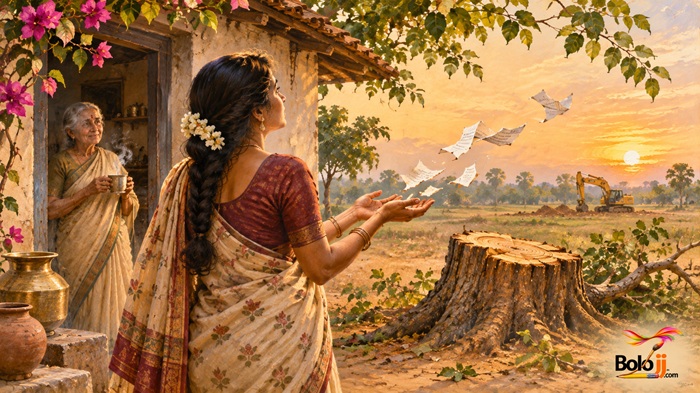
Srinija pressed her thumbnail into the brass rail of her mother’s kitchen window and watched the bulldozer chew through the neem tree her father had planted the week she was born.
The machine groaned. Roots thick as a man’s forearm tore free from the red Telangana soil, trailing clumps of earth that broke apart and scattered like offerings no one had asked for. Vamsi stood at the edge of the plot in a white cotton shirt gone translucent with sweat, directing the operator with crisp hand signals. He did not look toward the house. He did not need to. Everyone inside already knew.
Behind her, the kitchen smelled of yesterday’s tamarind rice crusted in a steel vessel and fresh jasmine that her mother had threaded into a garland for the puja niche. Jayamma was somewhere deeper in the house, her bare feet whispering over the mosaic floor in a rhythm Srinija had memorised as a child—three steps to the almirah, pause, six steps to the bed, pause, the faint click of a bangle against wood. Her mother moved through domestic space with the precision of a woman who had measured her life in rooms she did not own.
Srinija’s handbag sat on the kitchen counter behind her. Inside it, folded into thirds and tucked beneath her wallet, was the legal notice Venkatasai’s lawyer had drafted eleven days ago. She had not yet told anyone it existed.
The neem tree was forty-two years old. Suryanarayana had carried the sapling home from the Thursday market in Ramarru, wrapped in damp newspaper that bled ink onto his fingers. He planted it at the northeast corner of the ancestral plot—nine acres and thirty guntas of red-soil farmland that his own father had worked with bullocks and a wooden plough. Srinija knew the story because her father had told it to her every birthday until she turned twelve, crouching beside her at the tree’s base, pressing her small palm against the bark.
“Feel that? It’s growing with you, Srini,” he would say. “Idi nee chettu.” This is your tree.
She stopped hearing the story after twelve because that was the year Jayamma decided birthday visits to the plot were unnecessary for a girl who would, in any reasonable estimation, marry out of the family. What Jayamma actually said, standing at the threshold of this same kitchen with turmeric paste drying on her knuckles, was something more careful. “She has school. Why drag her to the field in this heat?”
Suryanarayana had not argued. He rarely did. He was a man made of silences—not the brooding, cinematic sort, but the exhausted quiet of someone who had learnt decades ago that his wife’s convictions operated with the grinding inevitability of a stone mill. He sat on the verandah that evening, smoking a beedi, and did not mention the tree again until Srinija’s wedding in 1998.
The wedding was a three-day affair held in the function hall behind the Hanuman temple, the one with the cracked pink facade and the speaker system that turned every song into a distortion. Venkatasai’s family had come from Warangal—his father a retired tahsildar, his mother a woman of terrifying politeness who inspected the lunch thali with the focus of a jeweller examining a stone. The dowry negotiation had lasted three months. What Jayamma offered, and what Venkatasai’s family accepted, was a two-bedroom flat in Hanamkonda, registered in Srinija’s name, and twelve tolas of gold.
Jayamma had been specific during the discussion, seated cross-legged on the floor of the front room with her reading glasses pushed high on her nose, almost touching her eyebrows. “We’re giving her property itself. Not just gold. Not just cash. Property.” She said it to Venkatasai’s mother but meant it for the room. For the record. For whatever cosmic accountant she believed was tallying the family’s debts and credits.
The flat cost fourteen lakhs. Suryanarayana sold a portion of the eastern boundary of the ancestral plot to fund it—three acres and ten guntas to a grain merchant named Sattaiah Seth who paid in two instalments and built a godown on the land before the second cheque had cleared.
No one asked Srinija whether she wanted a flat in Hanamkonda or three acres and ten guntas of her father’s land.
The partition deed came five years later, in 2003, executed on an auspicious day at the Sub-Registrar’s office in Jangaon. Srinija was not present. She was not informed. She learnt about it seven years after the fact, in 2010, during a phone call with Sridhar—the younger brother, the one who occasionally slipped and told the truth.
“Akka, you know Vamsi anna’s building on the northeast plot, right? His share from the partition.”
Srinija remembered pressing the phone harder against her ear, as if proximity to the device might change what she had heard. “What partition?”
The silence on Sridhar’s end was long enough for her to hear his wife calling him to dinner in the background.
“Sridhar. What partition?”
“The... Amma and Nanna divided the land. Between me and Vamsi anna. Registered and everything. In 2003.”
He said “2003” as though the date itself were an apology.
Venkatasai had found her that evening sitting on the balcony of their Hanamkonda flat, legs drawn up, heels resting on the railing’s bottom rung. The air smelled of diesel from the new bus-stand two streets over, and somewhere below, a pressure cooker was screaming through its third whistle. He sat beside her without speaking. He had the patience of a man who taught children at a secondary school and edited technical manuals on the side, accustomed to waiting for sentences to complete themselves.
“They divided it,” Srinija said, finally. “Amma and Nanna divided the land between the boys. Five years after our wedding. They didn’t even tell me.”
“What land?”
“The ancestral plot. All of it. Nanna’s plot.” She paused. “My neem tree is on Vamsi’s share.”
Venkatasai placed his hand on her knee. His palm was dry and warm and smelled faintly of the sandalwood soap he had used since college. He did not say what most husbands might have said—that she had received a flat, that it was done, that family bonds were better left undisturbed. What he said instead was nothing at all, which was better, because nothing left room for the thing neither of them yet had words for.
It was Venkatasai who, six weeks later, carried a brown paper file into the office of a property lawyer named Advocate Asheervadam in Hanamkonda and asked a single question.
“My wife’s father executed a registered partition of ancestral property in 2003. My wife was excluded. She is a daughter. What are her rights?”
Advocate Asheervadam was a heavy man with thick glasses and a habit of clicking his pen against his teeth while thinking. His office was unimpressive but clean, and the ceiling fan moved with the commitment of someone pretending to work. He listened to Venkatasai without interruption. Then he opened a hardbound copy of the Hindu Succession Act that had been annotated in three colours of ink and turned to a page marked with a torn railway ticket.
“Your wife was born in—what year?”
“1973.”
“And the property is ancestral. Self-acquired by the father or inherited?”
“Inherited. From his father.”
Asheervadam clicked his pen twice.
“The Andhra Pradesh legislature amended the Hindu Succession Act in 1986. Section 29-A. That amendment gave daughters of coparceners the same rights as sons in Hindu Mitakshara coparcenary property. Your wife was thirteen when that amendment took effect. From that date, she became a coparcener by birth.” He looked up. “The partition deed of 2003 excluded a coparcener. That deed is not valid to the extent of her share.”
Venkatasai sat very still.
“And the flat? The dowry?”
“Dowry is dowry. A coparcenary share is a coparcenary share. The two are not interchangeable. You cannot extinguish a statutory right through a marriage gift.” Asheervadam set down his pen. “But I must tell you something about time. Article 110 of the Limitation Act, 1963. For a suit to recover possession of immovable property, the limitation period is twelve years. The partition was registered in 2003. If she intends to challenge, she must act before 2015.”
“That’s five years from now,” Venkatasai said.
“Four years and eleven months, to be precise. Time is generous until it is not.”
Venkatasai thanked him, paid the consultation fee of five hundred rupees, and took an auto-rickshaw home through streets still wet from an afternoon rain that had turned the dust into a paste the colour of burnt sienna.
He did not tell Srinija about the visit for three years.
What Venkatasai did, in those three years, was quiet and methodical. He obtained a certified copy of the 2003 partition deed from the Sub-Registrar’s office. He sourced the original sale deed through which Suryanarayana’s father had acquired the land in 1961. He gathered encumbrance certificates, certified copies of pattadar passbooks, and other revenue records. He filed RTI applications when the tahsildar’s office was slow. He stored everything in a steel almirah in his home office, in a brown expanding file with “S. Family—Property” written on the cover in his careful, square handwriting.
Srinija found the file in 2013, while looking for their daughter’s birth certificate. She opened it on the dining table, read every document, and did not speak for the rest of the evening.
When Venkatasai came home from school, she was standing at the kitchen counter, the file open before her, the certified copy of the partition deed weighted flat with a coffee mug.
“You’ve been to a lawyer,” she said. It was not a question.
“Yes.”
“When?”
“2010. After Sridhar told you.”
Srinija looked at the partition deed. Her father’s signature was at the bottom, small and slanting to the right, the same hand that had signed her school progress reports, her hospital admission when she fell ill, her college papers, and her bus pass application. Her mother’s signature was beside it—larger, upright, deliberate.
“Why didn’t you tell me?”
Venkatasai pulled out a chair and sat. He folded his hands on the table. “Because you needed to be angry first. And then you needed to stop being angry. And then you needed to decide for yourself.”
She did not decide. Not in 2013. Not in 2014. The limitation clock bled through month after month, and Srinija let it bleed because the alternative was to telephone her father and say, in whatever language she could manage, that she intended to claim what was legally hers. And she could not separate “legally hers” from the image of Suryanarayana crouching beside her at the base of a neem tree, pressing her palm to its bark, saying “Idi nee chettu.”
Jayamma telephoned every Sunday without fail. She asked about Srinija’s daughter—how her marks were, whether she was eating enough curd, had they enrolled her in Kuchipudi classes. She sent pickles by bus parcel in the summer and woollen shawls in December. She did these things because she loved her daughter in the only grammar she knew, a grammar in which love and property occupied separate sentences that must never be parsed together.
Jayamma was not a villain. She was a woman who had entered her husband’s household at nineteen with nothing but a steel trunk and a conviction that daughters were guests in their birth families—loved, fed, celebrated, and ultimately sent elsewhere with whatever the family could afford. Her own mother had received nothing from her grandfather’s estate. Her grandmother before that, nothing. The pattern was so old it had fossilised into principle. When Jayamma excluded Srinija from the partition, she did not believe she was wrong. She believed she was following the natural order, and that the Hanamkonda flat—fourteen lakhs, east-facing, two bedrooms—was proof of her generosity.
In January 2015, with eleven months remaining before limitation would expire, Venkatasai made an appointment with Advocate Asheervadam for a second time. He went alone. This time Asheervadam had a newer, fatter edition of the Hindu Succession Act, and he referenced the 1986 AP amendment along with the 2005 Central Amendment.
“The Andhra Pradesh amendment already protects her. The 2005 Central Amendment only reinforces what your wife already has under state law.”
Asheervadam drafted a legal notice that afternoon. Three pages. Addressed to Suryanarayana, Jayamma, Vamsi, and Sridhar. Asserting Srinija’s coparcenary interest in the ancestral property, requesting re-partition to include her lawful share, and referencing Section 29-A of the AP-amended Hindu Succession Act.
Venkatasai carried it home, placed it on the dining table beside a plate of idli Srinija had kept warm under a steel cover, and said, “This is yours. Send it or don’t. But the last date is 15th December.”
Srinija unfolded the notice. Read it twice. Folded it back into thirds and slid it into her handbag. It remained there, beneath her wallet, for eleven days. Sometimes, during the nights when the ceiling fan chopped the air into warm quarters and sleep would not come, she would list, without meaning to, all the unrecorded transfers in the family ledger—her father’s hand on her fevered forehead at two in the morning, Sridhar’s half of a mango surrendered without complaint, Vamsi once carrying her home a whole kilometre because she had twisted her ankle. None of those things could be registered in Jangaon, or stamped, or entered in the pattadar passbooks. They were, inconveniently for argument, intangible.
And alongside those memories, another column had been building—Vamsi taking Nanna to the government hospital when his knees began to swell, Sridhar running to the pharmacist for blood-pressure tablets, the two of them rotating night duty whenever Amma’s sugar went out of control. She visited as a guest now, turning up with a box of Heeralal sweets from Hanamkonda and leaving with jars of mango pickle, new saris on Dussehra, bangles pressed into her daughter’s palms and bags of rice, dal and tamarind sent ahead of her, as if every visit required a return gift. If the flat and the gold had helped her step away into that other life, hadn’t they, in some lopsided way, already been paid for by the years her brothers stayed back and became, slowly and without fanfare, the people who would see their parents through to the end? On what moral ground, exactly, did a daughter who dropped in for long weekends and festivals stand when she thought of walking into their lives now with a lawyer at her shoulder and asking for a measured-out third of what remained?
~*~
Now she stood in her mother’s kitchen, watching the bulldozer finish its work.
The neem tree was down. It lay on its side in the red dirt, branches fanning out like the fingers of a hand reaching for something it would not find. Vamsi was pointing at the cleared ground, speaking to a man in a hard hat who held a rolled sheaf of construction drawings. They were laughing about something—the man in the hard hat gestured broadly, and Vamsi clapped him on the shoulder.
Behind Srinija, the kitchen tap dripped. The jasmine garland on the puja shelf had begun to brown at the edges, and the smell of it mixed with the sharper scent of raw tamarind and the ghost of yesterday’s mustard oil tempering. A housefly traced slow circles above the steel vessel of leftover rice.
“Srini?”
She turned. Jayamma stood in the kitchen doorway, a cup of coffee in her hand, her reading glasses perched on the bridge of her nose. She was sixty-four. Her hair had gone the grey of wood ash, pulled into a braid that reached the middle of her back. Her cotton sari—a pale green with a brown border—hung on a frame that had grown thinner each year, as though the woman inside were slowly withdrawing from her own body.
“I brought you coffee,” Jayamma said.
She looks tired. She hasn’t been sleeping enough. The girl works too much in Hanamkonda, and that husband of hers could do more around the house, but what can I say, it’s not my place.
Srinija took the cup. The coffee was sweet. Jayamma always added a little extra sugar, the same amount she had added when Srinija was a girl, as though her daughter’s palate had never matured.
“Amma.”
“Hmm?”
“Did you know they were cutting the neem tree today?”
Jayamma glanced past Srinija, through the window, and something moved across her face—not guilt, exactly, but recognition of a border she had helped draw.
“Vamsi needs to clear the ground for the foundation. He’s building two floors. Rental income.”
Srinija took a deep breath and said nothing.
She stepped out through the back door and into the yard where the stump of the neem tree sat raw and pale against the red earth. The smell of torn wood hung sharp and medicinal in the November air. She pressed her chappal into the loose soil near the roots and felt it give beneath her weight, soft as something recently grieved. From inside the house her mother's voice called out something about dinner, about rice, about whether Venkatasai would eat curd or not, and the ordinariness of it sat in her chest like a stone swallowed whole. She did not answer. She walked to the edge of the compound wall where the jasmine had once climbed in thick ropes during her childhood and opened her bag. The notice Advocate Asheervadam had drafted was still there, folded between a GWMC property tax receipt and a grocery list. For a moment she imagined another version of the day, with the postman at this same gate holding a registered envelope, her father’s hands shaking as he slit it open, her mother pushing her glasses up straining to read the English, and Vamsi’s jaw hardening as he understood that the sister whose tree he had just cut down now claimed, in writing, a third of the land. The picture rose in her mind with the clarity of a stamp-paper impression—names, dates, reliefs sought—and then, uninvited, another picture overlapped it, her father sitting on the verandah step shelling groundnuts into her cupped palms, Vamsi jogging beside her, one hand steadying the back of the cycle as she learnt to ride, Sridhar discreetly ladling extra payasam into her bowl when Jayamma wasn’t looking.
Idi nee chettu, her father had said, as if a tree could be notarised into belonging. Now the tree lay horizontal, and the plot lines on the deed ran straight across where its roots had been, but the sentence refused to die. If anything in these acres had truly been hers, it was her mother’s voice softening on the telephone every Sunday, her father saving for years—for the gold, the flat, the rich gifts—and her brothers’ instinctive habit of folding her into every festival photograph as if she had never left. That was the inheritance already sitting, untidily, inside her life—not cleanly divisible, notionally indivisible, immune to mutation by Section 29-A. She read the first line of the notice once more and heard, under the legal phrases, the sound of those other things being weighed and itemised.
There was a kind of betrayal, she realised, in trying to turn all that into acreage. To insist that the neem tree’s promise be redeemed only in square yards was to agree, finally, that daughters were guests whose only proof of belonging lay in what they could take away. The thought startled her with its neatness and, worse, with its accuracy.
She held the legal notice in both her hands, tore it once, then again, then again, until the pieces sat in her palms like scraps of a thought that no longer troubled her. A gust of wind came from the east, warm and gritty with red dust, and she opened her hands. The fragments lifted, scattered, sailed past the compound wall and over the cleared ground where the neem tree had stood, and kept going—white scraps tumbling through the November air far beyond the boundary of anything she could claim or name or keep.
14-Nov-2026
More by : Prof. Rajeshwar Mittapalli

|
Great story |
|
|
An exquisitely crafted story—its strength lies in its precision. The opening image of the neem tree being torn from the “red Telangana soil” instantly fuses place, memory and conflict into a single, unforgettable symbol. The prose is sensuous yet economical—scents of tamarind rice, jasmine, mustard oil and wet earth build a dense atmosphere without any decorative excess. Structurally, the narrative moves with almost musical control between present action and retrospective exposition. Legal detail, family history and interior monologue are braided so seamlessly that the story never loses its emotional pulse. The shifts in time feel organic, guided less by plot mechanics than by the ebb and flow of Srinija’s consciousness. Characterisation relies on delicately chosen gestures—Jayamma’s “bare feet whispering over the mosaic floor,” Venkatasai’s silence, the brothers’ untheatrical care—so that no one becomes a type. The closing act, with the legal notice torn and scattered like “scraps of a thought,” achieves a rare lyrical clarity. The final image of those white fragments drifting beyond “anything she could claim or name or keep” gives the story a resonant, open ending that lingers like a poem |
|
|
Inheritance captures so well the strange, tender maths many daughters live with after marriage. On paper, Srinija has been more than 'settled' by her natal family. The Hanamkonda flat in her own name, the gold, the constant pickles and saris and grain bags, the silent financial and emotional back-up from her parents and brothers. All of this is real, and she knows it. The story never lets us forget that she has already been given a great deal, without having to ask, long before the partition deed. What makes the story so compelling is how it shows daughters walking a tightrope between rights and relationships. Srinija has a clear legal claim, but she is also honest enough to see that her brothers stayed back, shouldered the daily grind of ageing parents, and never stopped treating her as part of the family. Her hesitation is not weakness. It comes from a very grounded sense that pressing for her share now would tear something fragile and irreplaceable. When she finally lets the legal notice go, the moment feels less like surrender and more like an ethical decision that fits her own sense of fairness. She chooses not to turn every act of love and long-term support into a transaction to be balanced against acreage. The story does not say daughters should keep quiet. Instead, it shows how a woman who has been generously provided for, in cash, property and affection, might still ache at exclusion yet decide that a lawsuit is too blunt a tool for such a complicated inheritance. |
|
|
Inheritance invites us to reflect on what we truly pass from one generation to another. Beyond property and possessions, our inheritance includes memories, relationships, values, and our responsibility toward the world we leave behind. The neem tree becomes a moving symbol of belonging, while Srinija’s decision exposes the delicate tension between legal entitlement and emotional inheritance. Particularly compelling is the portrayal of a mother whose affection is genuine, even as her inherited beliefs perpetuate inequality. The ending is poignant, though it leaves us with an unsettling question: Must one surrender a rightful claim to preserve the bonds of love? A sensitive, thought-provoking story whose silences speak as eloquently as its words. |
