Nov 17, 2026
Nov 17, 2026
Collaborating for Aviation Safety
One of the most important creation of modern civilization is aviation. It has revolutionised modes of transportation, business, information sharing and communications between people and across borders. Tasks that used to take weeks – even months – can now be done in a matter of hours. Airports are now serving as 'gates of opportunities', international cooperation, tourism and cultural exchange. Yet, there is another equally important responsibility that lies behind this amazing advancement – that is, securing the safety, security and reliability of every flight.
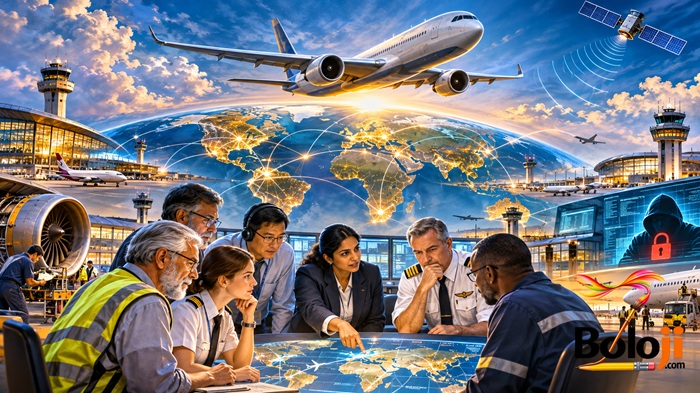
The sky may have no borders, but our responsibilities must have no blind spots.
In recent years, the safety of the airspace has been in danger due to aviation-related crises and the vulnerability of technologies.The safety of the airspace cannot be taken for granted with the recent aviation crisis and the concern of technological vulnerabilities.
The development of aviation has brought about opportunities and opportunities which were never seen before, but have made it more and more complicated to manage the air transportation systems. Modern aviation relies on a complex system of planes, airports, air traffic control systems, communication, navigation and other technologies, maintenance facilities and regulatory bodies. If any one of these components fails then the entire system may be compromised. Aviation safety is thus more than just a domestic issue, it's also an international responsibility.
The lack of preparedness and readiness of institutions is one of the major challenges faced by the aviation industry. The aircraft is getting more and more sophisticated, navigation systems more precise and digital technologies changing the face of airport operations. New opportunities for efficiency and convenience thanks to AI, automation, satellite navigation and the latest in communication. However, technology alone isn't enough for safety. For it to work, it requires good implementation, well-maintained systems, trained staff and effective regulatory controls. Even if the most sophisticated systems are in place, they may be at risk if institutions and accountability are overlooked and operational discipline not maintained.
Countries need to therefore modernise the aviation infrastructure in a comprehensive manner. Modernization doesn't have to be limited to buying new planes, or building new airports. It must involve the upgrade of air traffic management systems, upgrading of the runways, enhancement of aircraft maintenance and regular risk assessment of operations. The education and career development of pilots, engineers, air traffic controllers and ground crew as well as aviation security personnel are also vital. In the future, where automation is becoming more common, human competence will never be replaced.
A new challenge is the increasing reliance on digital facilities by aviation. The information and management software systems that airports and airlines are increasingly using are interconnected and serve passenger information, flight scheduling and planning, baggage handling, communication, navigation and operational coordination.
Digitalization enhances the efficiency but also increases vulnerabilities. The airport may be vulnerable to cyber attacks on its systems, its systems may fail, or technology may become disrupted, which can impact operations and services offered to passengers. To protect the air navigation services, aviation authorities need to be able to put in place a cyber security framework for the system, carry out periodic audits of the system, create emergency response procedures and ensure that system operations will not be interrupted even in the event of a technological failure.
Cooperation on an international level is also crucial. In contrast to national transportation policies, the world of aviation does not take political borders into account. An aircraft can fly over multiple countries and flights and passengers rely on uniform international safety regulations. One disruption in one region can impact other parts of the region along with flights, connecting service, passenger confidence, and other aspects of airline operations. The interdependency means that co-operation between governments, aviation regulators, airport authorities and international organisations is essential. Transferring technical information, conducting collaborative risk assessments, and exchanging information on new risks and threats can aid countries in providing early warning of vulnerabilities that might escalate into major crises.
These developments need to be given special attention in India. The nation has experienced significant development in air connectivity and journey, airport constructions and aviation related economic activities. India is on a trajectory to further expand its footprint in the global aviation market with the construction of new airports, development of regional connectivity projects, and rising airline operations. But growth needs to go along with commensurate safety and reliability and institutional readiness. The construction of new airports and expansion of air service is vital and significant steps, but the ability to safely and efficiently operate this growing network is what counts.
Policy measures will be required to enhance aviation safety in India by maintaining continuous oversight on the aviation sector, conducting transparent inspections, conducting timely aircraft maintenance, ensuring effective emergency preparedness and investing in advanced air traffic management. The infrastructure at airports needs to be future-proofed in terms of its operation and regional airports have to be provided with technical and institutional support. Special consideration, for example, should be paid to weather related issues, runway safety, bird and technical incidents and to ensure the cooperation between various aviation agencies. It's not something that can be separated from the everyday norms and procedures of flying, it has to be part of the culture.
Another crucial lesson to be learned is that accountability should continue to be at the heart of aviation governance. If an incident relating to aviation has happened, investigations should be independent and transparent, and the intention is to identify the root cause of the incident. Doing so without studying the weaknesses that lie deeper in the system can't be considered responsibility. The goal is to prevent the recurrence by taking corrective actions, training, equipment and institutional measures. A system that is for safety failure learns from its failures so that they are not repeated at that time or in the future as a weakness.
Human aspects of aviation safety should be given due consideration. Every trip is a gamble by the passengers on a complex system over which they have no direct influence. They feel that commercial considerations should not matter to the airline, airports or the regulators, as their lives come first. After all, while it's important to have on-time flights, so are comfortable terminals and affordable tickets, passenger confidence is built by the fact that someone is making sure that safety standards are upheld. It is important that airlines and aviation authorities communicate responsibly, address passenger concerns and ensure that emergency procedure is effective and accessible.
Aviation crisis in other parts of the world should not be a "foreign news" to countries like India. These developments hold important lessons on the preparedness of technology and regulatory efficiency, as well as institutional responsibility. Even a lagging country's aviation system can have repercussions in a global transportation network. Safety and security of international travel, commercial operations, tourism and economic cooperation all rely on reliable aviation infrastructure. Hence, safe skies can only be achieved by sharing responsibility and not by national boundaries.
Read Also: When the Skies Stood Still
17-Nov-2026
More by : Dr. Satyavan Saurabh
