Nov 21, 2026
Nov 21, 2026
The Three Threads That Weave a Writer's Journey
"A room without books is like a body without a soul." — Marcus Tullius Cicero
Every writer begins with life before beginning with literature. A child listens to stories from grandparents, reads a favourite book in school, observes people around them, and stores these experiences quietly in the heart. Years later, these memories bloom into words. Literature gives those words shape, and over time, those words become a legacy.
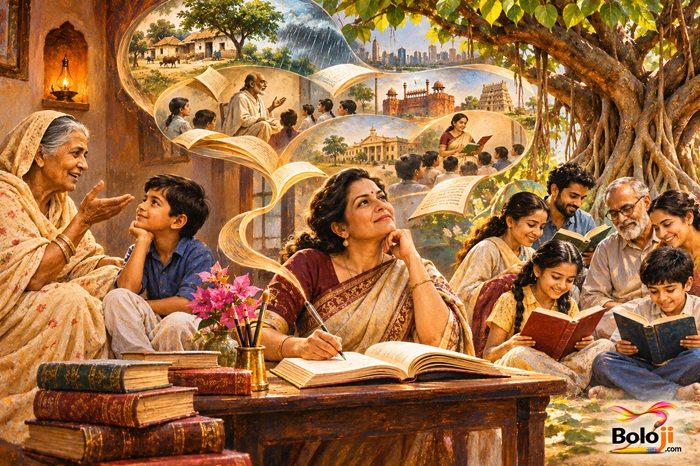
The theme "Life, Literature, and Legacy" is not merely a collection of three beautiful words. They are inseparable strands that define the journey of every writer. Life provides experiences, literature transforms them into meaningful expression, and legacy ensures those expressions continue to inspire generations.
For Indian writers, this relationship is especially profound. India itself is a living library of languages, traditions, folklore, philosophies, and family values. A writer growing up in such an environment does not simply inherit a language but also a cultural memory that finds its way into every page they write.
Life: The First Teacher
Before any writer reads a classic, life becomes the first textbook.
The struggles of ordinary people, festivals, family traditions, village life, bustling cities, classrooms, kitchens, railway journeys, monsoon rains, and moments of joy or grief become the raw material for literature.
Rabindranath Tagore drew deeply from Bengal's culture, music, and spirituality. R. K. Narayan transformed the ordinary streets of Malgudi into a timeless literary landscape. Ruskin Bond found extraordinary beauty in the simple rhythms of life in the Himalayan hills.
As Leo Tolstoy wisely observed,
"Describe your village, and you describe the world."
The writer's world begins locally but often reaches universally because human emotions remain the same across cultures.
Literature: Life Refined into Art
If life provides experiences, literature gives them permanence.
Books preserve emotions long after moments have passed. Literature converts individual experiences into collective wisdom. Through stories, essays, poems, and memoirs, readers discover pieces of themselves.
Virginia Woolf wrote,
"Books are the mirrors of the soul."
Literature reflects society while simultaneously shaping it. It comforts during loneliness, questions injustice, preserves history, celebrates culture, and imagines better futures.
Indian literature has performed this role for centuries—from the philosophical conversations of the Upanishads to the moral lessons of the Panchatantra, from the epics Ramayana and Mahabharata to the modern novels of contemporary authors.
A writer does not merely produce literature; literature, in return, shapes the writer's own thinking, discipline, empathy, and worldview.
Legacy: What Remains After the Last Page
Success may bring recognition, but legacy is measured differently.
A legacy is created when a writer's words continue to influence readers after decades—or even centuries.
William Faulkner wrote,
"The past is never dead. It's not even past."
Literature ensures that voices survive beyond lifetimes.
Today we continue reading Shakespeare, Jane Austen, Premchand, Mahasweta Devi, and Subramania Bharati not because they are historical figures, but because their words still speak to contemporary readers.
A writer's legacy lies not only in awards or sales but in the lives changed through reading.
The Family Legacy
Many writers inherit more than genes—they inherit stories.
Parents who encourage reading, grandparents who narrate folk tales, teachers who introduce poetry, and family traditions that preserve language all contribute to a writer's growth.
Rabindranath Tagore belonged to a family deeply involved in literature, music, and art. His creative environment nurtured one of the world's greatest literary minds.
Even when there is no literary background, families often provide emotional strength. A parent's encouragement, access to books, or belief in a child's imagination can become the foundation of an entire writing career.
Family legacy therefore is not always literary achievement. Sometimes it is simply the gift of curiosity.
The Mentor's Invisible Hand
Behind many successful writers stands a mentor whose name may not appear on the book cover.
Teachers, editors, senior authors, librarians, publishers, and even dedicated readers help writers refine their voice.
Toni Morrison advised,
"If there's a book that you want to read, but it hasn't been written yet, then you must write it."
Such encouragement often becomes the turning point in a writer's life.
Mentors teach far more than grammar. They teach patience, resilience, ethical writing, revision, humility, and the courage to face rejection.
Many Indian writers acknowledge school teachers who introduced them to regional literature, English classics, or creative writing competitions that transformed hobbies into lifelong vocations.
Can Writers Create Their Own Legacy?
Certainly.
Not every writer is born into a literary family or guided by celebrated mentors. Many create their own path through perseverance.
Dr. A. P. J. Abdul Kalam, though primarily known as a scientist and statesman, became one of India's most beloved authors. His books continue inspiring young readers because they emerged from lived experience, humility, and service.
These qualities influence not only literary work but the writer's personal life.
As Maya Angelou beautifully said,
"There is no greater agony than bearing an untold story inside you."
Writing becomes an act of emotional honesty. It helps writers understand themselves while helping readers understand humanity.
The Indian Literary Landscape
India offers an extraordinary literary ecosystem.
Its multilingual traditions allow stories to travel across cultures. Regional literature preserves local identities while translations connect them to national and global audiences.
From Tamil to Bengali, Malayalam to Marathi, Kannada to Assamese, Punjabi to Hindi, every language contributes unique voices to Indian literature.
This diversity enables writers to carry forward cultural heritage while addressing contemporary realities.
In doing so, they become custodians of memory.
Are Life, Literature, and Legacy Interconnected?
The answer is an unequivocal yes.
These three elements exist in a continuous cycle.
Thus, literature becomes an inheritance passed from one heart to another.
The Writer's Greatest Achievement
Many believe a writer's greatest success is bestseller status.
In reality, the greatest achievement is becoming unforgettable.
Legacy has already begun.
As Jorge Luis Borges famously remarked,
"I have always imagined that Paradise will be a kind of library."
Perhaps every writer hopes to leave behind one small shelf in that eternal library.
Conclusion
Life, literature, and legacy are not separate destinations but one continuous journey. Life provides experiences that awaken imagination. Literature transforms those experiences into enduring expression. Legacy carries those expressions beyond the writer's lifetime.
Every writer walks this path differently—some guided by family traditions, others by mentors, and many by determination alone. Yet all share a common purpose: to preserve the human experience through words.
In the end, a writer's true inheritance is not wealth or fame but the ability to leave behind ideas that continue to educate, comfort, question, and inspire.
Books may close, authors may depart, but literature keeps conversations alive across generations. That is the enduring power of legacy—and perhaps the greatest gift a writer can offer the world.
"Words are, in my not-so-humble opinion, our most inexhaustible source of magic." — J. K. Rowling
For as long as stories are told and books are read, life will continue to create literature, and literature will continue to create legacy.
21-Nov-2026
More by : Anuradha Sowmyanarayanan
Top | Literary Shelf | Home
