Nov 20, 2026
Nov 20, 2026
by B.S. Ramulu
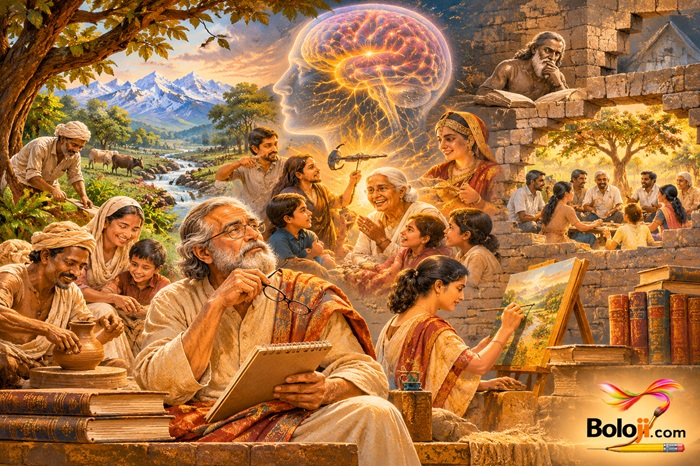
To comprehend the genesis of human consciousness, awareness, and knowledge, ancient metaphysical concepts or conventional philosophical frameworks are entirely insufficient. The construction of knowledge requires a comprehensive, materialist Bio-Materialist Foundation. Understanding this foundation constitutes true Advanced Thinking.
1. Life Force and Health – The Primary Basis of Knowledge
Knowledge is not a transcendental force born out of thin air; rather, it is a bio-chemical and neurological process occurring within the physical body. Sensory functionality and the construction of knowledge are possible only when the human body possesses Life Force (Prana) and maintains proper Physical Health. A lifeless body holds no awareness; in a body afflicted by severe illness or metabolic dysfunction, the cognitive process is stunted. Therefore, life force and health are the foremost foundational prerequisites for the birth of knowledge.
2. From Five Senses to Eight Senses – And onto the Comprehensive System of 11 Sense Organs
For centuries, ancient and modern philosophies, as well as aesthetics, revolved strictly around the Five Senses (eyes, ears, nose, tongue, and skin). Later, by incorporating the legs, hands, and genitals—which are fundamental to human activity, production, and interaction with nature, they were recognized as the Eight Senses (Ashtendriyas). These serve as the external gateways (Peripheral Receptors & Effectors) that gather information from the external world through sound, touch, form, taste, smell, movement, action, and physical sensations.
However, a fundamental question arises right here: Who is the true center that receives the sensations gathered by these eight senses, stores them like a ‘Global Knowledge Bank’, analyzes them, transforms them into memory, and generates awareness? It is the Cerebrum (Big Brain) and Cerebellum (Small Brain)inside the skull, along with the Spinal Cord / Central Nervous System (the Third Brain).
Without these three brains and their active involvement, no cognitive process can occur. These internal centers—which perceive the internal states of the body (such as hunger, fear, pain, respiration, memories, and the movement of thoughts)—are also master sense organs! Therefore, when we combine the 8 external senses that interact with nature and the 3 internal brains, they form a total of 11 Sense Organs (11 Jnanendriyas). Together with life force and health, these eleven sense organs operate as a holistic, inclusive ‘Global Knowledge Bank’.
3. A Critique of ‘Sectional Thinking’ in Ancient and Modern Sciences
When we examine the extent to which our ancestors, philosophers, and aesthetic theoreticians recognized this collective knowledge repository of the three brains within the body, a massive historical failure comes to light:
II The First Stage (Bottom-Up Process) – From Natural Activities to the Birth of Aesthetics
In the evolutionary cycle of human consciousness and knowledge, the First Stage is an organic, bottom-up physical developmental process. This stage emerged from the continuous coexistence and reciprocal activities performed by humans in tandem with nature.
1. From Imitation of Nature to Acoustic Mimicry and the Birth of Language
Human activities originally commenced in direct relation to nature. Through their interactions with nature, humans perceived the sounds of nature, the movement of winds, the cries of animals, and physical motions via their 11 sense organs, and began to imitate them. This imitation of nature gradually evolves into acoustic mimicry. From this acoustic mimicry emerged primeval melodies (ragas), rhythms, words, folk songs, and living languages. The root of all folk and indigenous creation lies strictly in these physical activities performed by humans with nature, and not in any transcendental power.
2. The Cognition Process, and the Conflict Between Imagination and Illusion
When the sensory experiences of the 8 external senses—generated through physical activities with nature—are deposited into the ‘Global Knowledge Bank’ of the three brains, the Cognition Process begins. While sensory response represents the present, thought driven by stored memories in the brain represents the past. From the synthesis of these two emerges a distinct Perception or Awareness (Erusa).
During this process of knowledge construction, alongside direct realistic awareness, humans also experience Imagination and Illusion:
3. ‘Alankara Shastra’ (Aesthetics) is Merely a Name Coined for Convenience
Here, we must recognize a vital historical-materialist truth. In the primary stages of human development, ‘Poetics’ (Alankara Shastra) or ‘Aesthetics’ (Soundarya Shastra) did not exist as pre-formulated, structured sciences created in a laboratory or purely in abstract thought. Rather, ‘Aesthetics’ and ‘Poetics’ are collective names codified in later periods for our analytical convenience, intended to comprehend the overarching goals and characteristics of songs, dances, literature, and arts that manifested naturally through human activity.
4. From Experiences to the Birth of Aesthetics – And Subsequently Philosophy
Thus, wisdom, discernment, and knowledge arose from the primeval human experiences of Rasa Nishpatti (aesthetic relish), Vakrokti (oblique expression), and emotional manifestations. The cumulative form of these artistic and sensory experiences ultimately crystallized into Aesthetics (Alankara Shastra). Later, built upon the foundation of this aesthetics and epistemology, the condensed essence of this accumulated knowledge finally gave birth to Philosophy. In other words, if Aesthetics is the mother, Philosophy is its youngest offspring.
III. The Second Stage (Top-Down Process) – Cognitive Conditioning by Perspective, Second-Order Literature, and the Invasion of Dhvani Theory
Once a philosophy or a specific perspective is codified from physical experiences, aesthetics, and epistemology, the Second Stage commences. In this phase, the established philosophy transforms into a guiding force within society, dictating literature, arts, and human thought from the top down.
1. Conditioning by Perspective (“This is Mine – This is Not Mine – I Do Not Need This”)
Once a specific religion, caste, political ideology, or philosophical perspective becomes entrenched in the human brain, it imposes a Cognitive Filtering or Conditioning upon the natural cognitive process of the 11 sense organs. Due to this conditioning, the brain ceases to freely receive new realities and living experiences. It accepts only that which aligns with its pre-existing perspective, declaring “This is mine.” Conversely, it rejects even profound realities and new truths that contradict its worldview, dismissing them with “This is not mine; I do not need this.” Because of this ideological conditioning imposed on the brain, the birth of new knowledge in society halts, and old dogmas are endlessly reproduced.
2. Second-Order Writings (Derivative and Activist Literature)
In this second stage, those who write according to pre-determined theories or someone else’s mandated perspective are Second-Order Writers. They are not self-luminous (Swayam Prakashulu). They lack the primal creative power of genuine poets who “discern what even the sun cannot behold.” They are merely followers of doctrines—activists of a specific system or political party.
3. The 1992 Guntur VIRASAM Conference Debate & Perspective-Driven Literatures
I extensively analyzed this fundamental philosophical distinction of ‘Philosophy vs. Manifestation’ in my seminal work ‘Pata Puttuka’ (The Origin of Song, 1993). Even earlier, when I brought this exact proposition to the forefront at the 1992 Guntur state conference of VIRASAM (Revolutionary Writers’ Association), it triggered an intense, two-day debate. Back then, I firmly institutionalized this contradiction between the immediate propaganda requirements of political organizations and the creative exploration of life required by authentic literature.
What we define today as a particular ‘School of Thought’ or specific cinematic and literary genres all fall under this category. These creators are writers only in terms of ‘Form’, but not philosophers in terms of ‘Content’ (Saram). The literatures that emerged in this second stage to propagate doctrines—such as Buddhist, Vedic, Hindu, Christian, Muslim, Gandhian, Marxist, and Ambedkarite literatures, upper-caste, BC, SC, ST literatures, as well as Saiva and Vaishnava Bhakti movement literatures—are all tools of ideological propagation rather than independent philosophical creations.
4. The Intrusion of ‘Dhvani Theory’ upon Literary Theories
In Indian literary criticism, the Theory of Suggestion (Dhvani Siddhamtam) did not originate from foundational aesthetics or natural literature. In its primal form during the First Stage, Dhvani (suggestion or implied meaning) manifested naturally and effortlessly in the daily lives, proverbs, and folk songs of ordinary people. However, during the Second Stage, elite scholastic theoreticians like Anandavardhana divorced this natural suggestion from the lives of common people, intertwined it with Vedic/idealistic Sphota theory, and transformed it into an authoritarian canon. This convoluted version of the Dhvani theory was then imposed from the top down upon aesthetics and literature. Hence, it is not an integral part of literature (Part of Literature), but rather a Philosophical Invasion superimposed upon literature (On Literature).
IV . The Relative Autonomy of the Independent Writer, Six Principles of Realism, and Historical Experiences of 1984–85
The answer to how a true litterateur transcends the ideological conditioning of the Second Stage, and how philosophy is born directly out of creative writing, lies in the foundational epistemology of the First Stage.
1. Philosophy Emerging from Writing & Relative Autonomy
A true independent writer is one who observes nature, society, and human relationships firsthand, without succumbing to any pre-formulated political doctrine or party manifesto. When life is depicted in its totality without being enslaved to any pre-existing philosophy, that depiction becomes the author’s original vision, and a new philosophy naturally births itself from that creation. Those whose writings give rise to new theories are the true litterateurs who become philosophers through their art.
However, we must acknowledge a stark historical truth: No writer exists outside of society or lives in a vacuum. Every writer is unconsciously influenced by the contemporary social hierarchies and class-caste perspectives of their era. For instance, even though Valmiki (author of Ramayana) and Vyasa (author of Mahabharata) depicted life with extraordinary depth and brilliance, they still operated within a philosophical worldview that accepted the prevailing Varna system of their time. Giants like Leo Tolstoy and Sarat Chandra Chattopadhyay also worked within the class and gender boundaries of their respective epochs. Therefore, a writer’s independence is a ‘Relative Autonomy’—they are independent of pre-drawn contemporary political frameworks, though not entirely divorced from historical social consciousness. Nevertheless, by depicting life realistically, they lay the foundation for new philosophical visions.
2. The Illusions of Socialist Realism – Six Principles from the 1985 ‘Arunatara’ Essay (The Proof of Sholokhov’s ‘Quiet Flows the Don’)
As early as 1985, I identified the inherent limitations of ‘Socialist Realism’, the doctrine propounded by Russian writer Maxim Gorky and institutionalized by the Soviet state. In practice, instead of uncovering the living contradictions and harsh realities of society, this doctrine degenerated into a tool that concealed and buried the truth.
When reading a short story or a novel, the reader must comprehend the underlying reality behind social evolutions. To achieve this, in my 1985 essay titled “The Philosophical Base of Literary Criticism” published in the renowned revolutionary literary monthly Arunatara, I proposed foundational pillars for a writer to depict life through self-observation. For realism to be fully realized, a writer must portray these six elements:
The Historical Testimony of Sholokhov’s ‘Quiet Flows the Don’: Nobel laureate Mikhail Sholokhov’s monumental 2,000-page novel Quiet Flows the Don (Tikhiy Don) stands as an irrefutable testament to how authentic truths emerge when a writer refuses to bow to political constraints and depicts reality truthfully capturing class, region, language, and culture in accordance with the six principles above. In this epic, Sholokhov brilliantly portrayed how the Russian Revolution led by Lenin and the subsequent civil war shattered the lives, culture, and human relationships of the Cossack people of the Don region, inflicting immense devastation upon his own people. Such fundamental truths come to light only when a writer remains loyal to the realities of life rather than party slogans.
3. Soviet Revisionism & Yuri Borev’s ‘Aesthetics’ (1985)
Concepts sprout directly from human activities, and their very first reflection occurs within living ‘Life’. In Russia, Leo Tolstoy and later Sholokhov observed society independently without yielding to ideological cages. However, subsequent generations of Soviet writers were bound by official state mandates under the banner of ‘Socialist Realism,’ depriving them of the freedom of expression to write the truths they observed. Had they observed and depicted life independently like Tolstoy, the harsh reality that Soviet society was covertly drifting toward Revisionism would have manifested much earlier through the organic essence of their literature. Having to wait until an ideologue post-facto formulated the term ‘Revisionism’ signifies both a failure of writers’ independent consciousness and the stranglehold of a rigid political apparatus.
This foundational philosophical discernment was crystallized in me in 1985 after reading the celebrated book ‘Aesthetics’ by the renowned Soviet philosopher Yuri Borev. Recognizing the profound philosophical worth of that work, I declared during that period that it was “greater than the Bhagavad Gita and greater than the Bible.” While religious scriptures offer static beliefs, Borev’s aesthetics provided the analytical wisdom to decode social movement.
Fiction vs. Non-Fiction: Who is the True Litterateur?
Just as grammar cannot exist without language, analytical non-fiction cannot exist without creative fiction that depicts living reality. Creative genres such as short stories, novels, and poetry constitute the primary ‘Language’ that uncovers social truths. Non-fiction writers who examine these works and formulate theories are merely the grammarians writing ‘Grammar’ for that language.
However, a major conceptual flaw persists in the literary world today: non-fiction writers are routinely labeled as ‘litterateurs’. In reality, they are literary analysts, theoreticians, or literary critics—not original creators. Most deplorably, prestigious institutions like the Sahitya Akademi frequently sideline creative fiction writers and bestow awards upon non-fiction critics under the general litterateur quota. Ignoring the genuine creators who forge the language while crowning the grammarians is a grave injustice to creative literature.
4. The Theoretical Vacuum of Party Leaderships – A Historical Dialogue & My 1984 Novels
My own lived experience proved how the hollowness of political doctrines is exposed through creative experimentation. While serving as the State General Secretary of the Radical Youth League and as an executive committee member of VIRASAM, I wrote novels in 1984. Brief introductions to these works have been documented in my autobiography as well as in several researchers’ PhD theses. However, precisely where my novels came to a halt, the revolutionary movement also stalled.
During the writing process, two major flaws within the leftist and revolutionary movements became glaringly obvious to me, causing my novels to stop:
Through my own writings, I realized that because of these two major deficiencies, the revolutionary and leftist movements abandoned living reality and confined themselves strictly to Sectional Thinking and narrow sectarian practice. Consequently, a sense of theoretical insecurity halted my novel writing.
I confronted the top contemporary revolutionary leaders, Mallojula Koteswara Rao (Prahalad) and Ganapathi, stating: “Tell me clearly what the party program is, and I will complete the novel.” However, they failed to grasp this philosophical secret. They countered: “You are the one writing the novel; how can you ask us for the program?” This occurred because they lacked the philosophical awareness that political programs must be revised by observing the truths born out of real life. Armed with this fundamental secret, I have consistently maintained from 1985 right up to 2025 that because of the absence of an appropriate socio-philosophical program, the revolution has not advanced even a single step forward.
People’s Writers vs. Party Writers (People as the Ultimate Goal)
Writers, artists, intellectuals, philosophers, aesthetic theoreticians, scholars, and the wise must always stand strictly on the side of the people. For us, the people are primary; the people are our destination; and the people are our ultimate goal. Therefore, whenever hostility or conflict arises between a political party or a government and the people, all these thinkers and creators must unequivocally stand with the people and extend their full support to them.
Conversely, those who ignore the interests of the people and side with a political party or a government become mere Party Writers, and their creations are reduced to Party Literature or State Literature. Similarly, theoreticians and philosophers who defend regimes instead of standing with the populace degenerate into mere party or state ideologues—philosophers who exist solely to propagate party doctrines. I explicitly analyzed this fundamental demarcation between a genuine people’s writer and a party writer as early as 1993 in my book ‘Pata Puttuka’ (The Origin of Song), under the dedicated subheading “People’s Writers – Party Writers. By truthfully depicting the devastation inflicted upon the Cossack people by the Leninist revolution in Quiet Flows the Don, Mikhail Sholokhov proved himself to be a true People’s Writer rather than a Party Writer.
V. Social Contradictions – ‘Life is Language, Formulation is Grammar’ (A Philosophical Synthesis)
When we apply our theory of the origin of knowledge to modern social relationships, personal friendships, and everyday rituals, several stark realities are laid bare.
1. The Inclusive–Exclusive Contradiction & The Caste System
Human activities, labor, and mutual necessities naturally possess a broad, ‘Inclusive’ character that brings everyone together. However, in the Indian historical context, the Caste System and Untouchability imposed upon society by upper-caste philosophy drew cruel ‘Exclusive’ boundaries between human beings. Discriminatory practices—such as making some people sit and eat outside on the veranda while welcoming others inside the house with honors and refusing to invite certain others altogether—create an unequal alliance that cannot last forever; it is merely a temporary compromise waiting to shatter.
This exact same contradiction manifests between individuals and among friends. Even when one person maintains an inclusive worldview that embraces everyone, others—driven by their own insecurities and selfishness—draw narrow circles around themselves and operate exclusively. Such individuals are friends only in ‘Form’, not in the true ‘Content’ of intimacy. In such relationships, while recognizing their narrow boundaries as their ‘cognitive limitation’ and maintaining a relative distance, one must draw everyone toward a common platform of shared human activity. Ultimately, these discriminatory lines will be erased only when Axiological Democracy (Value-Based Democracy) and the philosophical consciousness of “One Person, One Value” permeate human society.
2. The Burden of Religious Funerals vs. Body Donation (Living Humanism)
Despite acquiring immense knowledge, humanity still struggles to break free from the shackles of ancient religious rituals when it comes to final rites. In today’s fast-paced, busy life, performing traditional funerals and year-long death anniversaries (Shraddha rituals) has become a massive physical, financial, and psychological burden on the average human being.
Donating the physical body—which otherwise turns to dust after death—to medical college hospitals or research institutions (Body Donation) is a supreme humanitarian activity that contributes to future medical science and the birth of new knowledge. However, archaic religious sentiments fetter this scientific progress. Only when humans liberate themselves from artificial sentiments and simplify funeral practices can they truly attain modern scientific consciousness.
3. Concluding Metaphor – Life is ‘Language’, Formulation is ‘Grammar’
The codification of the theories I have propounded across various contexts and platforms over the past four decades can be summarized in one profound philosophical metaphor:
“If Life is a Language... then the theoretical formulation codifying its evolution is Grammar!”
In the history of the universe, Language is always born first; Grammar is written subsequently to codify it. Concepts sprout first from human activities, and their initial reflection and manifestation occur within living ‘Life’ (the Language). Only later do theoreticians formulate and codify those developments (writing the Grammar).
The exact same process has unfolded in this four-decade philosophical journey. The living existence we experience through life force, health, and the 11 sense organs (8 external senses + 3 brains) is the ‘Language’. All the fundamental truths I observed and articulated in society over the last 40 years are part of that living language. Bringing them all together today, systematically codifying them into this new framework, acts as the ‘Grammar’. The synthesis of this First Stage (the birth of aesthetics, epistemology, and philosophy from experience) and the Second Stage (artistic expansion and ideological conditioning from philosophy) constitutes the true Cognitive Evolution Cycle and the Origin of Knowledge.
21-Nov-2026
More by : B.S. Ramulu
Top | Perspective | Home
