Nov 21, 2026
Nov 21, 2026
“It is related in one of those legends which illustrate the history of Buddhism, that a certain disciple once presented himself before his master, Buddha, with the desire to be permitted to undertake a mission of peculiar difficulty. The compassionate teacher represented to him the obstacles to be surmounted and the risks to be run. Pourna – so the disciple was called–-insisted, and replied, with equal humility and adroitness, to the successive objections of his adviser. Satisfied at last by his answers of the fitness of his disciple, Buddha accorded to him the desired permission; and dismissed him to his task with these remarkable words, nearly identical with those in which he himself is said to have been admonished by a divinity at the outset of his own career: ‘Go then, O Pourna’, are his words; ‘having been delivered, deliver; having been consoled, console; being arrived thyself at the farther bank, enable others to arrive there also.
It was a moral deliverance, eminently, of which the great Oriental reformer spoke; it was a deliverance from the pride, the sloth, the anger, the selfishness, which impair the moral activity of man –- a deliverance which is demanded of all individuals and in all ages. But there is another deliverance for the human race, hardly less important, indeed, than the first--for in the enjoyment of both united consists man’s true freedom but demanded far less universally, and even more rarely and imperfectly obtained; a deliverance neglected, apparently hardly conceived, in some ages, while it has been pursued with earnestness in others, which derive from that very pursuit their peculiar character. This deliverance is an intellectual deliverance.
An intellectual deliverance is the peculiar demand of those ages which are called modern; and those nations are said to be imbued with the modern spirit most eminently in which the demand for such a deliverance has been made with most zeal and satisfied with most completeness. Such a deliverance is emphatically, whether we will or no, the demand of the age in which we ourselves live. All intellectual pursuits our age judges according to their power of helping to satisfy this demand; of all studies it asks, above all, the question, how far they can contribute to this deliverance.” –– Matthew Arnold in On the Modern Element in Literature.
Punarapi janang puarapi maranang, punarapi janani jatharei shayanang/
Eha smasarei bahudustarei kripayapare pahi murare//
––Adi Shankaracharya in Bhaja Govindam.
Shankaracharya, too, prays for deliverance through His Compassion from this difficult cycle of Eternal Birth and Eternal Death, and from being reared in and delivered from the mother's womb time and again.
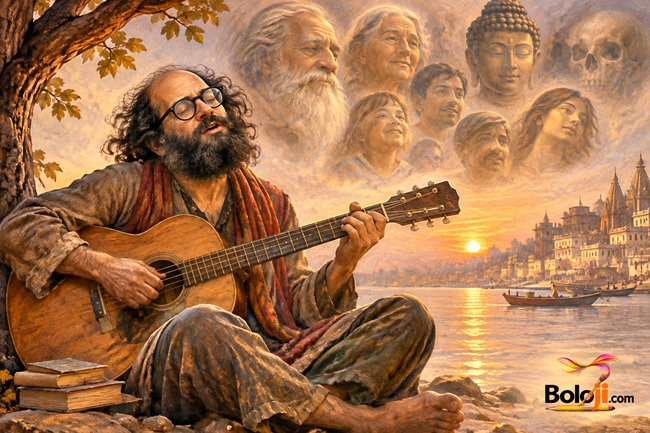
When we read the poem, images from On the Modern Element in Literature by Matthew Arnold are conjured up in the mind, along with the discussion of Vajashrava and Nachiketa as described in the Kathopnishada. Shankaracharya’s commentaries are very informative in this regard. Romesh Chunder Dutt’s Buddha’s Death can shed new light on the topic at hand: Ginsberg and his quest for truth and recuperation.
Who did not come? Huxley visited Benares to write an essay; Forster resided there as an insider for some time; Whitman wrote from afar. In recent times, Bob came too, besides Cohen, Steve Jobs and Mark Zuckerberg. So did Allen Ginsberg, after becoming disillusioned with America and denouncing its consumerist and capitalist policies against the backdrop of the Vietnam War and so on. He decried it all, as Blake does in London and The Chimney Sweeper, Wordsworth in The World is Too Much with Us and London, 1802, and Browning, to some extent, in The Lost Leader. Edmund Burke’s speeches in Parliament in favour of India are historic indeed.
While rushing home, flying back, he thinks of many things, including the death of his father and others under its shadow, and reflects upon death in vague generalizations. How is one to console? How is one to find comfort?
Guru Death your words are true
Teacher Death, I do thank you
For inspiring me to sing this Blues
He talks about Guru Death: Death as his Guru, telling him the right things and speaking the truth; the Teacher, the Reverend Teacher. He thanks the Teacher for inspiring him to sing the blues, falling short of saying:
“Gururbrahma gururvishnu gururdevo maheshwarah/
Guruh sakshat parabrahmaha tasmei sri guruvey namah//”.
Emerson’s Brahma also reflects upon this, and he seems to be walking under its shadow. A bluesman, Ginsberg is singing the blues of Death.
Buddha Death, I wake with you
Dharma Death, your mind is new
Sangha Death, we'll work it through
Guru Death, Buddha Death: what does it mean? What is the meaning of Buddha Death? The Buddha Jatakas? Buddha sacrificing himself, perhaps? Is he talking about Buddha’s final days and nobility?
When he talks about Sangha Death, he seems to be talking about Nirvana. Why fear it? Why not take Samadhi? While going through the line, we are reminded of:
Buddham sharanam gacchami,
Sangham sharanam gacchami,
Dhamma sharanam gacchami.
Suffering is what was born
Ignorance made me forlorn
Tearful truths I cannot scorn
Suffering: it is difficult to overcome the suffering of life, and without it, none can think of life. Who can say otherwise about bhoga, which is but bearing? We suffer for our actions, which is bhoga. Man is born to suffer, and this is his destiny. He was such an ignorant, forlorn child. He cannot scorn tearful truths.
A poet of the Beat and Beatle traditions, living a hippie and Bohemian life, so nomadic and uncertain, and believing in the gay tradition, the poet, as a rapper, raps about Death; as a jazz singer, he jazzes about it; as a bluesman, he sings the blues.
We are but mortal men and must go one by one, whether we visualize it or not. Who will go when? Who can say? Who will be there at that time? Those whom you expect to be there may not be, as it is preordained. During the COVID period, what happened? We could not even see the bodies. In the hospital, during critical moments, who was there at the time of death? Who stood by? Who faced and witnessed it? It was the hospital staff.
The old daddy has died. There is no one in the house. How lonely he must have been! How times and situations change in life! The mother, too, is no more. Who is there to be with, and who is not? Where is the brother? Where is the sister? A family consists of many members, just like the foliage of a tree. The pictures and images of death are alike. As the potter makes things of clay, so are we made.
How lonely must he have been? How does one feel it? To read these lines is to go through Sylvia Plath’s Daddy.
There is something of Thomas Hood’s I Remember, I Remember and something of Charles Lamb’s Dream Children: A Reverie.
What troubles us is that he speaks doubly: when he uses “Brother Death,” two things come together—the brotherhood of Death and the times spent with his brother. How are we to identify them and bring them together in an explanation?
Hey Father Death, I'm flying home
Hey poor man, you're all alone
Hey old daddy, I know where I'm going
Father Death, Don't cry any more
Mama's there, underneath the floor
Brother Death, please mind the store
Old Aunty Death Don't hide your bones
Old Uncle Death I hear your groans
O Sister Death how sweet your moans
O Children Deaths go breathe your breaths
Sobbing breasts'll ease your Deaths
Pain is gone, tears take the rest
Genius Death your art is done
Lover Death your body's gone
Father Death I'm coming home
Guru Death your words are true
Teacher Death I do thank you
For inspiring me to sing this Blues
Buddha Death, I wake with you
Dharma Death, your mind is new
Sangha Death, we'll work it through
Suffering is what was born
Ignorance made me forlorn
Tearful truths I cannot scorn
Father Breath once more farewell
Birth you gave was no thing ill
My heart is still, as time will tell.
We do not know what type of poem it is, or what kind of death it concerns, and where. Is its sentiment Indian or English? Is it a Hindu, Buddhist, Christian or Judaic death poem? It seems to have an Indian context, an Eastern interpretation. But whatever the kernel of the idea or the context of borrowing may be, it is an Allen Ginsbergian poem, a type in itself, commemorating the hippie view of life, a romantic concept, the Bohemian type, and gypsy life and living. It presents a wanderer wandering in search of peace and happiness, going against the social order and the establishment to recuperate and regain what was destroyed by wayward, public, rebellious, revolutionary, radical and natural living in contact with Nature and the cosmos, breast to breast, while trying to shun alcoholism and drugs and to keep the company of Zens, godmen, sadhus, fakirs and yogis.
Poetry came to him in the form of protest, with radical views, leftist leanings, revolutionary thoughts and a rebellious mood. He turned to communism and Eastern thought. Buddha counselled him to be wise and meditative, calm and composed, taking him to the peepul tree to instruct and teach him. He never admired American policies, particularly its capitalist policies. In protest against them, he expressed the anger, bewilderment, anxiety and loss seen in the younger generations, while the older ones, drunk with power, went on legislating and making policies for superpower status and dominance. Meanwhile, basic things remained unattended, bereft of love, sympathy, bonding, clemency, pity, compassion, virtue and philanthropy.
It is not The Terror of Death by Keats, nor is it Death Be Not Proud by Donne or Crossing the Bar by Tennyson. Maybe the poem addresses Death in the same way Donne does, but the style is different, and Ginsberg is modern, talkative and colloquial. Buddha’s wisdom counsels him to be wise and leave it all behind. This samsara involves both suffering and bhoga. What we do, we shall have to suffer for, and no one is beyond this suffering. We suffer for our karma; bhoga is something we have to bear. What bhoga is in your lot or mine, no one can say.
He talks about Mrityue, Iccha Mrityue—Death, Willed Death—with the babas and sadhus. He addresses Death and holds parleys with it.
“Hey Death”: with this he begins the poem, addressing Death. He says he is flying home. We do not know where he is going: to meet his old daddy or the Daddy of daddies. Whatever that may be, let there be the blues, with him as a bluesman singing the blues for Death, Poor Death, for his enjoyment, pleasure and profit. Seated in the audience, Death seems to be hearing his high-profile blues.
“Father Death, don’t, don’t cry, you baby. I am coming, coming to meet you”—this is what the song seems to suggest. Mama is there underneath.
Addressing Death as sister, brother, father, mother, aunty, uncle, friend, lover, genius and so on, he finds consolation in Buddha Death. Here he pauses for a while in lotus meditation, seeking blessings for shantih, with a raised hand, half-closed eyes and the halo of enlightenment around the head. There is an understanding of samsara and the cause of dukkha, along with the teaching and preaching of moksha, nirvana and mukti. The matter is very much like that of the story of Kipling’s Kim.
He has to repose in the gospel of peace, with his best wishes for world peace, cosmic peace, and internal and external peace. Om shantih shantih shantih. The body of the panchtattva is for seasoning, and as you season it, so it will be. Try to keep it good and righteous. Live a virtuous life. Try to be good and noble. Take to meditation. Contemplate. Awaken the kundalini within you. Be knowledgeable. Attain knowledge. Acquire it. Get light and give light to others. The Middle Path is before you to follow. Do you not hear the dancers dancing and indirectly telling you about the strings of the beena?
Death must come and will come. No one can check the advancing steps of death, even if one performs the Mrityunjaya Japa or brings the Sanjivini Buti.
Life is but Prana: Consciousness, Vibration, Breath, Pulsation. As long as the life-breath is in you, Prana is in you; the moment it ceases, life will no longer exist, and the body will turn lifeless and insensitive.
In search of peace—bodily, psychic, mental, spiritual, cosmic and theological—where did he come? Think about it. From America he came to India, a modern-day Hiuen Tsang or Magasthenes, a devotee and a bhakta of Indian thought and tradition. He saw India as Pearl S. Buck saw it, observing closely. Eliot, too, chanted the shantih mantras at the end of The Waste Land. But we do not know whether Eliot came to India or not. We are stunned to see how Ginsberg has imbibed Indian thought and elements within himself.
Not an American, but an Indian in dhoti and kurta, or a sadhu or fakir in saffron clothes—a mendicant, a traveller, a shisya of some guru or baba—this is how he appears at first sight. His pain is the pain of America, of materialism, materialistic pleasures and waywardness resulting from pleasure-seeking. Not the boon but the bane of capitalism marauds his self; drugs, alcoholism, hippie culture and a wandering temperament uproot him, turning him into a vagabond, a wanderer, a tourist.
21-Nov-2026
More by : Bijay Kant Dubey
Top | Literary Shelf | Home
