Nov 21, 2026
Nov 21, 2026
by B.S. Ramulu
Re-evaluating the Philosophical, Socio-Economic, and Domestic Legacies of Bhikkhunis and Upasikas
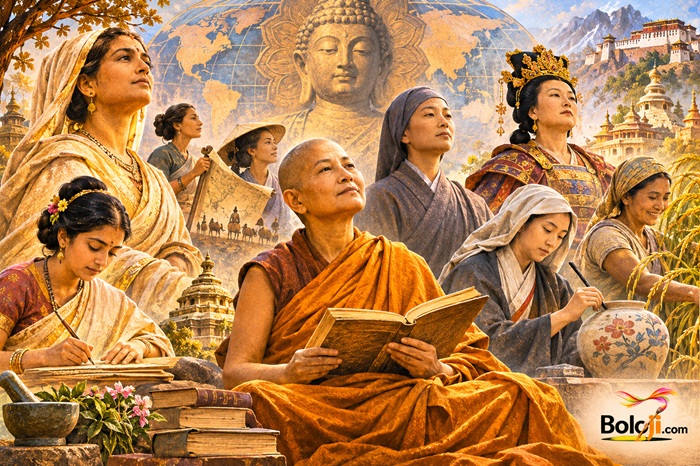
Historically viewed through a restrictive monastic or purely devotional lens, the role of women in Buddhism warrants a comprehensive re-evaluation. From the inception of the Bhikkhuni Sangha (the Order of Nuns) to the global spread of the Dhamma, women—both monastic sramanis and lay upasikas—have acted as structural pillars of Buddhist civilization. This paper traces their multi-faceted contributions across diverse geographies, extending from the subcontinental cradle to East Asia, Southeast Asia, the Tibetan plateau, and notably into the ancient Near East and Mediterranean spheres: Mesopotamia, Persia, and Ptolemaic Egypt. It systematically examines their agency not only in textual hermeneutics and transcendental philosophy (prajna) but also in applied socio-economic spheres: maternal medicine, epigraphic and architectural patronage, guild operations, agrarian sustainability, linguistic pedagogy, culinary arts, and mindful domestic governance.
1. Introduction: The Egalitarian Paradigm of Early Dhamma
The emergence of Buddhism in the 6th century BCE marked a radical departure from the rigid, stratified hierarchies of the contemporary Vedic landscape. By asserting that Nirvana (transcendental liberation) is universally accessible, Gautama Buddha dismantled the ontological monopoly of spiritual attainment based on gender or caste. The eventual institutionalization of the Bhikkhuni Sangha provided women with unprecedented structural autonomy.
The primary literary testament to this early phase of female intellectual emancipation is the Therigatha (Verses of the Elder Nuns), a foundational text within the Khuddaka Nikaya of the Pali Canon. Standing as one of the world’s oldest surviving anthologies of women’s literature, the Therigatha captures the unmediated voices of women experiencing profound cognitive and spiritual liberation. However, the legacy of Buddhist women extends far beyond monastic asceticism. Across millennia, upasikas (laywomen) and sramaṇis (nuns) served as dynamic agents of civilization, driving technological, economic, and social transformations across global trade networks.
2. Geographical Transformations and Philosophical Agency
A. India and the Subcontinental Cradle
In the subcontinental cradle, early monastic leaders established rigorous frameworks for female scholarship. Mahaprajapati Gautami, the Buddha’s foster mother, challenged socio-religious norms to establish the Bhikkhuni Sangha, asserting institutional rights for women. Monastic intellectuals like Dhammadinna achieved unparalleled hermeneutical acclaim. Celebrated by the Buddha as the foremost among dhamma-preachers (dhamma-kathika), her philosophical disputations recorded in the Cuḷavedalla Sutta of the Majjhima Nikaya offer masterful expositions on the panca-skandha (five aggregates), the metaphysics of Sunyata (emptiness), and the phenomenology of nirodha-samapatti (the cessation of perception and feeling).
As the Dhamma evolved, women continued to shape its institutional contours. Princess Sanghamitta, daughter of Emperor Ashoka, exported the Bhikkhuni lineage and textual corpuses to Anuradhapura, Sri Lanka, executing a historic feat of international religious diplomacy. Centuries later, during the golden age of monastic universities like Nalanda and Vikramashila, female acharyas like Dharmacandra composed sophisticated commentaries on Buddhist logic. Concurrently, Princess Lakshminkara authored the seminal tantric treatise Advayasiddhi, a text that radicalized the Sahajayana tradition by rejecting external ritualism in favor of innate, gender-transcendent wisdom.
B. East Asia: China and Japan
When Buddhism navigated the Silk Road into Confucian China, it encountered a patriarchal lineage system that strictly circumscribed female mobility. Buddhist women fundamentally disrupted this paradigm. Jingjian (4th century CE) defied societal expectations to become the first officially ordained Chinese bhikkhuni, establishing an institutional lineage that translated complex Sanskrit Vinaya texts into Chinese.
Politically, Empress Wu Zetian (624–705 CE) utilized the Mahaparinirvaṇa Sutra to legitimize female sovereign rule, state-funding massive translation bureaus and networks of female educational academies. Within the Chan (Zen) tradition, women demonstrated formidable dialectical acumen. The Chan master Iron Grindstone Liu (9th century CE) was legendary for her sharp wit and ability to defeat male masters in dharma-combat (shangfeng), demonstrating that ultimate truth (paramartha-satya) is entirely devoid of gendered characteristics.
In Japan, Zen Buddhism was similarly vitalized by female masters. Mugai Nyodai (1223–1298 CE), the first female Rinzai Zen master, established a powerful network of female convents (Amamonzeki) in Kyoto, securing long-term economic and political autonomy for ordained women. Centuries later, Otagaki Rengetsu (1791–1875 CE), a Buddhist nun, calligrapher, and ceramicist, encoded the profound tenets of impermanence (anitya) and universal compassion (karuṇa) directly onto her pottery, utilizing art as a medium for mass spiritual pedagogy.
C. Southeast Asia: Thailand, Vietnam, and Cambodia
In Southeast Asia, women navigated rigid institutional boundaries to preserve the spirit of the Dhamma. In Theravada Thailand, where formal bhikkhuni ordination lapsed for centuries, lay practitioners like Upasika Kee Nanayon (1901–1978) established independent meditation sanctuaries. Her widely published essays on Vipassana emphasized citta-anupassana (the relentless mindfulness of the mind), establishing her as one of the 20th century’s most profound meditation masters. This lineage of resilience paved the way for scholars like Dr. Chatsumarn Kabilsingh (Ven. Dhammananda Bhikkhuni) to reclaim formal Theravada ordination, challenging modern patriarchal monastic structures.
In Vietnam, the Chan tradition was deeply influenced by figures like Dieu Dinh, whose poetry synthesized karmic law with cosmic consciousness. In the 20th century, Thich Nu Tri Hai translated foundational Sanskrit and Western philosophical texts into Vietnamese, anchoring Buddhist studies in modern universities while engineering widespread humanitarian relief programs during the Vietnam War.
Further west, in the Khmer Empire of Cambodia, Queen Indradevi (12th century CE) emerged as a premier intellectual force. Serving as the chief professor and administrator of elite Buddhist universities, her sophisticated Sanskrit epigraphs at Angkor Wat demonstrate her mastery of grammar, logic, and Mahayana philosophy, while her state-backed initiatives created a vast network of schools for young women.
D. The Western Frontiers: Gandhara, Tibet, and the Greco-Roman Spheres
At the intersection of Hellenistic philosophy and Indian thought, the hybrid culture of Gandhara saw intense engagement from women. Epigraphic records in the Kharoá¹£á¹hi script reveal that Indo-Greek and Greco-Bactrian noblewomen were major institutional donors to Buddhist monasteries, actively reconciling the tenets of Greek Stoicism with Buddhist monastic discipline.
In the high-altitude terrain of Tibet, Vajrayana Buddhism recognized women as the living embodiments of enlightenment. Yeshe Tsogyal (8th century CE), the principal disciple of Padmasambhava, codependently established the Nyingma tradition. She compiled and concealed the terma (hidden treasure texts), ensuring the survival of esoteric lineages through centuries of political upheaval. Later, Machig Labdron (1055–1149 CE) developed the Chod system, a radical psycho-spiritual practice that synthesizes Prajnaparamita philosophy with shamanic visualization, engineering a profound method for severing the root of ego-grasping (atma-graha).
E. The Near Eastern and Mediterranean Expansions: Iran, Iraq, and Egypt
A critical yet heavily under-researched horizon of Buddhist history is its westernmost expansion along the trans-Eurasian trade corridors into the ancient Near East and the Mediterranean Basin, facilitated by Emperor Ashoka’s third-century BCE missions and subsequent Silk Road commerce. Archeological, textual, and linguistic indicators trace the footprints of the Dhamma—and the crucial agency of upasikas—into ancient Persia (Iran), Mesopotamia (Iraq), and Ptolemaic Egypt.
Ancient Persia and the Zagros-Meru Corridors (Iran): Long before the institutionalization of Islam, eastern and northeastern Iran (including regions of Khorasan and Bactria) were highly active centers of syncretic Mahayana and Vajrayana Buddhism. Local historical memory across the Zagros mountain passes and the symbolic “Meru” geographical axis notes that Persian women of the noble merchant classes acted as principal custodians of Buddhist caravanserais and monastic rock-cut cave complexes. Linguistic remnants in Old Persian reveal that women patronized local translations of the Dhamma, adapting Buddhist concepts of compassion into the prevailing Zoroastrian social matrix, thereby serving as intercultural bridgebuilders.
Mesopotamia and the Tigris-Euphrates Valleys (Iraq): In Seleucid and Parthian Mesopotamia (modern-day Iraq), bustling multicultural metropolises harbored diverse religious enclaves. Excavations and comparative records indicate that lay Buddhist women (upasikas) belonging to international merchant guilds funded minor viharas and public resthouses along trade nodes. These women managed communal funds that sustained transient monastics, ensuring that the therapeutic, meditative, and philosophical literature of Buddhism survived within the cosmopolitan crucible of ancient Mesopotamia.
Ptolemaic Egypt and the Alexandrian Spheres: Ashoka’s Edicts explicitly name Ptolemy II Philadelphus of Egypt as a recipient of his Buddhist emissaries. In Alexandria—the premier intellectual capital of the Mediterranean world—historical accounts suggest the presence of a Buddhist monastic community, often associated with the ascetic sect known as the Therapeutae (etymologically linked to Theravada). Hellenistic and Egyptian upasikas within these ascetic circles actively participated in advanced philosophical disputations. They integrated Buddhist concepts of Ahiṃsa (non-harming) and analytical self-inquiry into Alexandrian Neoplatonism and Gnostic thought, altering the intellectual landscape of the ancient Mediterranean.
3. Applied Innovations: Medicine, Art, and Socio-Economic Infrastructures
A. Applied Medicine and Obstetric Health
The monastic cells and domestic quarters managed by Buddhist women often served as centers for holistic medical practice. In antiquity, the physical perils of pregnancy and childbirth resulted in high rates of maternal mortality.
The Therigatha preserves poignant accounts of women like Kisa Gotami and Paá¹acara, whose encounters with profound domestic grief led them to the Dhamma. Upon entering the Sangha, these women converted their lived traumas into clinical expertise, establishing specialized infirmaries within convents. Sramaṇis specialized in pharmacology, herbalism, and psychiatric counseling for postpartum depression and grief. By creating safe, female-led clinical environments, they managed reproductive health, assisted in obstetrics, and offered pharmacological aid to pregnant women and young mothers who were otherwise alienated by male-dominated medical systems.
B. Architectural Patronage and Sculptural Innovations
The material landscape of Buddhist architecture bears the indelible imprint of female financial and aesthetic agency. Epigraphic analyses of the monumental stupas at Amaravati and Nagarjunakonda in Southern India’s Krishna River valley reveal that over ninety percent of structural expansions were financed by women. Lay upasikas like Bodhisiri, alongside royal queens of the Iká¹£vaku dynasty (such as Camatisiri and Kamasiri), held independent wealth and directed the construction of monasteries, apsidal shrines, and chaityas. Crucially, their patronage was not merely financial; it was deeply curatorial. These women worked directly with guild sculptors (sela-rupakaras) to dictate iconographic programs, ensuring that reliefs depicted women with high social dignity, celebrating themes of universal compassion (karuṇa) and maternal care rather than purely courtly aesthetics.
4. Secular, Domestic, and Guild-Based Dimensions of Female Agency
A. Agrarian Sustainability and Ecological Resource Management
The Buddhist commitment to ecological interconnectedness (Pratityasamutpada) was translated into applied agrarian science by its female adherents. Lay upasikas in ancient India, Sri Lanka, and Southeast Asia engineered advanced techniques in seed preservation and organic farming. In the high-altitude terrains of Tibet and the agrarian valleys of Thailand, convents directed by women transformed surrounding barren lands into highly productive terraced agricultural systems. They institutionalized “medicinal gardens” and seasonal grain redistribution networks, developing sustainable land-use models that protected rural communities from environmental precarity and cyclical famine.
B. Craft Guilds, Industrialization, and Artisanship
The socio-economic empowerment of the Buddhist laywoman was heavily anchored in the ancient system of trade guilds (srenis). Western Indian cave inscriptions (such as those at Karle and Kanheri) verify that upasikasactively operated as independent entrepreneurs, registered members, and even executives within potters’ guilds (kumbhakara-sreni), weavers’ guilds (saliya-sreni), and perfume consortia. In East Asia, Chinese and Japanese bhikkhuni convents functioned as key industrial centers. Nuns set up large-scale textile and sericulture (silk production) workshops within monastic walls, introducing innovative design motifs and providing rigorous vocational training to disenfranchised women, establishing highly successful models of female-led industrial self-reliance.
C. Linguistic Pedagogy, Vernacularizing, and Translation
In an era when access to formal education was strictly gatekept by elite classes through classical languages, Buddhist women democratized literacy. Early subcontinental sramanis bypassed elite Sanskrit to teach and compose in vernacular idioms—Pali, Ardhamagadhi, and various Prakrits—bringing literacy directly to marginalized communities. On the international stage, female monastics managed complex textual cross-translations. Monastic academies founded by figures like Jingjian in China formulated systematic methodologies for translating nuanced Sanskrit philosophical concepts into ideographic Sinitic structures. Queen Indradevi’s pedagogical models in Cambodia transformed Sanskrit language education into a structured curriculum, utilizing epigraphic poetry to teach advanced philology and classical grammar to generations of female students.
D. Culinary Engineering and Food Preservation Sciences
The strict structural requirement for vegetarianism (Ahimsa) across Mahayana cultures necessitated an absolute re-engineering of food production systems, a task primarily executed by women. Lay upasikas and sramanis transformed domestic kitchens and monastic refectories into sites of rigorous culinary innovation. In East Asia, female monastics perfected Shojin Ryori (devotional temple cuisine). To ensure year-round nutrition without relying on animal exploitation, they engineered advanced techniques in bio-fermentation and preservation, developing stable forms of miso, soy sauce, tofu, and lacto-fermented vegetables. These techniques maximized nutritional value during winters and famines, establishing scalable food preservation systems that were distributed to the wider lay populace.
E. Mindful Domestic Governance and Household Micro-Economics
For the lay upasika, the domestic sphere was re-conceptualized not as a site of subjugation, but as an arena for applied Dhamma. In the Sigalovada Sutta, the Buddha explicitly outlined a model of domestic partnership wherein the wife is entrusted with independent financial governance, responsible for managing household property, supervising workers with empathy, and budgeting resources. Prominent laywomen like Visakha (Migaramata) modeled this equilibrium. They demonstrated how a woman could manage vast corporate estates while systematically deploying capital to construct public welfare projects, medical dispensaries, and monastic complexes. They transformed home management into an active, mindful practice of economic discipline (saṃvibhaga-sila), balancing family welfare with institutional philanthropy.
5. Conclusion: Reclaiming the Gender-Transcendent Legacy
The global history of Buddhism cannot be accurately told without integrating the profound legacies of its women. Whether analyzing the metaphysical brilliance of Dhammadinna and Machig Labdron, the architectural transformations financed by Bodhisiri, the clinical interventions in obstetric health led by early bhikkhunis, the far-western expansions into Persia, Mesopotamia, and Egypt, or the culinary, linguistic, and economic systems developed by East Asian and subcontinental monastics, women have always been structural architects of the Buddhist world. They successfully unified the transcendental insights of Dhamma with the practical needs of human civilization. Recognizing their contributions reclaims Buddhism not as a detached, homosocial ascetic tradition, but as a dynamic, inclusive civilizational movement that pioneered gender equity, intellectual freedom, and societal welfare across the ancient world.
6. References
21-Nov-2026
More by : B.S. Ramulu
