Nov 21, 2026
Nov 21, 2026
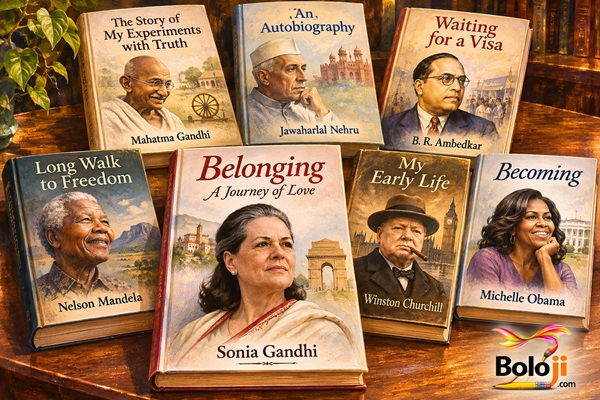
Reflections on how autobiographers open their narratives
One of the most famous comments on books came from Francis Bacon, the Father of the English Essay, who classically grouped them into three compartments: “Some books are to be tasted, others to be swallowed, and some few to be chewed and digested; that is, some books are to be read only in parts; others to be read, but not curiously; and some few to be read wholly, and with diligence and attention.”
He also has some good advice to the readers. “Read not to contradict and confute, nor to believe and take for granted, nor to find talk and discourse, but to weigh and consider.”
I do not know to which of the three categories would fall the latest flagship release from HarperCollins, ‘Belonging’ by Sonia Gandhi. It has already engendered heated political discussions across the country, besides providing a viral photo-op for many in her party to pose with the book and post the picture on social media.
I consider Bacon’s advice very relevant for both the detractors and supporters of the book. Read it not to contradict, don’t take it for granted, weigh and consider.
The premier benchmark I always put, in a way my own golden yardstick, to assess the worth of a book is its opening sentence, or in some respects the opening paragraph.
Does the opening sentence prompt you to read the next, and the next and the one after that? If it does the book is worth reading.
Or at least you come to have an idea of the character, the caliber or the intention of the author.
Sometimes the opening sentence may be so bland, so hypocritical, so insincere. That will help you to come to an early judgment on the author, if not on the book.
The opening-sentence judgment has its hazards too. I could not take to heart one of the greatest autobiographies in the world, that of Mahatma Gandhi, just because of what I personally considered as a flaw in the opening sentence and the subsequent part of the opening paragraph.
Gandhiji was one of the greatest crusaders against the opprobrious caste system prevailing in the country, but he began his autobiography with a declaration of his caste and an explanation how his family occupied a very high and privileged position in the society.
“The Gandhis belong to the Bania caste and seem to have been originally grocers,” he says in the opening sentence, adding “But for three generations, from my grandfather, they have been Prime Ministers in several Kathiawad States.”
He goes on further: “Uttamchand Gandhi, alias Ota Gandhi, my grandfather, must have been a man of principle. State intrigues compelled him to leave Porbandar, where he was Diwan, and to seek refuge in Junagadh. There he saluted the Nawab with the left hand. Someone, noticing the apparent discourtesy, asked for an explanation, which was given thus: The right hand is already pledged to Porbandar.”
Gandhiji’s caste and privileged social position only enhanced his humanism and played a great role in his effort to eradicate the caste system, but should they be highlighted in the very opening line of his autobiography? I have my doubts.
The same was the case with the sentence with which Jawaharlal Nehru opened his autobiography. Here also his caste (Kashmiri Pandit) and his family’s very affluent social position were given a predominant mention in the first three paragraphs of the first chapter titled ‘Descent from Kashmir.’
“An only son of prosperous parents is apt to be spoilt, especially so in India,” he begins, in a display of self-pampering. “And when that son happens to have been an only child for the first eleven years of his existence there is little hope for him to escape this spoiling.”
In his description of his large family he chooses to mention the exclusive nature of his early education. He had it at home, something that only the immensely rich could afford.
Contrast this with the pain and the pathos depicted by B R Ambedkar on his childhood of deprivation, detailed in the unfinished biographical notes collected as ‘Waiting for the Visa’ :
“Foreigners of course know of the existence of untouchability. But not being next door to it, so to say, they are unable to realize how oppressive it is in its actuality,” goes the opening sentences.
“It is difficult for them to understand how it is possible for a few untouchables to live on the edge of a village consisting of a large number of Hindus; go through the village daily to free it from the most disagreeable of its filth and to carry the errands of all and sundry; collect food at the doors of the Hindus; buy spices and oil at the shops of the Hindu Bania from a distance; regard the village in every way as their home – and yet never touch or be touched by anyone belonging to the village.”
One who suffered similar or more deprivation in a country across the oceans, Nelson Mandela, in his autobiography ‘Long Walk to Freedom,’ chose a different method to begin the story of his life, providing subtle humor on his father-given name ‘Rolihlahla.’
“Apart from life, a strong constitution, and an abiding connection to the Thembu royal house, the only thing my father bestowed upon me at birth was a name, Rolihlahla.”
“In Xhosa, Rolihlahla literally means ‘puling the branch of a tree,’ but its colloquial meaning more accurately would be ‘troublemaker.’
“I do not believe that names are destiny or that my father somehow divined my future, but in later years, friends and relatives would ascribe to my birth name the many storms I have both caused and weathered. My more familiar English or Christian name was not given to me until my first day of school.”
Among other international luminaries, Winston Churchill has a classic opening line, almost lyrical in its beauty:
“When does one first begin to remember? Where do the waving lights and shadows of dawning consciousness cast their print upon the mind of a child? My earliest memories are Ireland.”
Michelle Obama in her memoirs ‘Becoming,’ whose cover page design is projected as a model to Sonia’s book in social media trolls, has a remarkable, heart-warming opening.
“When I was a kid, my aspirations were simple. I wanted a dog. I wanted a house that had stairs in it— two floors for one family.”
“I wanted, for some reason, a four-door station wagon instead of the two-door Buick that was my father’s pride and joy……. In those days, I wore pigtails and bossed my older brother around and managed, always and no matter what, to get what I wanted.”
Sonia’s opening sentence in ‘Belonging, A Journey of Love’ is tender, nostalgic, beautifully describing her first meetings with Rajiv at a Cambridge restaurant they used to frequent in their separate groups. The beauty of the piece is that Rajiv by name does not appear anywhere on the first page.
“Tall and handsome with deep black eyes, he stood out from the others of his group who usually sat at a table opposite mine at the Varsity, a Greek restaurant I used to frequent with my friends,” she opens up, adding “It was the only place in Cambridge during the mid-1960s that served food somewhat similar to Italian.”
From first appearance her narration seems to go direct to the heart of the reader, though being a political biography, as much as a personal love story, the book is bound to have detractors by the legion.
In the final analysis the worth of a book is not determined by the number of pages it has or its price tag or the hype it created during release or the Bestseller label handed down by the publishers.
The lasting value of a book is determined by other factors: how the book gels with the reader, how the reader reacts to it and what feel he gets of it.
It will be good if Sonia’s book, overall, creates some resonance that goes to the reader’s heart. Otherwise the book, for that matter ANY book, will remain as a literary relic or a sidelined showpiece in his bookshelf.
21-Nov-2026
More by : P. Ravindran Nayar
Top | Literary Shelf | Home
