Nov 21, 2026
Nov 21, 2026
Guru Tegh Bahadur's Wisdom on Impermanence, Awareness, and Living
Chinta Ta Ki Keejiye, Jo Anhoni Hoye
Eh Marag Sansar Ko, Nanak Thir Nahin Koye
Jo Upjeyo So Binas Hai, Paro Aaj Ke Kaal
Nanak Har Gun Gaye Le, Chhaad Sagal Janjal
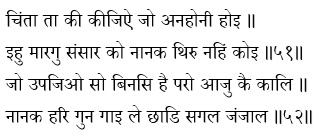
— SGGS - Ang 1429, Saloks 51–52, Guru Tegh Bahadur
Translation
Why worry over what lies beyond the natural order?
Such is the journey of this world, says Nanak; nothing remains unchanged.
Whatever comes into existence is subject to dissolution, be it today or tomorrow.
Remember and celebrate the virtues of the Divine, and release yourself from worldly entanglements.
My Understanding
Guru Tegh Bahadur begins with Chinta, questioning the usefulness of worrying about what is contrary to the natural order. Yet I believe the essence of the teaching lies in the second line:
Eh Marag Sansar Ko, Nanak Thir Nahin Koye.
In this journey through the world, nothing remains unchanged.
The significance of this observation extends beyond worry. It addresses the fundamental nature of our existence and our relationship with the circumstances through which we live. We inhabit a world in perpetual motion. The Earth rotates and revolves. Seasons change. Rivers flow. Within our bodies, breathing, circulation, and countless other processes continue whether or not we consciously direct them. Movement and change are intrinsic to living existence.
Our circumstances follow a similar pattern. Relationships evolve. Responsibilities change. Our physical capacities alter with age. An understanding that served us well yesterday may prove inadequate tomorrow.
Nothing remains Thir—permanently fixed. This is not necessarily a cause for despair. It is the nature of the journey.
Inevitability and Responsibility
The words Honi and Anhoni invite contemplation. Honi may be understood as that which is destined or inevitable, while Anhoni suggests something contrary to the natural order. Guru Sahib's opening line invites us to question the usefulness of worrying about what cannot be otherwise. Yet the inevitability of change must not be confused with the belief that every event in our lives is predetermined.
Recognizing that our bodies are subject to aging does not mean neglecting our health. Knowing that relationships change does not relieve us of the responsibility to nurture them. Accepting that death is inevitable does not diminish our obligation to care for the living.
The inevitability of change does not make human effort futile. It makes conscious effort necessary.
That effort is not directed toward defeating change, but toward living responsibly and harmoniously within it.
Harmony and Awareness
We sometimes imagine spiritual understanding as the attainment of a condition in which worry, attachment, anger, or ego will never trouble us again. But can such permanence exist in a life that is continually changing? We remain individuals with aspirations, relationships, and responsibilities. Circumstances affect us. We experience disappointment, fear, and anxiety. Sometimes our sense of individuality becomes dominated by ego, and we become entangled in our expectations.
Chinta manifests.
Understanding does not necessarily make us incapable of these experiences. It helps us recognize them and respond with greater awareness.
Consider breathing. We do not inhale once and declare that the work of breathing has been accomplished. Breathing continues because living continues. Similarly, harmony requires continuing attention. A relationship needs care. A vocation demands adjustment. A disagreement may require us to reconsider our assumptions.
Harmony is not an unchanging state. It is a continuing relationship with changing circumstances.
Chhaad Sagal Janjal
Guru Tegh Bahadur concludes:
Nanak Har Gun Gaye Le, Chhaad Sagal Janjal.
The word Janjal suggests the entanglements and shackles that restrict our freedom. These may arise through attachment, ego, fear, greed, possessiveness, or excessive expectations. But the entanglement is not necessarily in our relationships, responsibilities, or aspirations themselves. It is in the manner in which we become imprisoned by them. One may love deeply without demanding ownership of another. One may work diligently without allowing success or failure to determine one's entire sense of worth. One may hold convictions without becoming incapable of listening to another perspective.
Chhaad Sagal Janjal, therefore, need not imply withdrawal from worldly life.
I understand it as an invitation to live fully as an individual, fulfilling one's responsibilities and nurturing one's relationships, while making conscious efforts to loosen the bonds of ego and attachment. Entanglements may return as circumstances change. Our awareness and effort must remain responsive.
Har, Existence, and Simran
The instruction Har Gun Gaye Le is commonly understood as singing or praising the virtues of the Divine. I understand its significance in relation to Sat—Absolute Existence.
The individual is but a microscopic part of this immeasurable whole.
Raj, with his distinct identity, vocation, relationships, and experiences, exists within that whole. He does not stand outside it. Yet the demands of everyday living can cause him to forget this fundamental relatedness. His attention becomes absorbed in immediate concerns, and his individual interests may appear separate from the larger environment in which he lives.
This is where Simran acquires practical meaning.
For me, remembrance of the Divine is remembrance of Existence—an awareness that the individual belongs to a greater whole. Such remembrance need not be confined to religious recitation or a particular hour of worship. It can accompany the ordinary activities of life.
When Raj goes to work, encounters disagreement, manages disappointment, or fulfills family obligations, he has opportunities to remember his relatedness to Existence. That remembrance does not remove his difficulties or guarantee that he will always respond wisely. But it can help him recognize when ego, fear, or attachment has narrowed his perspective.
Simran is not an escape from everyday living. It is awareness carried into everyday living.
Guru Nanak's Reminder
Guru Nanak expresses a related understanding in Japji Sahib:
Gura Ik Deh Bujhayee
Sabhna Jiyan Ka Ik Data
So Mai Visar Na Jayee.
The Guru has imparted one understanding:
There is One Giver to all living beings.
May I never forget that One.
The concluding words, So Mai Visar Na Jayee, are especially meaningful to me.
May I never forget.
In my understanding, the individual need not abandon his identity to recognize his relatedness to the whole. That awareness can influence how he treats others, responds to circumstances, and fulfills his responsibilities. Remembrance thus becomes more than a personal spiritual exercise. It finds expression in our conduct toward one another.
Understanding in Everyday Life
Scriptural wisdom has little practical value if it remains confined to recitation, interpretation, or philosophical discussion without finding expression in our conduct. The question I must ask is not merely what Guru Tegh Bahadur meant centuries ago, but what his teaching means when I encounter the circumstances of my life today.
These questions cannot be answered once and for all. Their answers emerge through living. Even our understanding is subject to reconsideration and growth.
Eh Marag Sansar Ko, Nanak Thir Nahin Koye.
The Continuing Journey
Guru Tegh Bahadur's verses begin with worry, but their wisdom reaches into the nature of Existence itself. Everything in our worldly journey is subject to change. Whatever comes into existence is subject to dissolution. Recognizing this reality need not lead to fatalism or indifference. It can encourage us to participate more consciously in Life, knowing that our actions matter even though their circumstances and outcomes cannot be made permanent.
Har Gun Gaye Le reminds me to remain aware of the larger Existence to which I belong.
Chhaad Sagal Janjal reminds me to free myself, through continuing effort, from the entanglements that obstruct that awareness.
I may not always succeed. Attachment, fear, or ego may cloud my understanding. But recognizing that I have become entangled offers an opportunity to reconsider and respond.
Life does not wait for us to attain perfection. It invites us to participate with awareness.
Perhaps that is the practical wisdom I discover in Guru Tegh Bahadur's teaching:
To recognize change as intrinsic to Existence, remain conscious of our relatedness to the whole, and fulfill our responsibilities without becoming prisoners of the circumstances through which we pass.
The journey continues. So does the effort to live in harmony with it.
Read Also: Worry is the Bandit
20-Nov-2026
More by : Rajender Krishan

|
Nothing is permanent; neither joy nor sorrow. So, there is no need of much elation in joy or much sorrow in an adverse situation. Sama Bhava... balance, equanimity... well chosen, well articulated... |
|
|
Your elaborate and comprehensive analysis is marvellous. Nothing is permanent in this world. Despite its transitory nature, life must be lived responsibly, its beauty enjoyed consciously, and Nature must be respected while enjoying its various invaluable gifts |
