Nov 21, 2026
Nov 21, 2026
At 3:14 a.m. Hyderabad lay under a dull, sourceless dark.
The first scream did not sound human.
It tore through the house like sheet metal folding—high, ragged, endless—and Grishma found her daughter standing barefoot in the corridor, fingernails dug into her own forearms, blood rising in thin crescents. Vasanthi’s eyes were wide open but aimed somewhere past the peeling calendar tacked above the switchboard, past the cracked plaster, past anything solid. Five dogs had pressed themselves into corners of the hall, ears flat, whimpering low. One had knocked over a steel tumbler in the kitchen and it was still ringing a faint circle across the granite floor.
“Vasanthi!” Grishma seized her daughter’s wrists. The girl’s skin was cold and filmed with sweat. “Look at me. What’s happened?”
“They’re talking, Amma.” The whisper was eerily level. “They won’t stop. Can’t you hear them?”
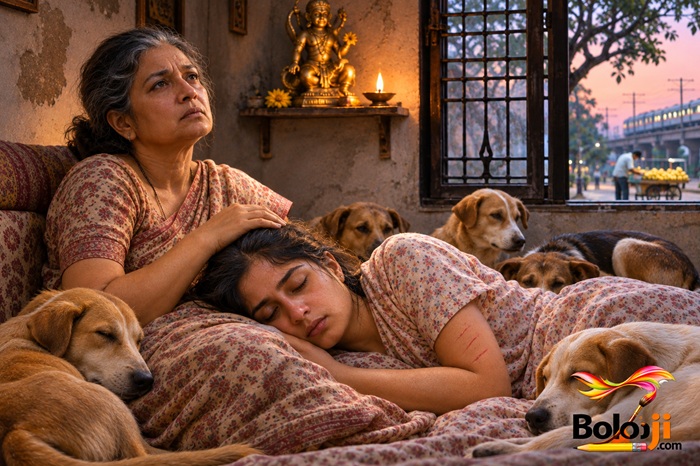
Nobody was there. The house held only the two of them, the dogs, and the stale weight of rooms that had not welcomed a guest in years. A single tubelight hummed overhead, its forty-watt glow turning their faces the colour of watered-down tea. Dog hair drifted across the tiles. A brass Hanuman idol on the shelf watched with painted eyes that reflected nothing.
Grishma pulled her daughter against her chest and felt the shuddering ribs, the knobs of a spine through a nightgown worn so thin it might have been gauze. She held on and thought—not for the first time—How did this happen to my daughter?
She did not think, How did I happen to my daughter? That sentence had never formed in her mind and likely never would.
The answer, had she been capable of hearing it, began twenty-seven years before this night, in a government school classroom in Malkajgiri.
~*~
Grishma was sixteen the year she discovered that rules bled when you pressed them. Her parents had spent years insisting decent girls maintained distance from boys. Teachers split classrooms into halves. Neighbour aunties spoke of honour and shame with tight, disapproving mouths. But when the boy from across the aisle—Vihan, with his ink-smudged collar and nervous grin—smiled at her during a chemistry period, nothing happened. No thunder. No scandal. Only a warm kick beneath her ribs and a new, intoxicating thought—Adults pretend the walls are stone, but they’re only cloth.
She did not fall in love with Vihan. She fell in love with what Vihan gave her—importance, attention, the electric feeling of being chosen. When he tried to retreat, frightened by whispers in the school lunchroom, Grishma wept in front of the principal and hinted that he had said terrible things to her. She watched the boy’s face crumble into panic, watched the vice-principal summon his father, watched a grown man beg a sixteen-year-old girl to please, please reconsider.
Standing outside that office, her hands still damp from tears she had produced on command, Grishma felt something darker than triumph settle in her stomach. She felt protected. She understood, with the clean clarity of an equation balancing, that other people’s fear could be made to work for her.
~*~
College was bigger, noisier, more complicated. She studied commerce at a women’s degree college in Habsiguda, sharing autorickshaws and canteen gossip, perfecting the talent she had stumbled upon at sixteen. She did not want boys who agreed with everything she said. Agreement was boring. What she wanted was gravity—a man whose life pulled the room slightly off-balance towards him.
Vivek had that quality. He was two years her senior at the neighbouring men’s college, a postgraduate student in economics whom lecturers described with the phrase “very promising.” He was not handsome in any way that turned heads—narrow shoulders, thick spectacles, a chin that receded when he laughed. But he carried a stillness about him that made louder men seem hollow. He did not chase her. He barely looked at her during inter-college debates. That was what made her want him with a grip she mistook for love.
If I can hold on to this one, she reasoned, I’ll have a life people respect.
She pursued him across bus stops and library corridors. He was polite, cautious, unfathomable. When she sensed him pulling away—not out of cruelty but out of a genuine preference for books over drama—something in her chest clenched shut. The thought of losing him felt less like heartbreak and more like being erased from a register. She existed most vividly in someone else’s attention.
So she did what had worked before. Tears in public. Frantic calls to his hostel warden. A letter, delivered through a common friend, implying that if he did not marry her she would tell both families he had compromised her. The word “compromise” carried a specific weight in their world, heavier than any lock, and Vivek—quiet, cautious, terrified of scandal—yielded.
He said yes like a man signing a document he has not fully read.
~*~
Their wedding took place on a sweating May evening in a function hall in Safilguda, marigold garlands already wilting by the time the muhurtham was called. Grishma, in a red Kanjeevaram that cost her father two months of pension, watched Vivek bow his head for the mangalsutram. His neck was thin. His collar damp. He looked, in that moment, not like the still, certain man she had wanted, but like a boy who had lost an argument and was too tired to appeal.
I won him, she thought. And then, immediately, an uglier thought she buried before it could finish—If I could win him, maybe he wasn’t worth winning.
The marriage began in a rented flat in Nacharam, two rooms and a balcony overlooking a drain. Vivek tried. He brought her jasmine from the corner vendor on Saturdays. He learnt to cook gutti vankaya curry because she disliked his mother’s recipe. He apologised first after every argument, sometimes mid-sentence, his voice dipping into a register that was half-plea, half-surrender.
To a different woman, this effort might have looked like devotion. To Grishma, each apology landed with the dull clink of a counterfeit coin. She had wanted someone she could lean against without toppling. Every time Vivek bent, she felt the terrifying absence of a wall behind her.
“You don’t have to keep saying sorry,” she told him once, arms crossed, standing in the kitchen doorway while he scrubbed a pot she had slammed down. “It makes you look pathetic.”
He paused, sponge in hand, water dripping. “I just don’t want us to fight, Grishma.”
“Then stop being the kind of man people fight with.”
He had no answer for that. His shoulders curved inward a little more. He returned to the pot. The scrubbing sound filled the silence between them—chhhk, chhhk, chhhk—steady and effortful and completely insufficient.
~*~
Children came. First a boy, Shireesh, and then Vasanthi, three years later. Vivek held each baby with such reverent, trembling hands that the nurses smiled. He woke at 2 a.m. for feeds. He carried Vasanthi against his shoulder, walking the corridor in slow loops, humming old film songs off-key until she slept.
He also worked harder, took evening tuitions, wore shirts until the collars frayed. With every new sacrifice his spine seemed to compress another inch. He developed a habit of asking, after fights that could strip paint from walls, a single question delivered in a voice barely above a breath.
“Are we alright?”
Grishma hated that question. It surfaced after every slammed door, every dinner eaten in silence, every night she turned her back to him in bed. Three words that should have meant care but sounded, to her ears, like a man checking whether the leash was still attached. She never answered. Or she answered with a look—chin lifted, eyes flat—that said, You already know we’re not.
He asks because he’s afraid, she thought, watching him wait by the bedroom door. And a man who’s afraid isn’t a man at all.
What she could not admit, even to herself, was that his fear was a mirror. She was terrified too—terrified of having married a reflection of her own weakness, terrified that no amount of control could build the solid ground she craved. The easiest response to that terror was contempt, and contempt came to her as naturally as breath.
~*~
The end, when it came, wore the costume of a small disagreement. Vivek returned forty minutes late from the college. Grishma demanded an explanation. He offered one—a faculty meeting, the HOD wanted revised syllabi. She called it a lie. He swore it was true. She escalated, pulling open drawers of grievance that went back a decade—his passivity, his spinelessness, his family’s failure to give her the jewellery she had been promised at the wedding. He stood in the centre of the room, arms at his sides, absorbing it.
“I’m leaving,” she finally said, the sentence bright with the old, familiar rush. “I’m taking Vasanthi and going to Nanna’s house.”
She expected resistance. She wanted it—some flash of the steel she had once imagined inside him, a hand on her arm, a voice that said No, you’re not.
He looked at the floor. “If that’ll make you happy.”
Six words. They confirmed everything she had feared and nothing she wanted to hear. If her happiness was his only compass, then there was no fixed point in him at all, only a needle swinging wherever she blew. She packed a bag in fifteen minutes, tucked a sleeping Vasanthi into an auto, and left.
Shireesh was at his friend’s place three floors down, playing ludo. When he came back an hour after his mother left, the flat felt lighter, as if someone had opened a window. Vivek tried to explain, choosing smaller words, reaching for an order that would suit a boy, but Shireesh only listened out of politeness. He understood enough from the packed space and the quiet. Something had finally happened that adults had been threatening for years, and a part of him, small and unshowy, felt relieved.
~*~
Her father, Seshagiri, opened the door in his lungi and a faded undershirt, blinking against the porch light. He was seventy-one, recently widowed, his days reduced to calculating DA additions to his basic pension, Telugu news channels, and a late-afternoon shuffle to the balcony so regular the neighbours set their clocks by it.
“Grishma?” His face held not welcome but alarm. “What’s wrong? Where’s Vivek?”
“Don’t ask about him. I’m staying here. Open the gate properly, Nanna.”
She walked past him into the house and, within a week, began remaking it. The cook was dismissed—“She’s been stealing rice, Nanna, you’re too trusting.” The part-time maid followed. Then the gardener. Grishma scrubbed the kitchen herself, rearranged the almirahs, changed the locks. She spoke of bringing discipline, efficiency, structure. Seshagiri sat in his room with the door ajar and the television turned low, watching his daughter move through the house with the purposeful energy of a woman renovating a building she intended to own.
She’s just upset, he told himself. She’ll settle. She’ll go back.
She did not go back.
The years moved on without anybody’s permission, but Grishma did not let them slip by easily. She quarrelled with the neighbours over boundary walls, with Amazon delivery agents over missed parcels, with the auto drivers who parked too close to the gate. She lectured women at the local temple about hygiene and child-rearing until they stopped sitting near her. Her brother, Omkar, reduced his visits from weekly to monthly to quarterly, then to phone calls that lasted under a minute. When their father’s property needed dividing, Grishma hired a lawyer before Omkar had finished his first sentence.
She won her share of the house and the small plot in Ghatkesar, and of the two madiges—commercial shutters—her father owned. She stood on the veranda afterwards, legal papers in hand, trembling—not with joy but with the residual electricity of combat. I can take care of myself. I don’t need any of them.
The dogs came next. A stray she fed at the gate. Then its companion. Then a third, rescued from near the railway tracks. Then more. They filled the courtyard, the veranda, the hall. They barked at every passing scooter, every vendor, every human shadow. They greeted Grishma with a devotion that asked nothing and questioned less. They never said, “Are we alright?”
~*~
Vasanthi grew up inside this fortress of bolted gates and barking. She watched her mother ring up astrologers and tantriks at all hours, accusing distant relatives of black magic. She watched her mother weep with rage at the phone when Omkar did not return a call, and work herself into the same fury when Shireesh did not check her WhatsApp messages for days on end. She watched plates thrown at walls, doors kicked open, gods alternately begged and blamed.
The girl learnt that love was a thing with sharp edges. At fourteen, she began shouting back. At sixteen, she went quiet. At nineteen, she started hearing voices.
The doctors at NIMHANS used careful words—“psychotic episode,” “stress-induced,” “prolonged environmental trauma.” Grishma sat in the consulting room in a starched cotton sari, back rigid, and told the psychiatrist it was genetic, something from her husband’s side, some flaw buried in his bloodline that had surfaced in the girl.
The psychiatrist, a woman in her fifties with reading glasses perched on a beaded chain, looked at Grishma for a long moment. Then she looked at Vasanthi, who sat curled in the plastic chair, picking at the skin around her thumbnails. The doctor’s pen hovered over the file.
“Has Vasanthi been exposed to prolonged conflict at home, Mrs Vivek? Shouting, arguments, instability of any kind?”
“Every family argues, Doctor. That doesn’t make children hear voices.”
“It can. It very often does.”
Grishma stood, smoothed her pallu, and told Vasanthi they were leaving. At the door she turned. “I’ll take her to someone who understands. Not everyone who wears a white coat knows what they’re talking about.”
The psychiatrist did not respond. She wrote something in the file, closed it, and placed it on a pile with other files that told other versions of the same story.
~*~
That was three years before the scream at 3:14 a.m.
In those three years, Grishma cycled through four doctors, two tantriks, one faith healer from Matralayam, and a jyotish pandit in Secunderabad who charged one thousand and sixteen rupees per session and prescribed gemstones she could not afford. Vasanthi’s episodes came and went—weeks of fragile calm broken by nights of weeping, scratching, and whispered conversations with presences only she could register. Medication helped when Grishma allowed it. Often she did not, convinced the tablets were poisoning her daughter’s liver, or that the real cure lay in puja, in planetary alignment, in anything that did not require her to sit in a consulting room and hear questions she refused to answer.
Shireesh had already pulled away. He lived in Bengaluru now, working at a small software company, visiting once a year during Sankranti and spending most of that visit on his phone in the courtyard. He spoke to his mother with the flat, careful courtesy of a man defusing a device. He spoke to his father more freely, on long calls late at night that Grishma knew about and resented but could not prevent.
Vivek still called every Sunday. Vasanthi’s number, not Grishma’s. When Vasanthi was well enough, she answered and spoke in a voice so small it sounded borrowed from a much younger girl. When she was not well, Grishma picked up and delivered a bulletin—“She’s fine, don’t keep calling and upsetting her”—and cut the line before he could ask anything further.
He never argued. He never pushed. He simply called again the next Sunday, steady as a temple bell that rings whether anyone is listening or not.
~*~
Seshagiri died on a hot Sunday afternoon in June, the ceiling fan turning slow circles above him while the television played a rerun of a Dasari Narayana Rao film he had seen eleven times. Grishma found him in his chair, head tilted to one side, mouth slightly open, remote still warm in his hand. For a full minute she stood in the doorway, waiting for him to blink. When he did not, she knelt beside him and pressed her palms against her knees, breathing hard.
She did not cry. She made calls. She arranged. She fought.
Omkar wanted the cremation at the Vaikuntadhamam in Malkajgiri, close to the house where they had all grown up. Grishma said no, demanded a different venue, accused him of trying to embarrass her in front of old neighbours. Omkar, who had spent a decade absorbing her fury and had nothing left to absorb it with, held the ceremonies elsewhere without informing her.
She found out from a neighbour’s maid.
Standing alone in the empty hall that evening, her father’s chair still holding the faint depression of his weight, the television still paused on the film’s interval card, Grishma felt something open beneath her feet—not grief, exactly, but a vast and formless bewilderment. She had controlled the locks, the finances, the food, the daily routine of this house for years. She had controlled everything except the one thing that mattered. Her father had left without asking her permission.
He didn’t even wait for me to say goodbye.
She cleaned his room the next morning with savage efficiency. Folded his clothes into jute bags. Stacked his papers. Gave his walking stick to the old watchman at the gate. She kept only his reading glasses, wire-framed, one arm held together with cello tape. She placed them on the shelf beside the brass Hanuman and did not look at them again.
~*~
Few visitors came in the weeks after the death. A distant uncle from Nizamabad sent a WhatsApp message. A retired colleague of Seshagiri’s left a condolence card in the letterbox without ringing the bell. Omkar did not call. The dogs barked at the gate, and the gate stayed shut, and the world outside continued without any visible interruption.
It was during this stillness that Grishma, walking through the courtyard one evening with a steel bowl of rice for the dogs, caught sight of herself in the dark window glass. She stopped. The reflection was hers—thick grey-streaked hair pulled into a tight clip, jaw set, eyes narrowed against even the mild seven o’clock sun—but for a half-second she saw her mother. Same posture. Same clamped mouth. Same look of a woman who had swallowed so much anger that it had calcified into bone.
Amma never needed anyone either, she thought. And then, unbidden, the correction—Amma never had anyone left.
She shook the thought off, put the bowl down, and watched the dogs crowd around it, tails frantic, tongues overlapping. Their need was honest and uncomplicated. They did not keep score. They did not ask, Are we alright?
~*~
Vivek, by now, had settled into a life so modest it barely cast a shadow. He taught at a degree college in Dilsukhnagar, the same institution that had once seemed a stepping stone to a university teaching position. The position had not come. He did not seem to mourn it. His flat in Malakpet was two rooms on the third floor—books stacked against every wall, a small kitchen that smelled of ginger chai and Priya pickles, a balcony where he graded papers in the evening light. Students called him “Raghu Sir” and came to him with problems that had nothing to do with economics—dowry troubles, fee worries, family fights they could not untangle. He listened with the same stillness that Grishma had once mistaken for strength and then for weakness and had never recognised for what it actually was. Patience. The kind that does not advertise itself.
When Shireesh visited him, Vivek made pesarattu on the small gas stove and asked about work, about Bengaluru, about whether the boy was eating properly. He never mentioned Grishma except once, when Shireesh, irritated after a phone call with his mother, muttered something bitter about her.
Vivek set down the spatula and looked at his son. “Don’t talk about your mother like that, Shireesh.”
“Nanna, you don’t even know half of what she—“
“I know enough. She’s your amma. That doesn’t change.”
Shireesh stared at his father. “How can you still defend her after everything she’s done to you?”
Vivek flipped the pesarattu. The edges crisped and browned. He did not answer for a long time. When he did, his voice held no anger and no performance of forgiveness, only the plain texture of a man stating something he had thought about for many years.
“She wasn’t always like this. And even if she was—I made my choices too. I could’ve said no. I could’ve stood firmer. I didn’t. That’s mine to carry, not hers.”
Shireesh said nothing. He ate his pesarattu in silence and took the evening train back to Bengaluru, turning those words over in his mind like a stone found in a riverbed, smooth and surprisingly heavy.
~*~
After Grishma pulled Vasanthi back to bed and sat beside her until the trembling stopped, after the dogs resettled and the steel tumbler was picked up from the kitchen floor, after the tubelight was switched off and the house sank into its shallow, watchful dark, Grishma sat alone on the veranda steps. The scream at 3:14 a.m. hung in the air as if it had only just been torn loose from her daughter’s throat. The street was empty. A single sodium lamp burned at the corner, its orange glow catching the chrome handlebars of a parked bicycle. Somewhere a generator hummed. The air smelled of neem and drying concrete.
She lit no lamp. She rang no one. She sat with her hands pressed between her knees, a posture that looked, if anyone had been there to see it, remarkably like her father in his last years—folded in, braced, waiting for something that would not come.
What if I got it wrong?
The thought did not form as a sentence. It came as a sensation—the faint, nauseating tilt one feels when a step turns out to be lower than expected. A lurch. A missed beat.
She thought of Vivek’s hands around the babies. She thought of his voice asking Are we alright?—not as weakness, not as pleading, but as a man holding out a brass lamp in a dark corridor, hoping someone would help him keep it steady.
She thought of her father’s half-closed door. Of Omkar’s last phone call, his voice already belonging to a stranger. Of Vasanthi’s fingernails drawing blood from her own skin.
What if I tested every person who loved me until they proved what I already believed—that love breaks? What if I broke it myself, every time, and then pointed at the pieces as evidence?
The thought was a thorn, sharp and deeply embedded, and she felt it clearly for the first time without flinching. She sat with it for a full minute. Maybe two.
Then a dog padded out from the hall, pressed its nose into her palm, and she scratched its ears and whispered, “You’re the only ones who understand, no?”
The thorn slipped back beneath the skin. The justifications rose like water filling a ditch—He should’ve been stronger. Nanna should’ve taken my side. Omkar was always selfish. The doctors never listened. Nobody can handle a woman who refuses to bend.
She went back inside and bolted the door. She checked on Vasanthi, who lay curled on her side, breathing the shallow, medicated breaths of a girl whose mind had learnt to attack itself in the same house where her mother had taught her that love was a battle.
Grishma lay down beside her daughter and placed one hand on the girl’s hair. The dogs arranged themselves on the floor—across the doorway, beneath the cot, one pressed against the almirah. Guardians of a kingdom whose borders had shrunk to four walls and a locked gate.
In the stillness, the house settled. A tap dripped in the bathroom. The fridge shuddered on. A gecko clicked somewhere above the false ceiling. The brass Hanuman on the shelf held its mace high, frozen in a war that never ended and never began.
And Grishma lay awake, stroking her daughter’s hair, telling herself this was enough.
Outside, the city moved on without her. Autos honked on the main road. A passing MMTS train sounded its horn. A fruit seller began setting up his cart for the morning, arranging bananas in a neat yellow arc under the first grey light. The world carried on its ordinary, indifferent business of living, and not a single pair of feet paused at her gate.
There was no one left close enough to argue.
Only the dogs stayed, circling the bed, breathing their warm, uncomplicated breath over a woman who had fought the whole world to feel safe and had won nothing but the quiet.
21-Nov-2026
More by : Prof. Rajeshwar Mittapalli
