Nov 21, 2026
Nov 21, 2026
To Be or Not to Be
“To be, or not to be: that is the question.” With these words, Shakespeare turned Hamlet’s private anguish into a universal meditation on suffering and resistance, courage and fear, action and inaction. The Prince of Denmark goes on to ask, “Whether ’tis nobler in the mind to suffer the slings and arrows of outrageous fortune, or to take arms against a sea of troubles, and by opposing end them.” More than four centuries later, amid technological triumphs and material prosperity, we still face the same dilemma: how should we live, what should we value, and what price are we willing to pay for our choices?
Modern life is a theatre of contradictions. We have extraordinary means of communication yet struggle to understand one another; we accumulate wealth but sacrifice peace; we celebrate freedom while remaining prisoners of social expectation. Henry David Thoreau observed in Walden that “the mass of men lead lives of quiet desperation,” and his words feel truer in our crowded, hurried age than in his quiet New England. Hamlet’s question now echoes through classrooms, offices, homes and the restless corridors of the digital world.
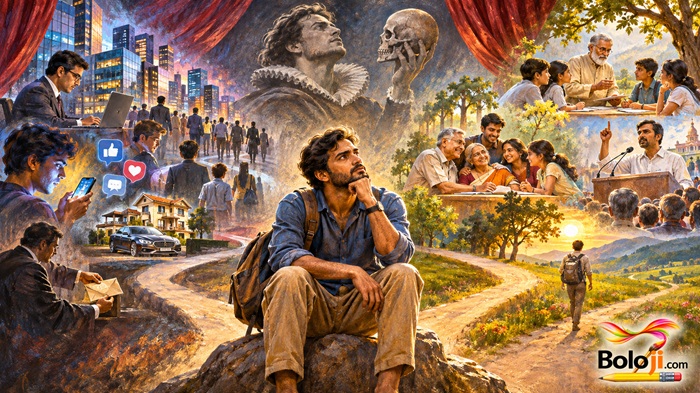
Consider the young graduate who dreams of writing or teaching but is pushed towards a lucrative career in technology. The family wants security, society applauds prestigious titles, and the individual longs for meaningful work. Here, the safety of conformity competes with the dignity of self-discovery. Ironically, it is in Hamlet itself that Polonius offers the timeless counsel: “This above all: to thine own self be true.” The Bhagavad Gita, too, warns that “it is better to perform one’s own duty imperfectly than to master the duty of another.” A borrowed dream, however glittering, rarely yields lasting fulfilment.
The workplace poses a sharper test. An employee who uncovers financial irregularities must choose between career and conscience. Silence may protect a job but corrode the soul; speaking out may invite retaliation but prevent injustice. Hamlet himself admits that “conscience does make cowards of us all,” for the fear of consequences often paralyses the will to do right. Whistle-blowers remind us that integrity is not an abstract virtue but a costly commitment to truth when falsehood is more convenient. As Martin Luther King Jr. wrote, “The ultimate measure of a man is not where he stands in moments of comfort and convenience, but where he stands at times of challenge and controversy.”
Technology adds another layer. Social media connects millions while deepening loneliness, comparison and the hunger for approval. The World Health Organization’s Commission on Social Connection has described loneliness as a pressing global health concern, linking it to hundreds of thousands of deaths every year. When young people measure their worth in followers and likes, authenticity becomes a casualty of performance. Oscar Wilde’s lament in De Profundis, “Most people are other people,” captures this condition precisely: our thoughts, opinions and even desires are increasingly borrowed from the screen. Shall we let algorithms define who we are, or reclaim the freedom to live beyond the tyranny of virtual applause?
Material ambition can be just as blinding. The real-estate craze has led families to drain their savings, take on heavy debt and postpone present happiness, sometimes falling prey to speculative or fraudulent schemes. A home meant to bring security becomes a source of anxiety. Mahatma Gandhi reminded us that “the earth provides enough to satisfy every man’s needs, but not every man’s greed.” The Roman philosopher Seneca warned, nearly two thousand years ago, that “it is not that we have a short time to live, but that we waste a lot of it.” Should wealth serve life, or should life be sacrificed at the altar of wealth?
Public life demands choices too. Citizens must decide whether to accept propaganda or question it, forward sensational messages or verify them, ignore injustice or defend democratic values. In an age of misinformation, silence strengthens the very forces that threaten society. Rabindranath Tagore’s prayer for a nation “where the mind is without fear, and the head is held high,” and “where knowledge is free,” is not merely poetry; it is a civic responsibility that each of us must choose to honour every day.
The same dilemma enters our homes. Exhausted professionals wonder whether another promotion is worth their health and relationships. Parents trade evenings with their children for longer hours at the desk, hoping to buy a better future that their families may never share with them. Success that leaves the spirit impoverished is only a glittering illusion, and achievements celebrated in an empty home ring hollow.
Yet Shakespeare’s question must not become an excuse for endless hesitation. Hamlet’s tragedy lies precisely here: “the native hue of resolution is sicklied o’er with the pale cast of thought,” and enterprises of great pitch and moment “lose the name of action.” Reflection is essential, but indecision imprisons. The Danish philosopher Søren Kierkegaard put it well: “Life can only be understood backwards; but it must be lived forwards.” The answer lies neither in reckless rebellion nor in blind conformity, but in choices guided by reason, compassion and courage.
Choice is both our burden and our privilege. Jean-Paul Sartre declared that “man is condemned to be free,” for even refusing to choose is itself a choice. Viktor Frankl, who survived the Nazi concentration camps, concluded that the last of the human freedoms is “to choose one’s attitude in any given set of circumstances.” Long before them, Socrates insisted that “the unexamined life is not worth living.” Self-examination, then, is not a luxury for philosophers but a daily discipline for anyone who wishes to live with purpose.
Ultimately, “To be or not to be” is a question not of mere existence but of authentic existence: fear or conviction, imitation or originality, greed or generosity, indifference or empathy. Life offers no certainty before each decision; it demands courage despite uncertainty. Swami Vivekananda’s call, “Arise, awake, and stop not till the goal is reached,” is an invitation to live deliberately rather than drift. To be truly human is to choose, consciously and courageously, a life in which ambition neither silences conscience nor extinguishes compassion.
21-Nov-2026
More by : Prof. Dr. Mahammad Ghouse Shaik
Top | Perspective | Home
