Nov 28, 2026
Nov 28, 2026
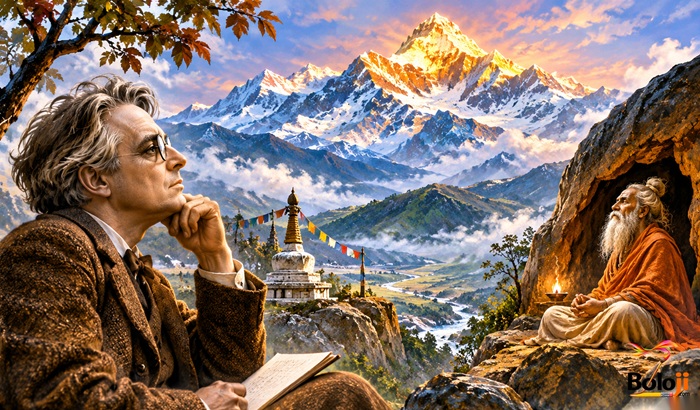
Where to go? To Mount Kailash, Dhaulagiri, Annapurna, Nanda Devi, or Amarnath? Where else? Everest, Makalu, Kanchenjunga, or Nanga Parbat? Where should the journey lead?
Meru! Meru is the answer, as the murmuring voice suggests.
The belongings must be packed for the journey to Meru, perhaps recalling the humorous description of packing in Jerome K. Jerome's Three Men in a Boat. What mysteries do these mountainous lands conceal? What myths and legends are associated with them? How magnificent are the sunrises and sunsets upon their snow-covered peaks! The panoramic landscape, glowing in the reddish hues of the setting sun, captivates the imagination. Holding the imaginary visitor by the hand, the scenery seems reluctant to let him depart, such is the enchanting beauty and mystery of the region.
Poetry is a search for knowledge, particularly self-knowledge and spiritual progression. It is a quest for light, a transcendental vision toward which the conscious mind remains a perpetual wanderer.
But how does one ascend Meru? How does one climb its heights and scale its summit?
The snow-capped Himalayas, the blue skies, glaciers, valleys, and highlands, with their distinctive greenery, have always fascinated and challenged humanity. How magnificent is the landscape, how breathtaking the panorama! It is something to behold, contemplate, and remember. Yet how many of us have truly experienced its deeper significance?
Man does not live by bread alone. The spiritual quest also nourishes him, providing sustenance for the mind and soul.
Where is that ancient knowledge? Where is the wisdom of the sages that has sustained humanity for centuries? It is their selfless penance, rigorous discipline, and unwavering perseverance that have kept the mystical flame burning, illuminating and guiding humanity through the ages.
Meru
Civilisation is hooped together, brought
Under a rule, under the semblance of peace
By manifold illusion; but man's life is thought,
And he, despite his terror, cannot cease
Ravening through century after century,
Ravening, raging, and uprooting that he may come
Into the desolation of reality:
Egypt and Greece, good-bye, and good-bye, Rome!
Hermits upon Mount Meru or Everest,
Caverned in night under the drifted snow,
Or where that snow and winter's dreadful blast
Beat down upon their naked bodies, know
That day bring round the night, that before dawn
His glory and his monuments are gone.
–– W.B. Yeats
Reading Yeats's Meru also brings to mind William Wordsworth's treatment of nature as a teacher, particularly in Three Years She Grew in Sun and Shower, often associated with the education of nature, and Tintern Abbey.
Before discussing the poem, however, we must understand what Meru represents. Where is it situated? What is its geographical or mythological significance? And how does it relate to Yeats's poetry?
In invoking Meru, Yeats does not intend to narrate an expedition or recount the adventures of a mountain climber. His subject is neither a mountaineer nor a daredevil, adventurer, geographer, trekker, or mariner. Rather, Meru becomes the source of a profound philosophical and spiritual inquiry.
How have people of different faiths and traditions understood Meru? Where does one find the Meru of the mind, the sacred mountain within the inner temple of the heart?
Meru is among those poems in which W. B. Yeats, the celebrated Irish poet, turns away from the familiar landscapes of Ireland and Irish mythology toward the spiritual symbolism of the Himalayas. Through this distant and mysterious mountain, he explores another dimension of human existence.
His poetic imagination takes flight in search of truth and knowledge. Like an eagle soaring above the mountains, his vision descends upon Meru, seeking the eternal light of wisdom.
Where does that light continue to burn? How does the meditative silence of the night descend upon the mountains? Where is Meru, not merely in geographical space but also within the inner landscape of consciousness?
Braving frost, biting winds, ice, and snow, the hermits dwell deep within mountain caves. Their lives are marked by self-denial, self-abnegation, austerity, and meditation. Untroubled by the darkness gathering around them, they persevere in their spiritual quest, seeking a truth that transcends the hardships of physical existence.
It is Meru toward which Yeats directs his imagination. It is Meru whose mysteries he seeks to understand.
One might imagine him listening to the tales of Himalayan mystics, sadhus, and sages, much as Coleridge's Ancient Mariner recounts his extraordinary experiences. There is also something of Tennyson's Ulysses in this restless longing to journey beyond familiar horizons, although Yeats's exploration is directed more toward the inner world than the outer.
Indifferent to name and fame, the hermits remain absorbed in their sadhana and tapasya. They seek neither worldly recognition nor material rewards. Their lives unfold in silence, hidden from the world, as they ascend the invisible steps of spiritual realization.
Civilizations have risen and fallen, their splendour eventually fading into the dim corridors of time. Great empires and kingdoms, established through bloodshed, conquest, vengeance, violence, hatred, and enmity, have failed to endure. Even the mightiest powers, sustained by the threat of the sword, have eventually crumbled.
Their achievements, ambitions, and claims to permanence have vanished, leaving behind little more than fragmented memories and faint echoes of departed glory.
What remains of their magnificence? What survives their struggles for supremacy?
Perhaps only the illusion of permanence, preserved briefly in the uncertain memory of history.
Had Yeats written a few more poems of this nature and philosophical depth, his exploration of Eastern spirituality might have acquired an even broader dimension. A remarkable myth-maker, he possessed the rare ability to perceive truth through mythical symbols and transform them into poetic visions. His imagination enabled him to discover enduring significance in ancient traditions and spiritual ideas.
T. S. Eliot, too, draws upon spiritual imagery and religious traditions to explore human suffering, desolation, and the possibility of redemption. His references to bones, spiritual barrenness, and renewal may be compared, in a broader symbolic sense, with the Indian legend of Bhagiratha's penance to bring the sacred Ganga to Earth and secure the liberation of King Sagara's descendants.
Yeats, however, offers a distinctive spectrum of thought and vision. Through Meru, he turns toward the lofty and sublime dimensions of human existence, toward truths preserved through centuries of contemplation and spiritual discipline.
These are not truths to be proclaimed casually or exposed to superficial understanding. They belong to the deeper recesses of human consciousness, where silence, austerity, and realization acquire a significance beyond the fleeting achievements of worldly civilization.
Thus, Meru becomes more than a mountain.
It becomes a symbol of the eternal spiritual quest, standing beyond the rise and fall of civilizations, reminding humanity that while worldly glory is transient, the search for truth continues.
28-Nov-2026
More by : Bijay Kant Dubey
Top | Literary Shelf | Home