Nov 28, 2026
Nov 28, 2026
by B.S. Ramulu
—The Movement: Guerrilla Diary
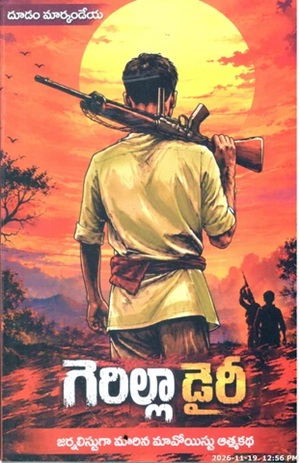 The four-decade-long journey of the revolutionary movement on Telugu soil is a confluence of many turning points, sacrifices, and internal conflicts. Having been a direct participant in that history, emerging from underground struggles, and today leaving his own mark in mainstream journalism as the Editor of Disha daily newspaper, Doodam Markandeya has written his autobiography, Guerrilla Diary, which I have read. The way he walked readers through his life's journey across various phases of the movement from the 1980s up to 2024 has established Markandeya as an author of international stature. This is the autobiography of a man of a generation who transformed from an underground fighter into a warrior of the written word. Coincidentally, the simultaneous emergence of Sonia Gandhi's Belonging, Markandeya's Guerrilla Diary, and the rise of the Cockroach Janata Party has brought India's diversity and multifaceted political perspectives right before our eyes.
Every turning point in history holds its own unique significance. Barack Obama getting elected as the President of the United States, Rajiv Gandhi becoming the Prime Minister, Dr. B. R. Ambedkar becoming the architect of the Constitution, Manyavar Kanshiram leaving his government job to enter politics—and similarly, on Telugu soil, people like me, Kancha Ilaiah, Kathi Padmarao, and Gaddar turning the tide of national and social politics—all these are historic milestones. Alongside national and international developments such as Abhijit and Neha Bora of the 'Cockroach Janata Party' stirring the nation, and the sacrifice of Martin Luther King Jr. not going in vain, these revolutionary movement experiences created a new history. Amidst all this, returning from underground life to hold his head high in society, living for social justice, and ultimately winning at life is Markandeya's true victory.
A Treasure Trove of Memories Recording an Era Precisely:
In this 312-page book, Markandeya vividly visualized the events of that era through his remarkable memory. My entry into revolutionary mass organizations in 1977, your acquaintance with me as a student leader in Jagtial around 1982–83, and the vivid portrayal of the subsequent events of my life (things that even I had forgotten or left out of my own autobiography) across the first hundred pages of Guerrilla Diary brought me immense surprise and joy. Your memory is truly extraordinary. You succeeded in visualizing the lives of countless comrades who worked in the revolutionary movement and the social conditions of that time without any concealment, with strict discipline, like a silent movie without dialogues, or like a video recording of that era.
A Clash of Two Ideologies – The Tragic Turning Point of My Life:
The most crucial turning points in my life were caused not merely by external circumstances—they were the result of an intense clash between two opposing ideologies! Most tragic of all for me is the fact that I was the very person who personally built both of those ideological camps on the soil of Jagtial.
For a decade, from 1967 to 1976, I worked in building the RSS ideology and its organizational expansion in Jagtial. Later, in 1977, I stepped into revolutionary mass organizations. The architect of the Jagtial Jaitrayatra was my co-brother, Kalluru P. Narayana Sir! Subsequently, I laid the foundations for building mass organizations and social consciousness. Becoming a participant in building two divergent ideological streams in the very same region and ultimately falling victim to the conflict that erupted between the two, is a tragedy in my life.
By 1984, retaliatory attacks and clashes began between those two forces. Those were incidents involving the squads (dalams) of that party and their mutual attacks—I had no connection whatsoever with them. However, a letter meant for the party squad lying in ambush to attack the RSS fell into the hands of the police through a courier; subsequently, the police arrested Anjaiah, who knew the details of that squad, and subjected him to severe torture. While enduring that torture and in the process of protecting the squad, Anjaiah brought B. S. Ramulu's name into the picture to divert the police. That is how Anjaiah implicated me in this case!
On one hand, fearing that if the squad was caught by the police they would all be killed in the name of an encounter, he could not tell the truth. On the other hand, due to being implicated and arrested in an incident of mutual attacks with which I had no connection, I had to leave my job and family and go into underground life for six years. Markandeya recalled this episode and Anjaiah in his biography. That single incident changed the course of my life. That clash of two ideologies in Jagtial back then took my life out of my own hands! Since that incident and Bathikepalli Anjaiah Teacher were mentioned, it is necessary to remind everyone of the actual facts of that time, isn't it!
Divergent Fields of Action – Ideological Conflict:
Any movement is understood not merely through its visible external struggles, but through the ideological debates taking place within it. Even though we belonged to the very same party, the People’s War Group, from 1985 onwards, our fields of action diverged. Following the all-India tour undertaken together by me as the State General Secretary of the Radical Youth League (RYL), Gaddar of Jana Natya Mandali, V.V. (Varavara Rao) of Virasam, and Sanjeev of Jana Natya Mandali—while I remained in the Publications Division, you went into Dandakaranya!
I foresaw the shattering of those future dreams a little earlier. That is why Gaddar and I stepped into public life in 1990. Thereafter, illuminated by Buddhism, Ambedkarism, Ram Manohar Lohia, B. P. Mandal, Acharya Konda Laxman Bapuji, Manyavar Kanshiram, dialectical Marxism, Praityasamutpada (dependent origination), humanism, and the glorious Constitution of India, I moved forward as the Founder-President of the 'Darakame Aikya Vedika' (United Forum).
Across the world, and particularly in India, successful social movements have triumphed not through the blind imitation of foreign ideologies, but through constructive programs that mobilize people on their own native soil. Dr. B. R. Ambedkar studied the ground realities of his own land and placed the supreme democratic weapon of the Constitution into the hands of the Bahujans. Dr. Ram Manohar Lohia achieved political empowerment through an indigenous ideology, enabling backward classes to rise as rulers. Periyar E. V. Ramasamy, without retreating into any forests, stood firm on his native Tamil soil and created a social revolution through the 'Self-Respect Movement'. Their victories proved that only ideologies born from the fragrance of one's own soil endure permanently.
The most unfortunate aspect of the movement's leadership back then was the double standards of certain intellectuals. When a prominent intellectual was asked, "Why did you not enter underground life?" he replied, "I am merely a milestone; showing the path is my job, I am not a traveler!" While enjoying secure jobs and journalistic positions, and providing modern education to their own children, they told Bahujan youth, "Today's development is for us, tomorrow's development is for you; wage a war for it," thereby distancing them from education—a hypocritical stance I publicly challenged as early as 1990.
I realized that a mere 'class perspective' alone is not enough. Since 1990, I have been striving against all forms of discrimination and inequality based on varna, class, caste, gender, race, religion, region, language, and nationality—working for liberty, equality, fraternity, self-respect, and equal opportunities for all. Determined that my people should not die needlessly, I worked intensely to halt recruitment into the revolutionary movement. Within the Left, I was able to make them recognize that caste is a foundational and superstructural determinant in life, production relations, and socio-political-cultural spheres, and prompt them to undertake programs accordingly.
In stark contrast, you waged an ideological struggle within the party advocating for the building of a 'People’s Army'. Distressed by the leadership's failure to respond in time, the anguish you felt when the party finally approved that very idea just before you stepped out is beyond words. On the other hand, everyone knows what transpired when Gaddar too questioned the party on the caste issue. Divergent studies, divergent experiences, and divergent fields of action within the very same party! Like branches growing out in different directions from the same tree of the movement, these varied experiences and ideas are immensely valuable—just like the branches, flowers, and fruits of the very same tree.
‘Second Innings’ – The Responsibility of Writing History:
With even deeper experiences, you stepped out in 2001. Sanjeev of Jana Natya Mandali worked relentlessly for 40 years, and later, writer Sadhana (Mallojula Venu) and people like Korutla Tirupati entered public life in 2025. Carrying the backdrop of such varied experiences, everyone eventually returned to the very place from where they had started. Returning to one's maternal home after marriage and enduring countless conflicts is not the same state as being unmarried before; each person returned to their starting point carrying many hard-earned lessons. Thinking "come what may, let bygones be bygones," we began our second innings. Ours were the early rooster crows before the world had even dawned! The scars on our minds and bodies remain living testaments to that journey.
In fact, I stopped writing my 1,700-page autobiography at the period of 1986. I felt there was no need to write about my movement experiences, history, and debates covering the years 1986–1990. Why put a spoke in the wheel of the Maoist party while it was still moving? Moreover, I thought it was unnecessary to reveal these secrets to those who had done no work in the party and had no experience of it. It was like watching a TV serial for several years—explaining the story midway to those who hadn't watched it is neither easy nor necessary; thinking so, I left that part unwritten.
However, reading your Guerrilla Diary has placed before me the absolute necessity of writing about that 1986–90 period as well. It is crucial to bring the internal debates that took place within the movement before society. Yours is a work that has brought forth the occasion for me, as a social philosopher, to put into writing the debates within the party, as well as the agony, anguish, and torture I endured in public life.
Allam Narayana, Mallojula Venu, Korutla Tirupati (Devji), Sattanna (Rajireddy), and others like them must all write their autobiographies intertwined with the history of the movement. Together, these will record the evolution of the movement and the role played by us and our former party in contemporary Indian history. Until then, they all remain 'illiterates' (those who have failed to commit history to writing)! Only when they write will society come to know the process of winning back life, giving immense courage to those starting their second innings today and tomorrow, showing them that "life does not end there; it can be begun anew."
Two clear paths lie before former activists who have stepped out into public life. The first is to hide the past as a bitter memory and confine oneself to an anonymous existence merely to earn a livelihood. If that happens, it amounts to admitting that what was practiced and preached all along was not one's own ideology, but something borrowed from someone else. After entering public life in 1990, I chose the very soil of Jagtial as my field of action, waging literary, social, and political battles for the past 37 years while living amidst my own town and my own people. Every individual emerging from underground life must begin their 'second innings' from the native soil where they were born and raised, standing firm in whatever field offers an opportunity and working on behalf of the people—that alone is true consciousness!
From Jagtial to Karreguttalu – Historical Background:
Since much of what is in this Guerrilla Diary consists of events already known to me, I finished reading it by skipping a few pages in between. Reading about the struggle Markandeya endured to step out of the party, and how, after coming out, he faced police, court cases, and financial hardships while surviving and establishing himself in journalism, evokes deep anguish.
As soon as I stepped into public life, I rejoined my old job—a facility made possible by the then Chief Minister, Chenna Reddy. Having retired in 2006, twenty years have already passed since then. However, Markandeya faced immense difficulties with the police and the government. The circumstances arising out of the policies of the then Chief Minister, Chandrababu Naidu, and in retaliation, the attack at Alipiri in Tirupati where he survived by a hair's breadth to begin his third innings, are well known. That attack led to mid-term elections for the Assembly, prompting Vajpayee to dissolve the Lok Sabha and go to polls, which subsequently brought the Congress to power for ten years both at the Centre and in the state in 2004—all crucial political developments.
Why did the Maoist party, which had thus expanded to 16 states and grown into a force dictating national politics, reach its grave in Karreguttalu? By 1984 itself, I knew what politics played in the name of religion was going to do to the country. Even without having such deep political experience back then, Markandeya directly experienced those developments in Jagtial during 1984–85. Taking what happened between 1982 and 1987 as a lesson, communal forces decided against a direct war with the People's War Group and instead sought to expand in national politics in the name of religion. Once they came to power, they exacted their revenge in Karreguttalu from a position of authority. Having been in RSS politics from 1967 to 1976, and in revolutionary politics from 1977 onwards, I am the only person who has looked deeply into both. That is why I am able to state this with such certainty. The movement that set out with the Jagtial Jaitrayatra and spread across 16 states ultimately met its grave in Karreguttalu without reaching its destination. The survivors returned home. Meanwhile, the communal forces that emerged at the very same time and place learned their lessons, grew across the entire nation, and are now wielding power. It is at this historical juncture that Sonia Gandhi’s Belonging and Markandeya’s Guerrilla Diary have been published. Behind them lies such a profound background.
Struggle for Survival – The Power of Determination:
The most heartbreaking, yet simultaneously inspiring, part of this book is the struggle faced after leaving underground life and stepping outside. Even though we knew the ideals with which we had set out and the reasons why we came back—on one side stood the solitary struggle faced upon coming out, and on the other side were the criticisms leveled by the very people whom we had considered 'our own' until yesterday! Only those who have experienced it know how difficult it is to withstand that severe mental stress (depression) and stand firm. Wielding the written word as his sole weapon to establish himself and survive in journalism is a testament to Markandeya’s extraordinary willpower. Had we not won back our lives, it is hard to imagine what this society would have called us. That very extraordinary power of determination shaped me, and it is what kept you standing as well.
"No matter how many differences we have, or how high we rise in various fields, we are all children born to the same mother—the movement (People's War Party)," Gaddar used to say repeatedly, and those words still echo in my mind. It is true, isn't it? Our all-India tours and life experiences may have been different, yet we are all the roots, branches, flowers, unripe fruits, and ripe fruits of the very same revolutionary tree! Our era has passed. This is no longer the society of 50 years ago! The Gen Z youth has stepped forward. They will take charge of how to lead society forward.
However, Guerrilla Diary serves as a crucial historical source to understand the four-decade journey stretching from the Jagtial Jaitrayatra to today's evolving national political landscape. This book stands as a great inspiration for all comrades from that era to put their own experiences into writing.
Jaiho Markandeya! Jaiho!!
(Book: 'Guerrilla Diary', Price: Rs. 300/-, For copies: 8639972160 publisher)
28-Nov-2026
More by : B.S. Ramulu
Top | Book Reviews | Home